the voice coil moves forward and backward in the magnetic
gap, producing distortion. Thiel also uses a copper sleeve
around the center pole in the woofer and midrange driver to
cancel unwanted changes in magnetic field strength caused by
the amplifier’s current through the voice coil. The result is
again a more stable magnetic field and reduced distortion.
The crossover in the MCS1 is what Thiel calls “phase correct.”
Jim Thiel seeks to preserve the phase coherence and the
harmonic integrity of the music by ensuring that all drivers
must move in and out in step with each other and with the
speaker's input signal. He uses wide
bandwidth drivers in conjunction with
crossover systems that are designed to
provide phase coherent transitions
between drivers. He feels that this
requires the use of first-order crossover
networks (6 dB/octave) because more
complex networks discriminate between
frequencies in ways that cause the phase
of the signal to be shifted, and causes the drivers to move out
of step with each other.
Thiel notes, for example, a second-order network which
reduces the high frequencies to one-fourth for each doubling
of frequency (12 dB/octave) will cause the phase of the higher
frequencies to be shifted almost 180°. A fourth-order network
will cause the higher frequencies to lag almost 360°, or one
complete cycle. Since one cycle represents a different amount
of time for different frequencies, the network smears the
frequencies in time. It also causes the individual harmonic
components of each sound, which are reproduced simulta-
neously by different drivers, to lose their synchronous struc-
ture. This loss is caused by the negative and positive motions
of the drivers being out of step with the input signal. This
changes the waveform and results in the loss of spatial and
transient information.
In contrast, Thiel states that the first-order crossover system
used in the MCS1 and his other speakers keep the phase shift
of each filter to less than 90° so that it can be canceled with a
filter that has an identical phase shift in the opposite direction.
The phase shift is kept low by using very gradual (6 dB/octave)
roll-off slopes that produce a phase lag of 45° for the low
frequency driver and a phase lead of 45° for the high fre-
quency driver at the crossover point. Because the phase shift of
each driver is much less than 90° and is equal and opposite,
their outputs combine to produce a system output with no
phase shift and perfect transient response. Thiel feels that
other types of crossover system cannot completely eliminate
time smear and phase shift.
The network in the MCS1 also corrects for small tonal
irregularities, improving frequency response. It uses pure
polystyrene and polypropylene capacitors, and air-core induc-
tors wound with high purity copper wire to preserve sonic
information for even greater fidelity.
A design feature that is critical for home theater and surround
sound purposes is that the MCS1 is matched in timbre and its
other sound characteristics with Thiel’s other high performance
speakers such as the CS6 or CS7.2. This means that the
MCS1s can either be used for all channels in a surround
system, be used as rear and center speakers with a pair of larger
monitors like CS7.2s for the front channels, or be used with
Thiel’s new rear and surround
channel speakers, the PowerPoint
and PowerPlane.
As for specifications, the MCS1 has
unusually extended frequency
response for a home theater speaker.
Its bandwidth is 47 Hz-23 kHz (-3
dB), and its amplitude response is 50
Hz-20 kHz (±2 dB). Its phase response is a minimum ±10°. Its
sensitivity is 90 dB at one meter with a 2.8-volt input, and its
impedance is 4 ohms (3 ohms minimum).
I wouldn’t bother going into so much technical detail if the
MCS1 did not meet the acid test of superior sound quality, and
if the sound quality of the speaker did not track so closely with
the engineering goals that went into its design. I shouls also
note that I am convinced enough with the overall merits of
Thiel designs to use the Thiel CS7.2 as one om my references.
At the same time, I should qualify my praise for the sound
quality of the MCS1 by saying that I have heard excellent
sounding speakers that break most or all of the design rules that
Jim Thiel has used in designing, and which use radically
different design principles, materials and enclosures. I have
never found that sonic excellence is limited to one design
approach, or even to one type of speaker—whether dynamic,
ribbon, or electrostatic. Ultimately, the quality of the execution
of a given design approach that seems to matter more than any
given set of engineering and design characteristics.
That caveat aside, the MCS1 is an intensely musical speaker for
the money. I review home theater speakers in two ways. First, in
terms of their performance in my reference stereo system, and
second in terms of their performance in my reference with a
home theater/surround system. What struck me immediately
about the MCS1 was how good it sounded in my stereo
reference system, and how much “larger” it sounded than its
size initially indicated.
Placed vertically on a stand with the tweeter near ear height, it
sounded much more like a large floor mounted speaker. The
timbre was also simply right. I generally pay more attention to
the overall timbre of a speaker and its realism with recordings of
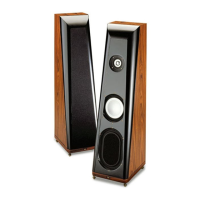
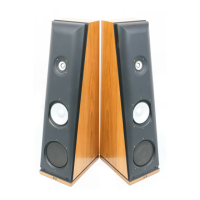
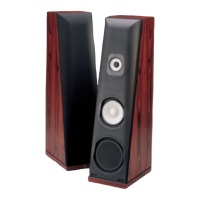
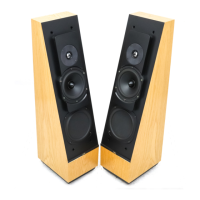
Thiel has long been one of
the top speaker
manufacturers in the U.S.


 To Next Page
 Loading...