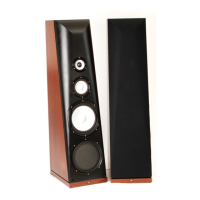
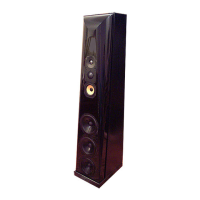
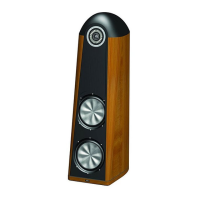
with an 80 Hz crossover are actually bass shy enough to sound
better at 100 Hz. Other reviewers may, however, feel differently.
There are some experts who argue that a speaker must be flat
down to nearly 40 Hz to be used with an 80 Hz crossover. This,
however, means either a much bigger left or right channel
speaker than the MCS1 or compromises in dynamics and other
respects. I guess that I would rather have musical and
soundstage coherence in the bass by maximizing the effective
range of the MCS1 than sheer power handling capability and
bass that I feel measures better in the crossover region than it
sounds.
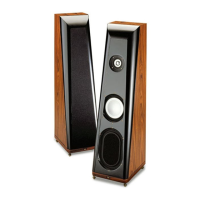
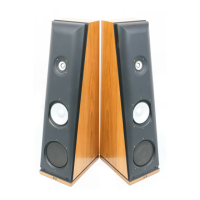
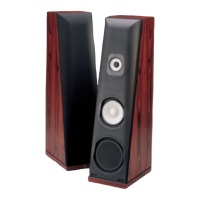
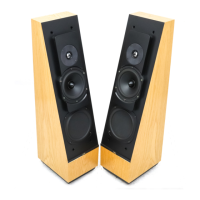
The use of the MCS1s for the side and rear channels may be
equally controversial. I found
that the MCS-1s worked very
well for me as side and rear
channel speakers for Dolby
digital, Dolby EX, Dolby Pro
Logic, Dolby Ad Nausea,
DTS, Logic 7, and surround
music. At the same time, they
are not dipole or bipole
speakers. The use of direct
radiators like the MCS1 can
create a very precise sense of direction in a relatively limited
area, and do so in a way I feel sounds considerably better than
bipoles or dipoles. You can also broaden the apparent sound
stage and feeling of ambiance simply by directing the speakers
so they reflect more energy or by moving them back from the
listening position. Any direct radiator does, however, still give
up some degree ambiance and the appearance of realism in the
broad sound field create by sounds like wind or rain. I’d suggest
some hard listening at a dealer or a friend’s to decide what kind
of side and/or rear channel sound you really want.
As for subwoofers, I used the MCS1s with the subwoofers with
my Polk SRTs, a Vandersteen V2W owned by a friend, and the
REL Storm IIIs. The REL Storm IIIs worked best, hooked up
in a configuration where one or two Storm IIIs were driven by
the effects (subwoofer) output of my reference AVPs in playing
back movie soundtracks, but were hooked up directly to the
output of the left and right channel amplifiers for stereo and
surround music. This allowed all hell to break loose in the
louder parts of movie soundtracks while it provided the most
natural sound in music. Incidentally, I set the crossover in the
REL Storms to around 42 Hz for music because these
subwoofers supplement the sound of the MCS1s when they are
hooked up directly to the left and right channel amplifiers
rather than use are high pass crossover to restrict the bass of the
MCS1s. A point of reviewer bias. No matter what I did, I could
hear slight to moderate colorations around the crossover point
between the MCS1s and the subwoofers. This, however, is true
of every system I have ever listened to in which the subwoofer
was not made by the same firm as the upper channels; where
the main channels and subwoofer were not designed with a
specific crossover (or dedicated crossover) in mind; and where
the end result is not unusually accurate. I realize other reviewers
and many audiophiles are not bothered as much by such
problem in the bass as I am, and I have to admit that the special
crossover features in the REL Storm III allowed my to get very
close to flat sound. Further, the fact that the REL Storm III
supplements the sound of the MCS1 in music, rather than
requires a high pass filter that reduces the bass response of the
MCS1, really helped in getting the best out of the MCS-s.
Nevertheless, there were still differences in apparent driver speed
and every adjustment I tried either produced a slight boost or
dip around the crossover
frequency. The result was
similar to the sound of a very
good full-range speaker
system with deep bass
extension where things are
not quite right in the transi-
tion to the lowest frequency
bass driver. I can’t criticize
the MCS1 in these respects
relative to other speakers of
its type. Every home theater speaker that is not part of a dedi-
cated home theater system presents this problem and so do at
least 80% of the home theater systems that do have a dedicated
subwoofer. For example, many THX audio-video systems have
clearly audible transitions between the left and right channels
and subwoofer in spite of a largely productive effort to ensure
high standards, and the subwoofer in such systems is often
audibly slower, dragging down the speed of the dynamics and
definition of the bass.
At this point, however, I have good news to add to my praise of
the MCS1. Thiel had new PowerPoint and PowerPlane side and
rear channel speakers at the CES in Vegas in January and it
showed the prototype of an exciting new approach to subwoofer
design that could match the MCS1 to a dedicated Thiel
subwoofer and electronic crossover. They also had the prototype
of a 10-channel audio processor with variable crossovers and
room correction for both the main speakers and subwoofer.
This means that by the time you read this review, Thiel should
have a full-range and integrated home theater system available to
use with the MCS1, and the first of what promises to be a series
of audio processors with variable crossovers and room correction
for any mix of speakers. In short, even if the MCS1 is a bit “too
good” for home theater as of the writing of this review, it should
be part of a family of dedicated home theater components by the
time you read it. Certainly, you should take a hard look at the
new Thiel subwoofer. It is one of the few designs I have seen
which really takes a serious approach to ensuring that
subwoofers sound truly natural and not simply deep and loud.
The use of direct radiators like the MCS1
can create a very precise sense of direction
in a relatively limited area, and do so in a
way I feel sounds considerably better than
bipoles or dipoles.

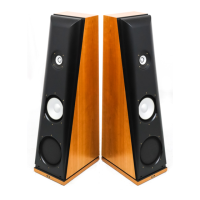

 To Previous Page
 Loading...