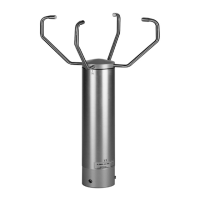
Wind Indicator LED
Instruction for Use 4.3223.xx.x50
Table of contents
1. General Information
1.1 Versions of the Indicator
1.2 Elements of the Indicator
2 Installation
2.1 Power supply
2.2 Wind transmitter input
2.3 Serial interface
3 Setting the Wind Indicator LED
4 Operating the Wind Indicator LED
4.1 Selecting the units
4.2 Controlling the brightness
4.3 Testing the LED’s (Soft reset)
4.4 Remote control
4.5 Selecting True / Relative Wind
4.6 Serial protocol
4.7 Specification protocol
4.7.1 Specification NMEA Protocol
4.8 Checksum in the Protocol
5 Troubleshooting
6 Technical Data
1. General Information
The Wind Indicator LED is a state-of-the-art indicator unit which displays both the wind direction and the
wind speed parameters. It is extremely reliable, flexible and offers optimal display.
Thanks to its compact construction and a system of integrated self-test functions, the Wind Indicator unit is
very reliable - an important quality. Moreover, its flexibility is guaranteed owing to the versatile connection
possibilities available on it to transmit the wind parameters; different wind transmitters can be connected or
the wind parameters can be transmitted over an optional serial interface.
Displayed are the True or the Relative Wind. The data for both wind values are received by serial telegrams
(NMEA-format).
Calculated and displayed are the instantaneous values of the wind speed and the wind direction. Moreover,
you can choose between 3 other modes of displaying the wind direction and its variation (see chapter 3.
Setting the Wind Indicator LED on page 7.
There are 3 different units for wind speed: m/s, kn , Beaufort (Bft). You can control the brightness of the
displays manually or automatically in a wide range.
1- 18 021229/07/01

 Need help?
 General

 To Next Page