4
TRAD 350 SO DIGIT
ited by screws that can only be removed with a special tool;
the parts are fed with alternating current at low voltage (24 V).
The equipment is protected against splashes of water and
dust.
- Protection of the system against short circuits is ensured by
means of rapid fuses and earthing; in the event of motor over-
load, protection is provided by a thermal probe.
- In case of power failure or removal of the flywheel guard, the
specific start-up button must be reset.
- The machine has been tested in conformity with point 20 of
EN 60204.
1.4 - Emergencies according to European Standard
"CENELEC EN 60 204-1"
- In the event of incorrect operation or of danger conditions, the
machine may be stopped immediately by pressing the red
mushroom button.
- The casual or voluntary removal of the protection shield of the
flywheels causes the stepping-in of a microswitch that auto-
matically stops all machine functions.
- In case blade breaks, the tightening pressure switch stops all
machine functions.
NOTE:Resetting of machine operation after each emergency
stop is achieved by reactivating the specific restart but-
ton.
RECOMMENDATIONS AND
ADVICE FOR USE
2.1 - Recommendations and advice for using the
machine
- The machine has been designed to cut metal building mate-
rials, with different shapes and profiles, used in workshops,
turner’s shops and general mechanical structural work.
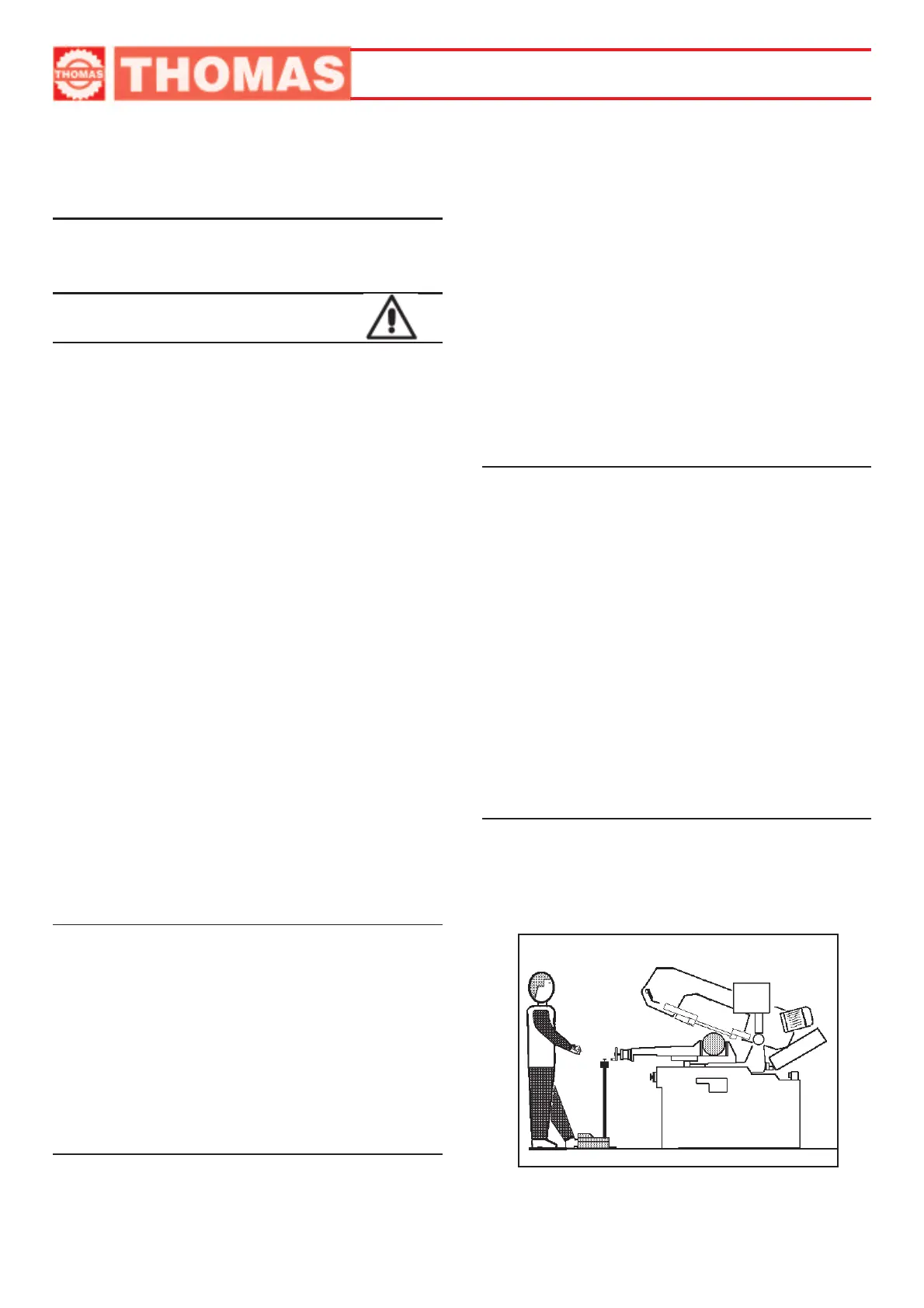
- Only one operator is needed to use the machine, that must
stand as shown in the picture.
This machine has been built to comply with the national and
community accident-prevention regulations in force. Improper
use and/or tampering with the safety devices will relieve the
manufacturer of all responsibility.
1.1 - Advice for the operator
- Check that the voltage indicated on the plate, normally fixed
to the machine motor, is the same as the line voltage.
- Check the efficiency of your electric supply and earthing sys-
tem; connect the power cable of the machine to the socket
and the earth lead (yellow-green in colour) to the earthing
system.
- When the saw frame is in suspend mode (up) the toothed
blade must not move.
- Only the blade section used for cutting must be kept unpro-
tected. Remove guarding by operating on the adjustable head.
- It is forbidden to work on the machine without its shields (these
are all white, grey or blue in colour).
- Always disconnect the machine from the power socket before
blade change or carrying out any maintenance job, even in
the case of abnormal machine operation.
- Always wear suitable eye protection.
- Never put your hands or arms into the cutting area while the
machine is operating.
- Do not shift the machine while it is cutting.
- Do not wear loose clothing with sleeves that are too long,
gloves that are too big, bracelets, chains or any other object
that could get caught in the machine during operation; tie back
long hair.
- Keep the area free of equipment, tools or any other object.
- Perform only one operation at a time and never have several
objects in your hands at the same time. Keep your hands as
clean as possible.
- All internal and/or internal operations, maintenance or repairs,
must be performed in a well-lit area or where there is suffi-
cient light from extra sources so as to avoid the risk of even
slight accidents.
1.2 - Location of shields against accidental contact
with the tool
- White, grey, blue metal guards, fastened with screws onto the
stationary blade-guide and relevant holding arm.
- White, grey or blue metal guard fastened with screws onto the
mobile blade-guide,ensures covering of blade section not used
in cutting operation.
- White or grey metal guard, fastened with knobs onto the saw
frame, to protect from flywheels.
1.3 - Electrical equipment according to Euro-pean
Standard "CENELEC EN 60 204-1" which as-
similates, with some integrating modifications, the
publication "IEC 204-1"
- The electrical equipment ensures protection against electric
shock as a result of direct or indirect contact. The active parts
of this equipment are housed in a box to which access is lim-
REFERENCE TO ACCIDENT-
PREVENTION REGULATIONS
2
1



 To Next Page