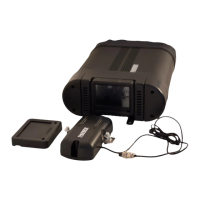
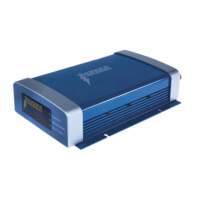
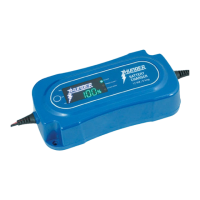
The Thunder DC to DC Battery Charger is a robust and versatile charging solution designed for automotive 12/24V systems, providing a reliable connection for weekend escapes and ensuring optimal battery health. It is not intended for use with dry cell batteries.
Function Description:
The Thunder DC to DC Battery Charger is an automatic, multi-stage battery charger that takes power from a vehicle's main starting battery (or a solar panel) and charges an auxiliary battery. It features an integrated MPPT solar regulator, allowing for efficient charging from solar panels without the need for an external regulator. The charger is designed to prioritize vehicle input over solar input when available. It automatically detects and adjusts charging rates for different battery chemistries, including GEL, AGM, standard Lead Acid, and Lithium. The unit incorporates MST (Modular Sense Technology), enabling multiple Thunder DC-DC chargers to be linked together to increase amperage output, with one unit acting as a source and others as slaves.
Important Technical Specifications:
- Output: 20A
- Input Fuse Rating: Minimum 30A
- Output Fuse Rating: Minimum 30A
- Vehicle Input Voltage Range: 12.2V - 26V (shuts off if voltage exceeds 26V, requiring a reset)
- Min and Maximum Charging Voltages: 13.1V - 15.2V (stops charging when alternator or vehicle battery is below 12.2V)
- Lithium Charge Voltages: 14.2V Bulk, 13.2V Float
- Solar Input Voltage Range: 13V - 50V
- Maximum Solar Watt Input: 300W (exceeding 300W will damage the charger)
- Charging Style: 8-stage from vehicle, 3-stage from solar
- Operating Temperature: 0°C to 90°C (current de-rates after 90°C)
- IP Rating: IP67
- Float Voltage: 13.8V
- Standby Current: 10mA
- Battery Range: 18 to 250Ah
- Recommended Minimum Cable Length / Twin Core:
- 0-10 Metres: 6 B&S/6AWG* amperage control
- Over 10 Metres: Consult an auto electrician
- *When fitting to a caravan, the cable may need to be connected to the towing vehicle with a suitable heavy-duty connector such as a 50A “Anderson” connector or similar.
Usage Features:
- Easy-to-Read Bluetooth LCD Screen: Provides real-time visibility on battery health and charging inputs. The display shows main and auxiliary battery voltages, auxiliary battery percentage, current flow, and indicates faults. It can switch between vehicle car charge screen and solar charge screen.
- Automatic Charging: Once the vehicle's main starting battery reaches 13.1V, the charger automatically begins to charge the auxiliary battery. It continues to operate even after the vehicle is switched off, until the main start battery falls below a loaded voltage of 12.2V.
- Solar Prioritization: The charger prioritizes vehicle input. When the main battery falls below 12.2V and the charger switches off from vehicle input, it will look for a solar input. If solar input is above 13V, the LCD will indicate solar charging.
- Multi-Stage Charging (8-Stage from Vehicle):
- Battery Check: Pre-charge for 5 seconds, switches to Stage 2 (12V).
- Soft Start: Less than 2A or 10 seconds charging, switches to Stage 3.
- Constant Current Charging (Bulk Charge): Max 20A, switches to Stage 4 when battery voltage reaches 14.5V. Voltage varies to maintain constant current until 14.5V is reached.
- Constant Voltage Charging (Absorption Charge): Constant 14.5V, up to one hour or current drops to 3A, then switches to Stage 5. Current varies to maintain constant voltage until it drops below 3A.
- Analysis: If battery voltage drops to 12V or less in one minute, a faulty battery indicator lights up with a beeper. If voltage is over 12.6V after one minute, it proceeds to Stage 6. If the battery is faulty, charging stops.
- Boost Stage: Voltage up to max 15.2V (dependent on battery chemistry), or up to one hour (up to 20A). If current drops below 4A, it switches to Stage 7. Battery chemistry is determined during charging stages using algorithms for AGM, Calcium, flooded, etc.
- Final Charge / Test: Highest voltage 13.8V. When current is less than 1A or one hour has passed, it switches to Stage 8.
- Maintenance Charge (Float): Constant 13.8V pulse charging. Pulse Check every 20 seconds to monitor discharge; if discharge is found on the auxiliary battery, it returns to Stage 3.
- Solar Charging Mode (3-Stage):
- Stage 1: Direct solar energy charges the battery until voltage reaches 14.5V, then switches to Stage 2.
- Stage 2: Overpressure pulse charging. If battery voltage is lower than 14.5V, the charger pulses for 1 second on and 1 second off for 2 hours, or until 14.5V average is reached, then switches to Stage 3.
- Stage 3: Pulse floating charge, 1 second on, 1 second off at 13.8V.
- Lithium Battery Charging Profile: A specific charging profile option is available for lithium batteries. To activate, the green battery select wire must be connected to battery earth. (Note: Only connect this wire for lithium battery packs; it will damage alternate battery packs).
- Modular Sense Technology (MST): Allows multiple Thunder DC-DC units to be added to increase amperage output. The units automatically synchronize to work as one.
- Display Switch: The LCD display can be disabled via a switch.
Maintenance Features:
- Microchip Monitoring and Control: Ensures precise and efficient charging.
- Internal Charger Temperature Monitoring and Power Output Control: Prevents overheating and optimizes performance.
- Over Charging, Short Circuit, and Over Temperature Protection: Safeguards the charger and batteries from damage.
- Reverse Polarity Protection: Protects against incorrect wiring.
- Pulse Mode Technology: Reduces oxidation and minimizes temperature, contributing to longer battery life.
- Heavy Duty Aluminium Case: Provides durability and protection.
Safety Warnings (Important):
- For automotive 12/24V use only. Not to be used with dry cell batteries.
- Never use a naked flame near a battery during charging, as batteries generate explosive gases.
- Never smoke or light cigarettes near a battery.
- Do not place tools on top of a battery or allow them to fall on the battery to prevent short circuits and sparks.
- Always wear eye protection when charging a battery.
- Ensure charging and testing are conducted in a well-ventilated area.
- Ensure the charger's ventilation holes are not obstructed to prevent overheating and inefficient operation.
- If skin or clothing comes into contact with battery acid, flush the affected area immediately with water and seek medical attention.
Installation Recommendations:
- Secure the charger using the mounting tabs.
- Connect the input blue wire to the main starting battery (with a minimum 30A circuit breaker).
- Connect the auxiliary battery to the output red wire (with a minimum 30A circuit breaker).
- Secure the negative wire to the common negative black wire and to a metal part of the vehicle, preferably directly to the negative terminal of both batteries.
- For vehicles with variable voltage alternators, the negative must be connected to the vehicle chassis.
- If connecting a solar panel, connect the positive from the panel to the solar input yellow wire and the negative of the panel to the negative black wire. No external regulator is needed.
- Ensure all connections are tight and secure.
- Fit the LCD display in a desired spot.
- Connect the red wire of the display to battery positive and the black wire to earth.
The Thunder DC to DC Battery Charger is a comprehensive and user-friendly solution for managing dual battery systems, offering advanced features for both vehicle and solar charging.

 Need help?
 General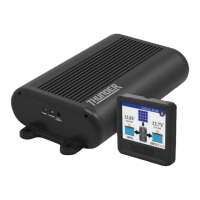

 To Next Page