EasyManua.ls Logo

Tigo EI - User Manual

Tigo EI
4 pages
Print Icon
To Next Page IconTo Next Page
Loading...
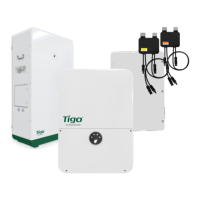
EI Residential Solar Solution
Quick Start Guide – EI Inverter
All components must be installed and maintained
by qualied personnel in accordance with applicable
electrical codes.
Always wear appropriate PPE and use insulated tools.
Improper installation may cause damage not covered
by the warranty.
Locate all EI enclosures:
In a well-ventilated, easily accessible location.
On a at surface against a solid wall without tilt.
Away from antennas and electromechanical interference.
Sheltered from direct sunlight and precipitation with
ambient temperature <50°C.
Above potential ooding.
Enclosure Mounting
Inverter Bottom Panel
DC disconnect PV Battery
ATS/Grid
WiFi antenna
E-Stop/TAP ATS/BAT
Cell antenna
Equipment grounding conductor (EGC) busbar:
Inverter Grounding Points Enclosure grounding conductors: 10 – 8 AWG
Grounding electrode conductor (GEC) terminal:
Use this guide in conjunction with the Quick Start Guides (QSG) included with the Tigo EI ATS, EI Battery, and TS4s. Detailed
installation documentation for all Tigo products is available at www.tigoenergy.com/Downloads.
Order of Installation
Install an EI system in this order:
1. Install TS4s and the Tigo Access Point (TAP) anytime
before wiring the inverter.
2. Mount the ATS and connect it to the grid. To enable
household power pending commissioning, use the ATS
manual bypass feature described in the ATS QSG.
3. Mount the inverter and E-Stop rapid shutdown switch.
4. Place the battery.
5. Wire communications and power connections.
You must install communications connections.
6. Connect an antenna.
7. Commission the system.
Communication Connections
Battery – Inverter Inverter – ATS
RS-485
TAP – Inverter For TS4-A-O/S/M
CAT 5/6
RS-485/
CAT 5/6
Use 2- and 3-pin plugs from the
Accessories
bag.
If the left-most 2-pin socket is absent, disregard
the 12V connection to ATS CN9 pins.
©20230504 Tigo Energy, Inc. 002-00119-00 Rev. 3.0
*002-00119-00*

Other manuals for Tigo EI

Question and Answer IconNeed help?

Do you have a question about the Tigo EI and is the answer not in the manual?

Summary

Order of Installation

Enclosure Mounting Requirements

Mounting Location Criteria

Specifies location criteria for EI enclosures, including ventilation, accessibility, and interference.

Communication Connections

Battery to Inverter Connection

Details the wiring and connection between the EI Battery and the EI Inverter.

TAP to Inverter Connection

Describes the connection of the TAP to the EI Inverter for TS4-A-O/S/M.

Inverter to ATS Connection

Outlines the connection process for the EI Inverter and the ATS.

Inverter Grounding Points

Grounding Conductor Specifications

Specifies wire gauge requirements for enclosure grounding conductors and EGC busbar.

Power Connections

EI Battery Power Connections

Details the power wiring from the EI Battery to the EI Inverter.

EI Inverter Power Connections

Outlines the power connections for the EI Inverter to the ATS and PV array.

ATS Power Connections

Describes the AC power connections for the ATS to the load panel and grid.

E-Stop Rapid Shutdown Switch

E-Stop Switch Installation and Labeling

Covers mounting the E-Stop switch, its placement, and applying the rapid shutdown label.

System Commissioning

Commissioning Process Steps

Details the process for commissioning the EI system using the Tigo EI mobile app.

Inverter System Status Indicators

Power Indicator Status

Explains the meaning of the inverter's power status indicator light.

Communications Indicator Status

Describes the status indicators for system communications (4G/WiFi).

Battery Indicator Status

Explains the status indicators related to the EI Battery's charge state.

Fault Indicator Status

Details the status indicators for system faults and warnings.

Tigo EI Specifications

General IconGeneral
CoolingNatural convection
Efficiency97.5%
CommunicationEthernet, Wi-Fi, RS485
Operating Temperature Range-25°C to 60°C
Frequency60 Hz
Operating Temperature-25°C to 60°C