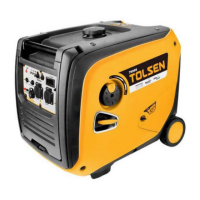
2. Never use a generator indoors, including in garages, basements, crawlspaces and sheds. Opening doors
and windows or using fans will NOT prevent carbon monoxide build up in the home.
3. When using generators, keep them outdoors and far away from open doors, windows, and vents to avoid
toxic levels of carbon monoxide from building up indoors.
4. If you start to feel sick, dizzy, or weak while using a generator, get to fresh air right away. The carbon
monoxide from generators can quickly lead to full incapacitation and death.
5. Keep children away from the equipment, especially while it is operating.
6. Keep all spectators at least six feet from the Engine during operation.
7. Do not touch engine during use. Let engine cool down aer use.
8. Never store fuel or other flammable materials near the engine.
9. Fire Hazard! Do not fill gas tank while engine is running. Do not operate if gasoline has been spilled.
Clean spilled gasoline before starting engine. Do not operate near pilot light or open flame.
10. If the plugged-in product operates abnormally or unusually slow, immediately stop using the Generator
as a power source. Always read and adhere to the instruction manual of the product to be powered, to
make sure that it can be safely and efficiently powered by a portable generator.
11. Before connecting an appliance or power cord to the Generator: Make sure that it is in good working
order. Faulty appliances or power cords can create a potential for electrical shock.
12. Do not exceed the maximum power rating of the Generator. Make sure that the total electrical rating of
the all of the tools or appliances plugged into the Generator at the same time does not exceed that of the
Generator. Check that the startup surge will not be beyond the limit of the Generator. Power levels
between rated and maximum may be used for no more than 30 minutes.
13. Avoid substantially overloading which will trip the circuit breaker. Exceeding the time limit for maximum
power operation or slightly overloading the Generator may not switch the circuit breaker or circuit
protector OFF, but will shorten the service life of the Generator.
14. Do not attempt to connect or disconnect load connections while standing in water, or on wet or soggy
ground.
15. Do not touch electrically energized parts of the Generator and interconnecting cables or conductors
with any part of the body, or with any non-insulated conductive object.
16. Connect the Generator only to a load or electrical system (230 volt) that is compatible with the electrical
characteristics and rated capacities of the Generator.
17. GFCI PRECAUTIONS Test Ground Fault Circuit Interrupter (GFCI) receptacles before each use as follows:
a. Disconnect all devices from the Generator. b. Start the engine. c. Press Test button on receptacle to trip
the GFCI device. d. The Reset button should extend, cutting off electricity to the receptacle. e. If above
test fails, do not use receptacle until it is repaired or replaced. f. Press Reset button in for use. GFCI
receptacles will not protect against electric shock if Generator is not grounded. Refer to Grounding on
page 8.
18. Insulate all connections and disconnected wires.
19. Guard against electric shock. Prevent body contact with grounded surfaces such as pipes, radiators,
ranges, and refrigerators.
20. Only use a suitable means of transport and liing devices with sufficient weight bearing capacity when
transporting the Generator.
21. Secure the Generator on transport vehicles to prevent the tool from rolling, slipping, and tilting.
22. Industrial applications must follow OSHA requirements.
SAFETY 3



 To Next Page