This document is an operation manual for a 4-in-1 Petrol Powered Garden Tool, model TSBC6, distributed by The Tool Shed.
Function Description
The TSBC6 is a versatile 4-in-1 petrol-powered garden tool designed for various outdoor tasks. It combines the functions of a brush cutter, hedge trimmer, pole saw, and line trimmer into a single unit. The tool is powered by a 2-stroke petrol engine, requiring a fuel mixture ratio of 25-1 (petrol to oil).
Important Technical Specifications
- CC Rating: 42.7
- Power: 1.1KW
- Fuel Mixture: 25-1 (Petrol to Oil)
- Weight: 6.6KG
- Fuel Capacity: 1.2L
The tool includes several key components:
- Engine unit: The main power source.
- Shoulder harness: For comfortable and safe operation.
- Handle: For control and maneuverability.
- Extension tube: To extend the reach of attachments.
- Hedge trimmer head: For trimming hedges.
- Chainsaw head: For cutting branches.
- Fuel tank cap: For the fuel tank.
- Primer bulb: For starting the engine.
- Starting handle: For manual engine start.
- Fuel tank: To hold the fuel mixture.
- Air filter: For engine protection.
- Choke: For cold starting.
- Spark plug cap: Protects the spark plug.
- Switch: For turning the engine on/off.
- Brush cutter head: For cutting thick brush.
- Throttle lock: To maintain engine speed.
- Throttle: To control engine speed.
- Guide bar: For the chainsaw attachment.
- Adjusting screw: For various adjustments.
- Oil tank: For lubricating the chainsaw chain.
- Saw chain: The cutting component of the pole saw.
- Cutting unit: The general term for the cutting attachments.
- Adjusting handle: For ergonomic positioning.
- Adjusting handle lock lever: To secure the handle position.
- Brush cutter head: Another reference to the brush cutter attachment.
- Jumper: A component related to the engine.
- Bar cover: Protects the guide bar.
- Blade cover: Protects the cutting blades.
Usage Features
Safety Instructions:
- Always wear a helmet, hearing protection, eye or face protection, work gloves, and non-slip work boots.
- Do not wear loose clothing, jewellery, short trousers, open-toed shoes, or bare feet.
- Ensure the shoulder length is above the moving part of the unit.
- Never start the engine inside a closed room or building due to dangerous carbon monoxide.
- Do not operate the machine when the ground is slippery or when you can't maintain a steady posture.
- Avoid operating at night or at times when your field of vision might be limited.
- Do not operate during lightning storms or at times of strong or gale-force winds.
- Ensure the machine is undamaged and functions properly.
- Do not operate the machine unless you did not find any faults on checking.
- Do not operate the machine unless you did not find any faults on checking.
- The environment must be free of easily flammable and explosive materials.
- Do not overload the machine and use it only for its intended purpose.
- Always work with care and stay alert.
- Do not operate the machine when tired, ill, under the influence of alcohol, drugs, or medication.
Starting the Engine:
- Feed fuel into the fuel tank and tighten the cap securely.
- Feed chain oil into the oil tank and tighten the cap securely (for pole saw only).
- Rest the unit on a flat, firm place. Keep the cutting head off the ground and clear of surrounding objects, as it will start rotating upon starting the engine.
- Press the primer bulb several times until overflowing fuel flows out in the clear tube.
- Move the choke lever to the closed position.
- Set the stop switch to the 'START' position. Press down the throttle lock.
- While holding the unit firmly, pull out the starter rope quickly until the engine fires.
- Move the choke lever downward to open the choke.
- Allow the engine to warm up for several minutes before starting operation.
- To stop the engine, release the throttle and run the engine for half a minute, then shift the stop switch to the STOP position.
Joint Attachment Assembly:
- Press the lock lever down.
- Insert the attachment to the main shaft. Fix the lock lever into the hole.
- Tighten the knob bolt securely.
Installing the Handle:
- Insert the barrier handle to the top handle.
- Fasten the four internal hexagon screws with a spanner.
Chain Tension Set Up (Pole Saw):
- The saw chain has very sharp edges. Use protective gloves for safety.
- Always pay attention to the chain tension. A slackened chain will increase the risk of backlash. If slackened, the chain could spring out of the guide, could cause injury to the operator, and could be damaged. A slackened chain wears out very quickly and the sprocket wheel and guide bar wear out.
- Unscrew the fixing nut.
- Turn the adjusting screw until the chain fits but may be moved with ease.
Exchange the Bar or Saw Chain (Pole Saw):
- Unscrew the fixing nut and remove the chain wheel guard.
- Remove the saw chain and guide bar.
Installing the Guide Bar and Saw Chain (Pole Saw):
- Place the sawing chain onto the sawing rail.
- Position the guide bar so that the chain tensioning studs project into the guide bar. Ensure the saw chain runs in the correct direction.
- Attach the chain wheel protection and then tighten the fixing bolt lightly.
- Tighten the tensioning screw.
- Tighten the fixing nut.
- NOTE: The chain should not sag, but it should be possible to pull it a few millimeters away from the saw rail.
Brush Cutter Set Up:
- Press the lock lever down.
- Insert the attachment to the main shaft. Fix the lock lever into the hole.
- Tighten the knob bolt securely.
Adjusting Oil Flow Rate (Pole Saw):
- Never fill the oil reservoir nor adjust the oiler with the engine running.
- An increase in bar oil flow rate will speed oil consumption, requiring more frequent checks on the oil reservoir.
- To ensure sufficient lubrication, it may be necessary to check the oil level more frequently than at fuel tank refills.
- The pump is set at the factory to deliver a minimum flow rate, but it can be adjusted in the field.
- A temporary increase in oil flow is often desirable when cutting things like hardwood or wood with a lot of pitch.
- Adjust the pump as follows:
- Stop the engine and make sure the stop switch is in the OFF position.
- Place the unit on its side with the oil reservoir up.
- With a screwdriver, push in on the oil flow rate adjusting screw and turn in the desired direction.
- CAUTION: The oil flow adjusting screw must be pressed in slightly in order to turn. Failure to do so could damage the pump and screw.
Pole Hedge Trimmer Operation:
- DANGER: This product is equipped with extremely sharp blades, and when used improperly these blades can be extremely dangerous. Improper handling can cause accidents, which may in turn lead to a serious injury or death. For this reason, you should always be careful to follow the following instructions when using your trimmer.
- Never hold the trimmer in a way in which the blades are pointed towards someone else.
- Never allow the blades to come into proximity with your body while the engine of the trimmer is in operation.
- Always be sure to turn off the engine before changing the angle of the blades, removing branches which have become stuck in the blades, or at any other time when coming in proximity with the blades.
- Always wear work gloves made of leather or some other sturdy material when using the trimmer.
- Always place the blade cover provided with the trimmer over the blades when not in use.
- Falling branches may fall onto the face or into the eyes, resulting in injuries, scratches, and cuts. For this reason, you should always be sure to wear a helmet and face protector when using your trimmer.
- CAUTION: The thickness of branches which may be cut using this trimmer is limited to up to approximately 5mm. Never try to cut branches thicker than this, as doing so may result in damage to the trimmer.
- Adjusting the Angle of the Cutting Blades:
- Stop the engine.
- Lift the lock lever and press down the adjusting lever.
- Adjust the angle of the blades to the desired angle and release the levers.
Operation for Brush Cutter:
- Working on grass areas, hold the scythe at an angle of 30 degrees and make semicircle turns to the left and right.
- The best results are achieved with grass 15cm high. If it is higher, it is recommended to repeat mowing several times.
- CAUTION: When the machine is running, never put the mowing head on the ground.
- If the mowing output decreases:
- Hold the running machine over the grass and knock the ground several times with the mowing head.
- The cutter enclosed in the protection shield will cut the fibre to the required length.
- The fibre remnant may be thrown off and cause an injury.
- If the machine is vibrating:
- Clean it or, where necessary, remove the grass stuck on the mowing head and protection shield.
- Hold the clipper safely with both hands.
- Mow grass and weed only, low shrubbery may be cut with a thick blade.
Maintenance Features
Important Information:
- Improper maintenance, or failure to correct a problem before operation, can cause a malfunction in which you can be seriously hurt or killed.
- Always follow the inspection and maintenance recommendations in this owner's manual.
- WARNING:
- Make sure the engine has stopped and is cool before performing any service or maintenance on the machine. Contact with moving cutting head or hot muffler may result in a personal injury.
- Read the instructions before you begin and make sure you have the tools and skills required.
- To reduce the possibility of fire or explosion, be careful when working around gasoline. Use only a nonflammable solvent, not gasoline, to clean parts. Keep cigarettes, sparks and flames away from all fuel related parts.
Maintenance Schedule:
| System/Components |
Procedure |
Before Use |
Every 25 hours |
Every 50 hours |
Every 100 hours |
Note |
| Engine |
Fuel leaks, fuel spillage |
Wipe out |
✓ |
|
|
|
|
Air cleaner |
Inspect |
✓ |
✓ |
|
Replace if necessary |
|
|
Clean |
|
✓ |
|
|
|
Fuel tank, fuel filter |
Inspect |
✓ |
|
|
Replace if necessary |
|
|
Clean |
|
✓ |
|
|
|
Idle adjusting screw |
Adjusting idling speed |
|
✓ |
|
Replace carburetor if necessary |
|
Spark plug |
Clean and readjust |
|
✓ |
|
|
|
Cylinder fins, intake air cooling vent |
Clean |
|
✓ |
|
|
|
Muffler, cylinder exhaust port |
Clean |
|
✓ |
|
|
|
Combustion chamber |
Clean |
|
|
✓ |
|
| Others |
Throttle lever, stop switch |
Check operation |
✓ |
|
|
|
|
Cutting parts |
Replace if somethings wrong |
✓ |
|
|
Pole hedge trimmer only |
|
Transmission |
Grease |
|
✓ |
|
|
|
Screws/nuts/bolts |
Tighten/replace |
✓ |
|
|
|
|
Guide bar |
Clean |
✓ |
|
|
|
|
Sprocket |
Inspect/replace |
|
✓ |
|
|
|
Saw Chain |
Inspect/sharpen |
✓ |
|
|
|
Engine Maintenance:
- Air Cleaner: If the air cleaner is clogged, it will reduce the performance of the engine. Check and clean the filter element in warm soapy water as required. Dry completely before installing. If it is broken or shrunk, then replace it with a new one.
- Spark Plug: Starting failure and misfiring is often cause by a fouled spark plug. Clean the spark plug and check that the plug gap is in the correct range (0.6-0.7mm).
- NOTE: Using any spark plug other than those designed for this engine type may result in the engine failing to operate properly or in the engine becoming overheated and damaged. To install the spark plug, first turn the plug until it is finger tight, then tighten it a quarter turn more with a socket wrench. Tightening torque = 9.8-11.8N.m (1-1.2kg.m).
- Muffler: Inspect the muffler periodically for loose fasteners and any damage or corrosion. If any sign of exhaust leakage is found, stop using the machine and have it repaired immediately. Failing to do so may result in the engine catching on fire. Remove the muffler, insert a screwdriver into the vent, and wipe away any carbon build up. Wipe away any carbon build up on the muffler exhaust vent and cylinder exhaust port at the same time.
Hedge Trimmer Maintenance:
- Blade:
- When refilling the tank or resting, it often a good idea to use the time to oil the cutting blades.
- If a gap exists between the upper and lower blades, follow the procedure below to adjust them so they fit closer together.
- Loosen lock nut (A) as shown in the diagram.
- Tighten screw (B) fully, and then turn one-third to one half of a rotation backwards.
- While holding onto the screw to keep it in position, tighten the lock nut.
- Check to make sure the flat washer (C) is loose enough so that it may be turned by pressing on it.
- NOTE: Screwing in the screw too tightly may make it impossible for the blades to move. Conversely, not screwing in the screw tightly enough may make the blades of the trimmer feel dull and cause leaves and branches to become caught in the blades of the trimmer.
- QUICK TIP: If the blades become so worn down that it is no longer possible to eliminate the gap between them, you should have the blades sharpened or replaced.
- Transmission: The reduction gears are lubricated by multipurpose grease in the transmission. Supply new grease every 25 hours of use or more often if the condition of the job requires it. When adding lubricant, use a grease gun to insert lubricant into the three grease nipples located on the transmission.
Pole Chainsaw Maintenance:
- Oiling Port: Dismount the guide bar and check the oiling port for clogging.
- Guide Bar: Remove sawdust in the bar groove and the oiling port. The bar rail should always be a square. Check for wear of the bar rail. Apply a ruler to the bar and the outside of a cutter. If a gap is observed between them, the rail is normal. Otherwise, the bar rail is worn. Such a bar needs to be corrected or replaced.
- Sprocket: Check for extensive wear and replace it when teeth are worn over 0.3mm.
- Saw Chain Maintenance: It is very important for smooth and safe operation to keep the cutters always sharp.
- Your cutters need to be sharpened when:
- Sawdust becomes powder-like.
- You need extra force to saw.
- The cut isn't straight.
- Vibration increases.
- Fuel consumption increases.
- BE SURE TO WEAR SAFETY GLOVES
- Before filing:
- Make sure the saw chain is held securely.
- Make sure the engine is stopped.
- Use a round file of proper size for your chain.
- Place your file on the cutter and push straight forward. Keep the file positioned as illustrated.
- After every cutter has been set, check the depth gauge and file it to the proper level as illustrated.
- NOTE: Be sure to round off the front edge to reduce the chance of a kickback or tie-strap breakage.
- Make sure every cutter has the same length and edge angles as illustrated (Cutter length, Side plate angle, Filing angle, Top plate cutting angle).
Storage:
- Aged fuel is one of the major causes of engines failing to start. Before storing the unit, empty the fuel tank and run the engine until it uses all the fuel left in the fuel line and the carburettor. Clean and maintain the machine before storing. Store the unit indoor, taking necessary measures for rust prevention.

 Need help?
 General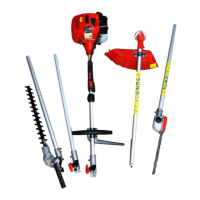

 To Next Page