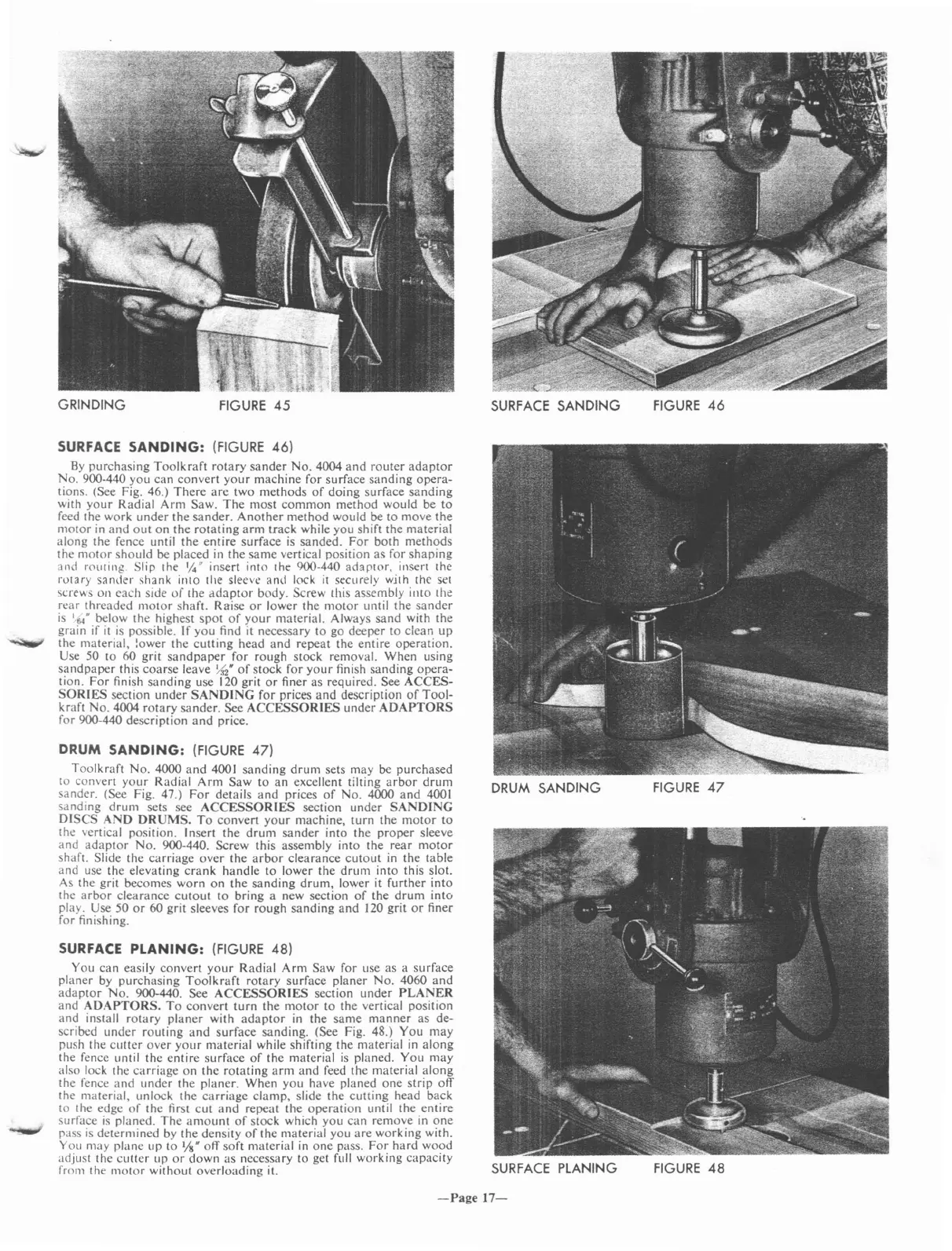
GRINDING
FIGURE
45
SURFACE
SANDING
FIGURE
46
SURFACE
SANDING:
(FIGURE
46)
By
purchasing
Toolkraft
rotary
sander
No.
4004
and
router
adaptor
No. 900-440 you
can
convert
your
machine
for surface
sanding
opera-
tions. (See Fig. 46.)
There
are
two
methods
of
doing
surface
sanding
with
your
Radial
Arm
Saw.
The
most
common
method
would be
to
feed the work
under
the
sander.
Another
method
would be
to
move
the
motor
in
and
out
on
the
rotating
arm
track
while you shift the material
along
the
fence until
the
entire
surface
is
sanded.
For
both
methods
the
motor
should be placed in
the
same
vertical position as for
shaping
and rClwing. Slip the 1;''' insert into the 900-440 adaplClr. insert the
rotary
sander
shank into the sleeve
and
lock
it
securely with the set
s~rews
on
each
side
of
the
adaptor
body. Screw this assembly iuto the
rear
threaded
motor
shaft. Raise
or
lower
the
motor
until
the
sander
is
"64"
below the highest
spot
of
your
material. Always
sand
with the
grain if
it
is
possible. If
you
find it necessary to go deeper
to
clean
up
the material, :ower the
cutting
head
and
repeat the
entire
operation.
Use 50 to 60 grit
sandpaper
for rough stock removal.
When
using
sandpaper
this
coarse
leave
~2"
of
stock for
your
finish
sanding
opera-
tion.
For
finish
sanding
use 120 grit
or
finer
as
required. See
ACCES-
SORIES
section
under
SANDING
for
prices
and
description
of
Tool-
kraft
No.
4004
rotary
sander.
See
ACCESSORIES
under
ADAPTORS
for 900-440 description
and
price.
DRUM
SANDING:
(FIGURE
47)
Toolkraft
No.
4000
and
4001
sanding
drum
sets may be purchased
to convert
your
Radial
Arm
Saw
to
an
excellent tilting
arbor
drum
sander. (See Fig. 47.)
For
details
and
prices
of
No.
4000
and
4001
sanding
drum
sets see
ACCESSORIES
section
under
SANDING
DISCS
AND
DRUMS.
To
convert
your
machine,
turn
the
motor
to
the vertical position. Insert
the
drum
sander
into
the
proper
sleeve
and
adaptor
No.
900-440. Screw this assembly into
the
rear
motor
shaft. Slide the
carriage
over
the
arbor
clearance
cutout
in the table
and use the elevating
crank
handle
to lower
the
drum
into this slot.
As the grit becomes
worn
on
the
sanding
drum,
lower it
further
into
the
arbor
clearance
cutout
to
bring
a new section
of
the
drum
into
play. Use 50
or
60 grit sleeves for rough
sanding
and
120 grit
or
finer
for finishing.
SURFACE
PLANING:
(FIGURE
48)
You
can
easily
convert
your
Radial
Arm
Saw
for use
as
a
surface
planer
by
purchasing
Toolkraft
rotary
surface
planer
No.
4060
and
adaptor
No.
900-440. See
ACCESSORIES
section
under
PLANER
and
ADAPTORS.
To
convert
turn
the
motor
to the vertical position
and
install
rotary
planer
with
adaptor
in
the
same
manner
as
de-
scribed
under
routing
and
surface
sanding. (See Fig. 48.)
You
may
push the
cutter
over
your
material while shifting the material in
along
the fence until the
entire
surface
of
the material
is
planed.
You
may
also lock the
carriage
on
the
rotating
arm
and
feed the material
along
the fence
and
under
the
planer. When you have planed
one
strip off
the material, unlock
the
carriage
clamp,
slide the
cutting
head back
to the edge
of
the first
cut
and
repeat the
operation
until the
entire
surface
is
planed.
The
amount
of
stock which you
can
remove in
one
rass
is
determined by
the
density
of
the material you
are
working
with.
You may plane
up
to l/S" off soft material in
one
pass.
For
hard
wood
adjust the
cutter
up
or
down
as necessary to get full working
capacity
from the
motor
without
overloading
it.
DRUM SANDING
SURFACE
PLANING
FIGURE
47
FIGURE
48
-Page
17-



 To Next Page
 Loading...