
 Need help?
Do you have a question about the Toolots FMJ-1600E-WARM and is the answer not in the manual?
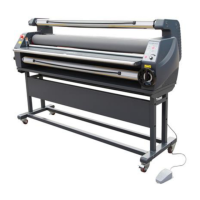
The Ving 63" Entry Level Full Auto Wide Format Heat Assisted Cold Laminator, model FMJ-1600E-WARM, is a new type of laminator designed for wide-format applications. It builds upon the FMJ-1600-II-Warm model, incorporating auto-peeling of liner paper and print take-up functions. The machine is characterized by its simple structure, user-friendliness, and cost-effectiveness.
The laminator operates with both top and bottom rollers driven by a motor. The film mandrel and liner paper roll are driven by the internal force motion of the printed picture between the main rollers, which simplifies operation and saves labor. It supports consecutive laminating and long picture laminating, facilitated by a film mandrel, an S bar, and a prints roller. The auto-peeling of liner paper and print take-up are achieved through the rolling force of the main rollers. The machine offers efficient, energy-saving operation with adjustable velocity. It features a heat-assisted cold lamination process, with heating primarily applied to the upper roller.
The laminator is equipped with a control panel that includes a power on/off button, an F/R-direction switching button for roller rotation, a motor on/off button, and a heating button. The heating function allows for temperature setting via up/down buttons, with the actual temperature displayed after 6 seconds. The machine also supports specification settings (D-1 to D-5) for temperature correction, high-temperature alarm points, maximum temperature, and temperature units. These settings can be accessed by pressing and holding the "heating" button for 3 seconds. The machine can be operated using either a hand switch or a pedal switch.
Installation involves moving the machine to its final location, connecting it to the mains (ensuring power supply matches the machine's ID label and a reliable ground connection), and installing the film mandrel and print roll cabinets. The film mandrel and liner paper roller are designed for quick installation and removal. Three rubber strips on the aluminum mandrel lock the film roll core, and a Bakelite knob on the liner paper roller allows friction regulation to ensure consistent speed between main rollers and the liner paper roller, thus maintaining lamination quality. Turning the knob clockwise increases damping, while counter-clockwise decreases it. A lift knob on the right cabinet controls the roller's height; clockwise lifts, counter-clockwise drops. The "idle stroke" phenomenon occurs when the top roller reaches the bottom roller with reduced turning force, indicating the weight is well-distributed for lamination. Further counter-clockwise turns increase pressure.
The manual provides instructions for adjusting the parallelism and pressure of the main rollers, which is crucial for lamination quality and preventing off-tracking or wrinkles. While rollers are factory-aligned, violent vibration or long-term operation may cause misalignment. To reset main roller pressure:
Users must read the manual thoroughly and familiarize themselves with the machine's structure, function, and operation. All warning symbols should be observed. The mains supply must match the machine's identification label, and a reliable ground connection is essential. The machine lacks an optical safety device, so users should not approach the rolling rollers to prevent injury. After operation, the roller should be lifted to prevent deformation from long-term pressure, and the power supply should be cut. When cutting films or images, maintain distance from the rollers to prevent damage from edge tools. Glue on rollers can be cleaned with cotton cloth and alcohol; organic solvents or water should not be used to avoid rubber damage or short-circuits. The machine should be installed in a dry, well-ventilated environment, free from water or moisture, and away from flammable or explosive objects to prevent fire. Regular checks for electricity leakage and power line integrity are recommended, and any abnormal phenomena should be addressed promptly to prevent further damage.

 To Next Page
 General