Need help?
Do you have a question about the Top Flite Models SPITFIRE Mk IX and is the answer not in the manual?
General safety instructions for assembling and operating the model.
Advice on getting help from experienced modelers and joining AMA.
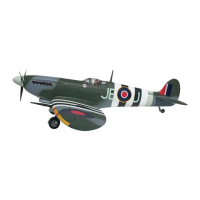
Information about the Spitfire Mk IX and the kit's construction.
Key instructions for safe and correct assembly and operation of the model.
Guidance on choosing the appropriate engine size and type for the model.
Details on headers and mufflers for engine exhaust.
Information and parts needed for installing retractable landing gear.
Details on building and installing optional flaps for improved flight characteristics.
Information about the optional scale cockpit kit.
Modifying a propeller and choosing a spinner for scale appearance.
Information on scale competition classes and requirements.
Where to obtain scale documentation and photos.
A list of necessary components not included in the kit.
A list of glues, fillers, and other building supplies needed.
A comprehensive list of tools required for building the model.
Information on recommended sanding tools and sandpaper.
How to identify and use the different types of screws in the kit.
Guidance on test fitting parts and selecting appropriate glues.
Explanation of terms like "test fit", "glue", and orientation references.
A list of abbreviations used in the manual.
Identification of the different wood types used in the kit.
Initial steps for preparing the workspace and parts before construction.
Step-by-step instructions for constructing the horizontal stabilizer.
Final steps for assembling the stabilizer, including hinge blocks.
Steps for fitting and mounting elevator control horns and making adjustments.
Steps for assembling elevator bases, tip blocks, and root blocks.
Instructions for cutting and fitting hinges for the elevators and stab.
Information on using the provided CA hinge material and common mistakes.
Steps for final fitting, control horn mounting, and elevator throw adjustments.
Steps for cutting fin ribs and attaching the leading edge core.
Instructions for attaching the fin TE, skinning, and shaping the leading edge.
Steps for preparing the rudder base, attaching rudder blocks and ribs.
Installing hinge slots, control horn block, and shaping the rudder.
Initial steps for wing construction, including flap bellcrank assembly.
Instructions for constructing the left and right outer wing panels.
Steps for attaching ribs, spars, and leading/trailing edges.
Instructions for installing wing joiners and applying top sheeting to the center section.
Steps for joining wing bolt plates, ribs, spars, and leading edges.
Instructions for mounting flap servos, pushrods, and wing bolt plates.
Detailed steps for joining the outer wing panels to the center section using epoxy.
Steps for fitting and securing fixed landing gear components.
Detailed instructions for installing pneumatic retracts, including wheel and axle placement.
Steps for mounting retract units, testing their operation, and fitting wheel covers.
Instructions for installing flap bellcranks, hinge blocks, and aileron servo hatches.
Steps for joining and preparing balsa sheets for wing skin construction.
Instructions for cutting, fitting, and gluing the bottom wing skins.
Cutting bottom sheeting for landing gear and fitting wheel covers.
Instructions for cutting the wing for aileron servo hatches and mounting servo blocks.
Steps for installing flap pushrods, Y-harness, and fuelproofing the wing interior.
Instructions for fitting, gluing, and trimming the top wing skins.
Steps for cutting flap skins, fitting them to the wing, and marking hinge locations.
Instructions for drilling hinge holes, installing hinges, and mounting flap control horns.
Steps for attaching the aileron base, leading edge, and ribs.
Instructions for fitting hinges, mounting aileron control horns, and shaping the aileron.
Steps for gluing and shaping the wing leading edges and attaching wing tips.
Instructions for building radiators and gluing them to the wing.
Steps for preparing the fuselage plan and gluing formers and stringers for the top structure.
Steps for gluing formers, crutches, and the servo tray to form the fuselage structure.
Steps for trimming cockpit floor, installing rails, and gluing stringers to the fuselage.
Instructions for cutting, fitting, and gluing balsa sheets to form the top fuselage skin.
Steps for preparing the fuse sheeting, positioning the stab, and checking alignment.
Instructions for gluing the fin to the stab and fuselage, and final shaping.
Steps for assembling the firewall and attaching it to the fuselage structure.
Gluing lower crutches, stringers, and formers to complete the fuselage frame.
Steps for assembling the tail gear bracket, plate, and steering arm.
Installing the tail gear pushrod guide tube and connecting the steering.
Gluing doublers and wing bolt blocks to the fuselage crutches.
Sanding formers and stringers to prepare for fuselage sheeting.
Instructions for cutting and applying the bottom fuselage skins.
Steps for fitting, gluing, and trimming the bottom fuselage sheeting.
Detailed procedure for attaching the assembled wing to the fuselage.
Steps for fitting and gluing the wing fillets to blend the wing and fuselage.
Instructions for shaping and attaching the bottom wing fairing.
Steps for installing the engine mount, engine, and cowl components.
Detailed steps for fitting the cowl halves, trimming, and marking mounting points.
Instructions for reinforcing cowl seams, filling, sanding, and cutting air holes.
Steps for mounting the throttle servo and temporarily installing the fuel tank.
Instructions for making throttle, elevator, and rudder pushrods and connecting them.
Steps for connecting rudder and elevator servos and setting up controls.
Instructions for mounting the receiver, battery, and servos on the bottom servo tray.
Steps for securing the battery pack and mounting the on/off switch.
Instructions for cutting, fitting, and installing cockpit components.
Steps for fitting, marking, and trimming the canopy and fuselage.
Applying fuelproof paint to areas exposed to fuel or exhaust.
Steps for inspecting, filling, sanding, and cleaning the model before covering.
Procedure for ensuring the model is balanced side-to-side for stable flight.
General advice and techniques for applying Monokote covering material.
A technique for applying invasion stripes using masking tape and panel liner.
Recommended sequence for applying covering to fuselage, wing, and control surfaces.
Instructions for preparing, priming, and painting plastic parts and accessories.
Steps for hinging control surfaces using CA and epoxy.
Instructions for adding scale cockpit details and the pilot figure.
Guidance on masking and painting the canopy frame.
Instructions for modifying a display propeller for scale accuracy.
Alternative methods for creating a static display propeller and spinner.
Instructions for creating and mounting scale guns and the antenna mast.
Steps for fitting and attaching scale wheel covers, radiators, and machine gun covers.
Techniques for adding realistic panel lines using pens or tape.
Instructions for cleaning, trimming, and applying decals to the model.
Determining and adjusting the model's balance point for stable flight.
Ensuring all connections are secure and controls move correctly.
Recommended throws for elevator, rudder, ailerons, and flaps.
Ensuring model identification and proper battery charging.
Balancing propellers and performing essential ground checks of the model.
Guidance on choosing an appropriate and safe place to fly your model.
Performing radio range checks and a comprehensive pre-flight inspection.
Verifying CG, securing components, and checking critical fasteners with thread lock.
Checking control direction, throws, clevises, pushrods, and servo connections.
Essential safety measures for operating model engines and propellers.
Key safety regulations from the Academy of Model Aeronautics.
Precautions for handling fuel and operating the model engine safely.
Guidance on performing a safe takeoff, including using dual rates.
Information on flying the model, recommended control rates, and handling.
Information on identifying and preventing control surface flutter.
Guidance on using flaps for landing and general flying advice.
Techniques for performing safe landings with the Spitfire.
 General
| Brand | Top Flite Models |
|---|---|
| Model | SPITFIRE Mk IX |
| Category | Toy |
| Language | English |

 To Next Page