pressure being exerted on the pump and the tube.
Apart from making assembly more difficult, this
pressure could even break them. (Fig. 2)
Suction tube installation is done at a slight angle of 2
% towards the pump, thus avoided siphon formation.
(Fig.2).
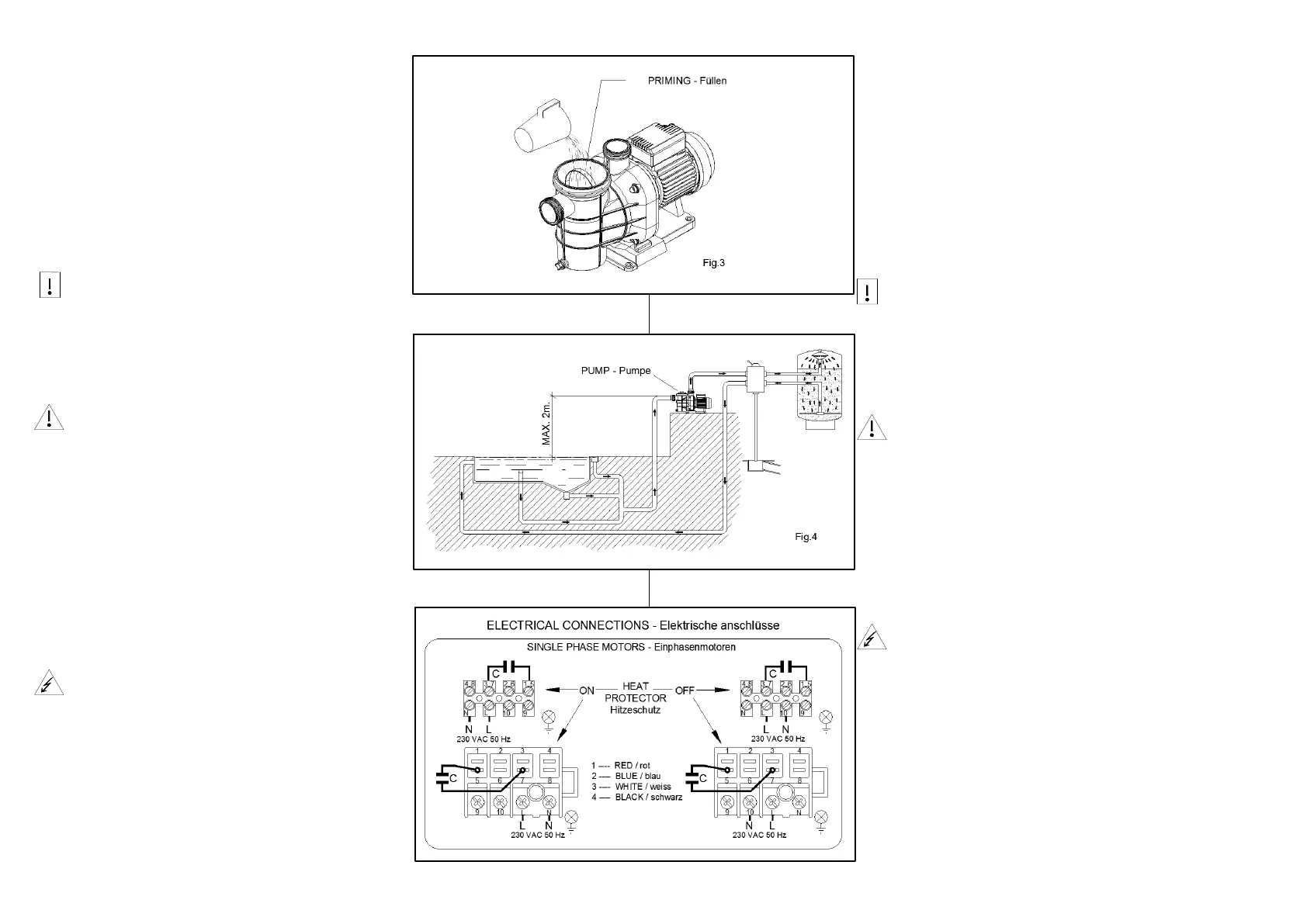
For the correct operation of the pump, it must be
primed until water reaches the surface of the suction
pipe. In models with built-in pre-filter, the pump can
be filled with water by opening the lid of the pre-filter
(Fig. 3).
POSITIONING
It is always advised mounting the pump below the
water level in the pool or pond.
If you have to install a pump model "self-priming"
above water level, the difference in height should not
exceed 2 meters (Fig. 4), ensuring that the suction
pipe is as short as possible as, a longer pipeline
increases the suction time and the loss of head of
the installation.
It should be ensured that the pump is free from
possible flooding and it is given dry ventilation.
SAFETY INSTRUCTIONS
ALL ELECTRICAL INSTALLATIONS MUST
CORRESPOND TO THE STANDARD:
EN 60335-2-41.
"All electrical devices at 230v single phase or 400v
three-phase must be installed with a minimum distance
of 3.5 meters from the edge of the pool. For any
modification of the filtration system, the manufacturer
must be informed without fail. "
ELECTRICAL UNIT
The electrical unit should have a multiple separation
system with contact opening of at least 3 mm.
The cables used for the electrical connection must
ensure the correct fixation to the motor terminals.
A heat protector is incorporated into single-phase
pumps. In these, switch installation is sufficient as in
the “Network connection” diagram
In the three-phase motor a motor guard with heat-
magnetic protection needs to be used.
A protection differential of 30mA is needed for any
pump in order to protect from electrical escapes
(shown in diagrams).
Sie unnötige äussere Krafteinwirkungen auf Pumpe und
Rohrleitung, die nicht nur die Montage erschweren würden,
sondern auch zu einem Bruch der Teile führen könnten
(Abb. 2).
Installieren Sie die Saugleitung mit einer Neigung von 2%
zur Pumpe. Damit wird die Entstehung von Lufttaschen
verhindert (Abb. 2).
Für einen einwandfreien Betrieb der Pumpe muss diese
zum Ansaugen gebracht werden, bis das Wasser in der
Saugleitung zu sehen ist. Bei den Modellen mit
eingebautem Vorfilter kann die Pumpe durch Öffnen des
Vorfilterdeckels mit Wasser gefüllt werden (Abb.3).
AUFSTELLUNGSORT
Die Pumpe sollte immer unterhalb des Wasserspiegels des
Schwimmbads oder Teichs eingebaut werden.
Falls ein „selbstansaugendes“ Modell oberhalb des
Wasserspiegels eingebaut werden muss, darf der
Höhenunterschied nicht mehr als zwei Meter betragen (Abb.
4). Es ist auch wichtig, darauf zu achten, dass die
Ansaugleitung so kurz wie möglich ist, da sich im
gegenteiligen Fall die Ansaugzeit verlängert und der
Druckverlust erhöht.
Schützen Sie die Pumpe vor Überschwemmungen und
sorgen Sie für eine trockene Belüftung.
SICHERHEITSHINWEISE
SÄMTLICHE ELEKTROINSTALLATIONEN MÜSSEN DER
VORSCHRIFT EN 60335-2-41 ENTSPRECHEN.
„Jedes elektrische Gerät mit einphasiger 230 V- oder
dreiphasiger 400 V-Versorgung muss in einer
Mindestentfernung von 3,5 Meter vom Schwimmbeckenrand
installiert werden. Bei jeglicher Änderung des Filtersystems
muss umgehend der Hersteller informiert werden“.
ELEKTRISCHE INSTALLATION
Die elektrische Installation muss über eine mehrstufige
Trennung mit einer Kontaktöffnung von mindestens 3mm
verfügen.
Die für die Elektroinstallation verwendeten Kabel müssen
eine vorschriftsmäßige Befestigung an den Motorklemmen
sicherstellen.
In die Einphasenpumpen ist ein Thermo-Schutzschalter
eingebaut. Es genügt also die Installation mit Schalter wie
im Schema “Netzanschluss” vorgesehen.
Für den Dreiphasen-Motor muss unbedingt ein
magnetothermischer Motorschutzschalter verwendet
werden.
Bei allen Pumpenmodellen muss ein
Differentialschutzschalter von 30mA als Schutz vor
Stromschlägen eingesetzt werden.


 To Next Page
 Loading...