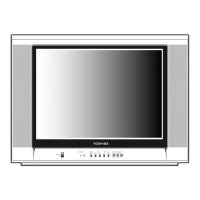
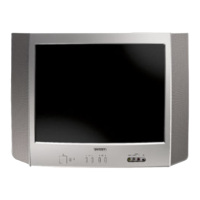
This document is a service manual for Toshiba Color Televisions, specifically models 21CS2TR, 21S2M, 21S2MJ, and 21S2MQ, all built on the S3E Chassis. It was published in February 2004. The manual provides comprehensive information for servicing these color televisions, covering general adjustments, specific technical details, and circuit diagrams.
Function Description:
The devices described are color televisions, designed to receive and display broadcast television signals. They feature a color picture tube (CRT) for visual output and integrated audio capabilities. The manual outlines procedures for setting up, adjusting, and maintaining the television's performance, including color purity, convergence, white balance, and various electrical parameters. It also details self-diagnostic functions to aid in troubleshooting and repair.
Important Technical Specifications:
The manual provides a table of specifications for the different models:
- Rated Voltage: 220-240V, 50Hz for 21CS2TR, 21S2M, 21S2MJ, and 110-240V, 50/60Hz for 21S2MQ.
- Power Consumption: 79W (at ~220V 50Hz).
- Dimensions (Width x Depth x Height): 630.8(W) x 484.7(D) x 454.5(H) mm.
- Mass: 20.8kg for 21CS2TR, 20.4kg for 21S2M, 21S2MJ, 21S2MQ.
- Picture Tube: Type 21 (533.4mm overall diagonal, 508.0mm viewable diagonal) with 90° deflection.
- Television System (Aerial Input):
- PAL B/G (CCIR): VHF (2-12), UHF (21-69), CATV (X~Z+2, S1~S41)
- PAL I (UK): UHF (21-69)
- PAL D/K (CHINA): VHF (1-12), UHF (13-57), CATV (Z-1~Z-38)
- SECAM B/G (CCIR): VHF (2-12), UHF (21-69), CATV (X~Z+2, S1~S41)
- SECAM D/K (OIRT): VHF (1-12), UHF (21-69), CATV (X1~X19)
- NTSC M (US): VHF (2-13), UHF (14-69), CATV (A-6~A-1, A~W, AA~ZZ, AAA, BBB)
- NTSC M (JAPAN): VHF (1-12), UHF (13-62), CATV (M1~M10, S1~41)
- Special RF Signal:
- NTSC4.43: Sound system 5.5/6.0/6.5 MHz
- PAL 60 Hz: Sound system 5.5/6.0/6.5 MHz
- Color System: PAL / SECAM / NTSC4.43 / NTSC3.58.
- Sound Output: 2.5W x 2.
- Terminals:
- Input: Video/Audio (monaural)
- Monitor output: Video/Audio (monaural)
- Speaker: 6 x 12cm (2).
- High Voltage at Zero Beam: (A) 27.8 kV (for 21" models).
- Max High Voltage: (B) 29.0 kV.
- AV Voltage: (C) 110-240 V.
Usage Features:
The televisions are designed for standard home use, offering various input options for video and audio. The remote control and front panel controls allow users to:
- Power on/off the TV.
- Select channels directly or sequentially.
- Adjust volume.
- Access and navigate menus for settings.
- Select TV/VIDEO input.
- Mute sound.
- Control picture settings.
- Access on-screen display.
- Select game mode.
- Utilize Red/Green/Yellow/Blue buttons for specific functions (though some buttons may not be available on all models).
- Program channel memory, including auto search and manual tuning.
- Skip unnecessary channels.
- Perform auto fine tuning (AFT) for optimal picture quality.
Maintenance Features:
The manual is primarily a guide for service technicians, detailing numerous maintenance and adjustment procedures:
- Safety Instructions: Emphasizes X-RAY RADIATION PRECAUTION and PRODUCT SAFETY NOTICE, including the use of an isolation transformer, discharging the picture tube anode, and replacing parts with identical safety-related components.
- Set-Up Adjustment: Procedures for color purity, convergence (center and circumference), and white balance. This involves mechanical adjustments of the deflection yoke, purity/convergence magnets, and rubber wedges, as well as electrical adjustments via service mode.
- Service Mode: Provides access to a hidden menu for adjusting various parameters (e.g., RCUT, GCUT, BCUT, GDRV, BDRV, BRTC, COLC, TNTC, COLP, COLS, SCNT, HPOS, VPOS, HIT, VLIN, SRY, SBY, RAGC). Technicians can select adjustment items, change data values, and perform memory initialization (QA02) after replacement.
- Test Signal Selection: Built-in test patterns (red, green, blue, black, white rasters, cross-bars, cross-hatches, cross-dots, H signals) are available in service mode for precise adjustments.
- Self-Diagnostic Function: A function accessible via the remote control to check the interface among ICs and display status codes for power, bus line, bus control, and block information, aiding in identifying faulty components or circuits.
- Electrical Adjustments: Detailed steps for adjusting focus, sub-brightness, horizontal and vertical position, and vertical amplitude using test patterns and service mode controls.
- High Voltage Check: A procedure to verify that the high voltage remains within specified limits, crucial for X-ray radiation safety.
- Parts List: Comprehensive lists of chassis and cabinet replacement parts, including capacitors, resistors, coils, transformers, semiconductors, and miscellaneous components, with specific part numbers and descriptions for different models and regions.
- PC Boards Bottom View: Diagrams showing the layout of components on the main and CRT/D boards (PD1561-1, PD1418G-1, PD1418K-1, PD1561-2, PD1418G-2, PD1418K-2) to assist in component identification and replacement.
- Terminal View of Transistors: Illustrations of various transistor types and their pin configurations (ECB, BCE) to ensure correct installation.
- Circuit Block Diagram: A high-level overview of the television's internal architecture, showing the interconnections between major functional blocks like the tuner, micro-processor, video/chroma/OEF, memory, audio out, vertical/horizontal output, and power supply.
- Schematic Diagram: Detailed circuit diagrams for the main/CRT drive and power/deflection sections, providing component values and connections for in-depth troubleshooting and repair. Warnings about hazard symbols (A) for safety-critical components are highlighted.

 Need help?

 To Next Page
 General