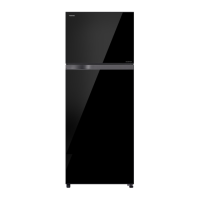
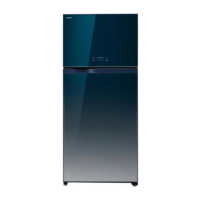
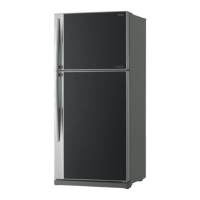
This document is an owner's manual for TOSHIBA refrigerator freezers, designed for home use. It covers various models including GR-AG48MDZ, GR-AG43MDZ, GR-A48MBZ, GR-A43MBZ, GR-AG39MBZ, GR-AG35MBZ, GR-A39MBZ, GR-A35MBZ, GR-AG46SEDZ, GR-AG41SEDZ, GR-A46SEBZ, GR-A41SEBZ, GR-AG37SEBZ, GR-AG32SEBZ, GR-A37SEBZ, GR-A32SEBZ, GR-AG37HBZ, GR-AG32HBZ, GR-A37HBZ, and GR-A32HBZ.
The manual begins with crucial safety information, emphasizing that the appliance is not intended for use by persons with reduced physical, sensory, or mental capabilities, or lack of experience and knowledge, unless supervised or instructed by a responsible person. Children should be supervised to ensure they do not play with the appliance.
Key safety warnings include:
- Ventilation: Keep ventilation openings clear of obstruction in the appliance enclosure or built-in structure.
- Defrosting: Do not use mechanical devices or other means to accelerate the defrosting process other than those recommended by the manufacturer.
- Refrigerant Circuit: Do not damage the refrigerant circuit.
- Electrical Appliances: Do not use electrical appliances inside the food storage compartments unless they are of the type recommended by the manufacturer.
- Flammable Substances: Do not store explosive substances such as aerosol cans with a flammable propellant. Substances like ether, benzene, alcohol, thinner, adhesive, spray, LP gas, or other chemicals may explode.
- Disposal: When disposing of the refrigerator, do not leave it in places where children play. Remove the door packing to prevent dangerous confinement. Contact environmental protection units for proper disposal of insulation blowing gas and flammable refrigerant.
- LED Light: If the LED light is damaged, contact a TOSHIBA-approved service agent for replacement. Only qualified service personnel should remove the LED light.
- Supply Cord: If the supply cord is damaged, it must be replaced by the manufacturer, its service agent, or similarly qualified persons to avoid hazards.
The manual uses specific markings:
- WARNING: Indicates a high possibility of serious injury or death. Serious injury includes hospitalization, lengthy treatment, blindness, hot/cold skin burn, electric shock, broken bones, or poisoning.
- CAUTION: Indicates a high possibility of injury or property loss. Injury refers to harm not requiring hospitalization or lengthy treatment, while property loss includes damage to houses, furniture, domestic animals, or pets.
- PROHIBITED!: Indicates prohibited actions, with detailed instructions provided.
- IMPORTANT: Indicates mandatory actions, with detailed instructions provided.
- CAUTION (triangle): Recommends precautions, with detailed instructions provided.
The appliance contains flammable refrigerant R600a (iso-butane).
Technical Specifications and Installation
The refrigerator is designed for a main voltage of 220-240V. Direct connection to a single power socket is recommended; avoid using multiple sockets to prevent fire and electric shock. The power supply cord and plug should not be pressed or pinched by objects, or have the refrigerator's back panel apply pressure to them, to prevent damage, fire, or electric shock.
In case of malfunction or breakdown, disconnect the power supply by unplugging the power plug. When unplugging, hold the plug itself, not the cord, to prevent damage to wire insulation.
Usage Features
Cleaning and Maintenance:
- Disconnect the power plug before cleaning to prevent injury and electric shock. Ensure hands are dry when handling the plug.
- Periodically clean dust from the power plug to prevent insufficient circuit connection and fire.
- Do not use the appliance if the supply cord is damaged or frayed, or if the power plug has a loose connection, as this may cause fire or electric shock.
Placement and Environment:
- Do not block ventilation openings around the refrigerator.
- Ensure proper grounding for safety.
- Avoid installing in places with water or excessive moisture to prevent fire or electric shock.
- Do not sprinkle water on the refrigerator body or inside, as this may weaken electrical insulation.
- Do not use other electrical appliances inside the refrigerator.
- Do not disassemble or attempt to service the appliance yourself. All repairs should be referred to qualified service personnel.
- The refrigeration system contains refrigerant; do not allow sharp objects to contact it.
- If the refrigerant circuit is damaged, do not use electrical items or fire equipment nearby. Open windows for ventilation and contact a local maintenance agent.
- Children should be supervised to ensure proper use.
- Do not hang or stand on the refrigerator door, as it may overturn, detach from hinges, or cause injury.
Food Storage and Safety:
- Do not store medicines, chemicals, or temperature-sensitive reagents.
- Do not place heavy objects or liquid containers on the refrigerator, as spillage may affect electrical insulation, causing fire or electric shock, and falling objects may cause injury.
- Do not eat food that has changed color or emits a strange odor, as this may cause food poisoning or illnesses.
- In case of gas leakage nearby, do not unplug or touch the refrigerator; keep ventilation openings clear to prevent electrical sparks, fire, or explosions.
- Regularly check the outlet and power supply cord for damage from rats, cockroaches, etc., which could lead to short circuits or electric shock.
- Warning labels and the user manual should be kept with the refrigerator throughout its life, especially if it is transferred or recycled.
Installation Steps:
- Connect the plug to the power socket firmly. Loose connections can cause malfunction. Take precautions like replacing the power socket if needed.
- Lift the refrigerator from the bottom when moving to prevent hands from slipping and injury.
- Install on a strong and even floor to prevent overturning and injury.
- Be careful when moving the refrigerator to avoid scratching the floor.
- Use the handle when closing the door to prevent finger injury.
- Ensure doors are closed properly to avoid poor cooling, slow ice making, icing/frosting in the freezer, or water dripping in the refrigerator. Check that food inside does not block the door.
Initial Setup:
- Install the refrigerator on a strong, level floor. Turn the adjustable legs to stabilize it horizontally.
- For GR-AG48/43MDZ, GR-AG46/41SEDZ, GR-A48/43MBZ, GR-A46/41SEBZ models, adjustable legs on both sides can be adjusted up and down. Turn clockwise to raise, counter-clockwise to lower.
- For GR-AG39/35MBZ, GR-A39/35MBZ, GR-AG37/32SEBZ, GR-A37/32SEBZ, GR-AG37/32HBZ, GR-A37/32HBZ models, the right-side adjustable leg can be adjusted up and down. Turn clockwise to raise, counter-clockwise to lower.
- Avoid humid places near kitchen sinks to prevent corrosion or electric leakage. If installed directly on the ground, place a board underneath.
Placement Guidelines:
- Keep away from direct sunlight, gas ranges, or heaters to maintain cooling efficiency and prevent failure.
- Leave space around the refrigerator: at least 10 cm (4 inches) at the top and rear, and 4 cm (1.6 inches) on the left and right for proper air circulation.
- A plastic smell may be present when first opening the door; this is normal.
- If switching off the refrigerator for an extended period, remove all food, clean the interior, unplug the power cord, and leave doors open.
Information on Operation:
- Compressor Heat: The compressor generates heat during normal operation, which is not a malfunction.
- Refrigerator Wall Heat: The condenser is built into the outer shell, radiating heat into the room. The outer shell may become hot during normal operation, which is not a malfunction.
- Refrigerator Operation: When first turned on or when ambient temperature is high, the refrigerator surface may warm up or the compressor may make noise. This is normal once the refrigerator stabilizes.
Operation Cautions
Moving and Transporting:
- First, remove all food.
- Place a large cloth under the refrigerator and tilt it backward to remove water from the drain pan.
- When carrying, hold the positions shown in the figures (not the door or handle). Lift from the bottom.
- Do not lay the refrigerator on its side during transport or relocation, as this may cause malfunction.
- After unplugging, wait at least 8 minutes before reconnecting to prevent the compressor from malfunctioning or making rattling noises.
Refrigerator Details and Parts
Models GR-AG48/43MDZ, GR-A48/43MBZ, GR-AG46/41SEDZ, GR-A46/41SEBZ:
- Components: Ice Tray, Ice Box, Freezer Shelf, Glass Shelf-B, LED Light, Glass Shelf-C, Glass Shelf-A, Vegetable Crisper, Pockets, Freezer Door Pocket, Egg Pocket, Utility Box, Small Pocket, Bottle Pocket, Bottle Pocket Small, Adjustable Leg.
- Control Panel: Features Temperature Control Freezer Dial, Temperature Control Refrigerator Dial, Quick Freezing Control Button, ECO Mode Control Button.
- MIN position: Increases temperature.
- MAX position: Decreases temperature.
- Tall bottles or items may hit the ceiling when sliding the shelf.
Models GR-AG39/35MBZ, GR-A39/35MBZ, GR-AG37/32SEBZ, GR-A37/32SEBZ, GR-AG37/32HBZ, GR-A37/32HBZ:
- Components: Freezer Shelf, Ice Tray, Ice Box, Glass Shelf-B, Freezing Control Dial, LED Light, Refrigerator Control Dial, Glass Shelf-C, Glass Shelf-A, Vegetable Crisper, Freezer Door Pocket, Egg Pocket, Pockets, Small Pocket-A, Small Pocket-B, Bottle Pocket, Adjustable Leg.
- Control Panel: Features Temperature Control Freezer Dial, Temperature Control Refrigerator Dial.
- MIN position: Increases temperature.
- MAX position: Decreases temperature.
How to Use Your Refrigerator Correctly and Effectively
Temperature Controls:
- Freezer and Refrigerator Compartments: Normally set the temperature control switch to the Middle position.
- If the refrigerator is not cold enough, turn the Refrigerator Control Switch toward "MAX".
- If it is too cold, turn toward "MIN".
- Food Freezing in Refrigerator Compartment: When ambient temperature decreases excessively (e.g., in winter), set the Refrigerator Switch to "MIN" to prevent food from freezing. High moisture content food (tofu, vegetables) may freeze if placed at the back.
- Freezer: For storing ice cream, set the Freezer Control Switch between Middle position and "MAX" position (FREEZER).
- Changing the refrigerator compartment temperature control also varies the temperature in the vegetable crisper.
- Do not obstruct the outlet and inlet of cool air circulation with food or containers to prevent uneven cooling or freezing.
How to Make Ice:
- Fill the ice tray with water up to the water level line. Overfilling will make ice hard to remove.
- To remove ice, twist the lever as shown in the figure.
Self-defrosting:
- This refrigerator is self-defrosting, eliminating the need for manual defrosting.
- Frost on the evaporator (externally invisible) is automatically removed by a time-controlled heater.
LED HYBRID Deodorizer Unit (GR-AG48/43MDZ, GR-AG46/41SEDZ):
- Installed behind the sliding shelf.
- Consists of:
- A photocatalyst for bacteria elimination and deodorization.
- A photocatalyst for bacteria elimination and disintegration of ethylene gas.
- A built-in LED unit.
- Receives LED light to generate hydroxyl radicals from moisture in cold air, which inactivate bacteria, disintegrate ethylene gas (promoting vegetable aging), and deodorize odors.
- Information: Store strong-smelling food in tightly sealed containers.
HYBRID BIO Deodorizer Unit (GR-AG39/35MBZ, GR-A48/43MBZ, GR-A39/35MBZ, GR-AG37/32SEBZ, GR-A46/41SEBZ, GR-A37/32SEBZ, GR-AG37/32HBZ, GR-A37/32HBZ):
- Installed at the cool air circulation for bacteria elimination, deodorization, and refreshing vegetables and fruits.
- Requires no maintenance throughout its duration.
- Information: Store strong-smelling food in tightly sealed containers.
Energy Saving (GR-AG48/43MDZ, GR-A48/43MBZ, GR-AG46/41SEDZ, GR-A46/41SEBZ):
- To activate: Press the ECO MODE button; the eco icon appears.
- To disable: Press the ECO MODE button again; the eco icon disappears.
- Note:
- Entering energy saving mode raises the freezer compartment temperature by approximately 1-2°C above the preset temperature.
- Energy saving performance depends on application conditions (temperature control, outside temperature, door opening/closing frequency, food amount).
- Disable this function if beverages are not cool enough or ice making takes too long.
- ECO will be displayed as ECO for GR-AG48/43MDZ, GR-A48/43MBZ.
Quick Freezing (GR-AG48/43MDZ, GR-A48/43MBZ, GR-AG46/41SEDZ, GR-A46/41SEBZ):
- Use this operation to quickly cool beverages or other food.
- To activate: Press the QUICK FREEZING button; the icon appears.
- To disable: Press the QUICK FREEZING button again; the icon disappears.
- Note:
- The refrigerator remains in quick freezing mode for 150 minutes and then returns to normal operation.
- Quick refrigeration performance depends on application conditions (outside temperature, door opening/closing frequency, food amount).
- This mode can be deactivated immediately once the freezer compartment reaches the desired temperature.
Troubleshooting
Refrigerator not getting cold:
- Check if the refrigerator is plugged in properly.
- Check if the house fuse or breaker has tripped.
Refrigerator not cold enough:
- Check if the temperature control dial is set to "MIN".
- Check if the refrigerator is in direct sunlight or near a stove/heater.
- Ensure the door is closed properly.
- Avoid frequent door opening/closing.
- Check if hot items were placed inside.
- Avoid overloading the refrigerator.
- Ensure sufficient air circulation (at least 10 cm at top/rear, 4 cm at sides).
- Check for power outages.
Food freezing in refrigerator compartment:
- Check if the temperature control dial is set to "MAX".
- Check if the surrounding temperature is below 5°C.
- Avoid placing high moisture content food at the rear of the compartment.
Loud noise:
- Ensure the floor is firm and level.
- Check for trays or dishes left around the refrigerator.
- Check if the refrigerator is unstable or touching the wall.
Moisture on outside of refrigerator:
- This is normal, especially in high humidity (rainy season), similar to condensation on a cold glass. Wipe off with a dry cloth.
Moisture inside of refrigerator:
- Check for frequent or prolonged door opening.
- Check if high moisture content food is left uncovered. Wipe off with a dry cloth.
Dewing on refrigerator compartment (CAUTION):
- Wipe off dews with dry clothes to prevent accumulation.
- To prevent excessive dews:
- Do not open the door often or for long periods.
- Ensure the door is closed properly.
- Dewing may occur on the duct surface due to cold air and outside air invasion when opening the door, or water evaporation from food.
- Dews will disappear naturally when the door is kept closed. Wipe off with dry clothes if needed.
Periodic Maintenance
To ensure maximum life, periodically clean refrigerator parts.
- Before cleaning: Unplug the refrigerator. Be careful not to pull the cord or get it caught. Do not pour water directly on the refrigerator.
- Outside Surfaces: Polish with a soft rag. For heavy stains, use a rag soaked in natural detergent. Wipe the door handle with a dry cloth.
- Door Packing: Regularly inspect and clean door packing with natural detergent to prevent stains from shortening its lifespan.
- Interior Plastic Units: Clean with natural detergent if stained or odorous. Wipe off salad oil or other cooking oil smears immediately to prevent cracking.
How to Remove Accessory Parts
Accessory parts can be easily removed for cleaning. Reassemble in reverse order. Open the door fully for removal. Be careful of falling objects.
Glass Shelf A, B, and C / Vegetable Crisper Shelf:
- Slightly lift and pull out the shelf downwards. For the crisper shelf, remove the vegetable crisper first.
Freezer Shelf:
- Lightly lift and pull out the shelf downwards.
Utility Box:
- Lift the top side and pull towards you.
Pockets:
- Lift up and pull towards you.
How to Change Positions of the Twist Ice Tray:
- The twist ice tray can be installed in two positions.
- Remove the ice box and the twist ice tray.
- Press the lock latch of the twist ice tray with your fingers and remove it sideward.

 Need help?
 General

 To Next Page