This document is an instruction manual for Toshiba Refrigerators, specifically models GR-R25MPT and GR-R30MPT. It covers safety instructions, identification of parts, usage, maintenance, and technical specifications.
Function Description
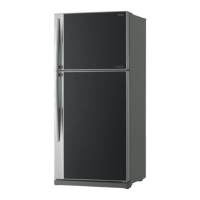
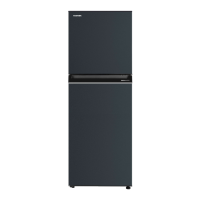
The Toshiba Refrigerator is designed for home use, providing both freezing and refrigeration compartments for food storage. It features an automatic defrosting system, eliminating the need for manual defrosting. A Platinum Deodorizing Device is integrated into the cold air passage to remove unpleasant odors from the compartments, requiring no replacement of deodorizers.
Important Technical Specifications
The manual provides specifications for two models: GR-R25MPT and GR-R30MPT.
GR-R25MPT:
- Total Storage Volume: 188 liters
- Freezer Storage Volume: 58 liters
- Refrigerator Storage Volume: 130 liters
- Outside Dimensions (Width x Depth x Height): 549 x 596 x 1386 mm
- Frequency: 50 Hz
- Voltage: 230-240 V
- Net Weight: 44 kg
- Refrigerant (g): 115 g
- Refrigerant Type: HFC-134a
GR-R30MPT:
- Total Storage Volume: 228 liters
- Freezer Storage Volume: 58 liters
- Refrigerator Storage Volume: 170 liters
- Outside Dimensions (Width x Depth x Height): 549 x 596 x 1577 mm
- Frequency: 50 Hz
- Voltage: 230-240 V
- Net Weight: 47 kg
- Refrigerant (g): 125 g
- Refrigerant Type: HFC-134a
Both models operate on a 230-240V, 50Hz power supply and use HFC-134a as the refrigerant.
Usage Features
The refrigerator includes several compartments and accessories:
- Freezing Compartment: Ice Twist, Ice Box, Freezer Shelf, Control Panel (for freezing compartment).
- Refrigerator Compartment: Meat Case, Control Panel (for refrigerator compartment), Interior Lamp, Upper Shelf, Mini Pocket, Crisper Shelf, Vegetable Crisper, Bottle Pocket, Egg Pocket.
- Temperature Control: Separate dials for the freezing and refrigerator compartments.
- Freezing Compartment Temperature: Setting "5" is 2-3°C lower than "3" (approx. -18°C). Setting "1" is 1-2°C higher than "3". Ice cream storage is recommended below setting "3".
- Refrigerator Compartment Temperature: Setting "5" is 2-3°C lower than "3" (approx. 1°C). Setting "1" is 1-2°C higher than "3".
- Ice Making: Water is filled into an ice tray up to a marked level line. Ice is removed by twisting the ice twist mechanism.
- Installation:
- Location: Should be placed in a dry, well-ventilated area, away from direct sunlight, gas ranges, or other heat sources.
- Clearance: Requires at least 10 cm (4 inches) at the top and rear, and 4 cm (1.6 inches) on both sides for proper air circulation.
- Leveling: Must be installed on a strong and level floor, with adjustable leveling screws to ensure stability.
- Post-Power Interruption: After a power plug is removed, wait at least 7 minutes before reinserting to prevent compressor malfunction.
- Moving and Transporting: Food should be removed. The refrigerator should be lifted from designated positions (not by the door or handle) and should not be laid on its side during relocation to prevent malfunction.
Maintenance Features
The manual outlines periodic maintenance procedures to ensure the refrigerator's longevity and proper functioning.
- General Cleaning: Before cleaning, always unplug the refrigerator. Avoid pulling the cord or getting it caught. Do not pour water directly on the refrigerator.
- Outside Surfaces: Polish with a soft rag. For heavy stains, use a rag soaked in a cleanser solution. The door handle should be wiped with a dry cloth.
- Door Packing: Inspect and clean the door packing periodically with a cleanser solution to prevent stains and prolong its lifespan.
- Interior Plastic Units: Clean with a cleanser solution if stained or odorous. Immediately wipe off any salad oil or cooking oil smears to prevent cracking of plastic units.
- Accessory Parts Removal: Various parts like freezer shelves, egg pockets, mini pockets, bottle pockets, meat cases, vegetable crispers, lower shelves, and crisper shelves can be easily removed for cleaning by following specific lifting and pulling instructions.
- Lamp Replacement: The internal lamp (15 Watt) can be replaced by first unplugging the refrigerator, then pushing up the bottom of the shade, pulling the shade, and finally removing the bulb.
- Troubleshooting Guide: Before requesting repair, the manual advises checking common issues such as:
- No Cooling: Verify if the refrigerator is plugged in, if the house fuse/breaker is active, and if there's a power outage.
- Insufficient Cooling: Check if the temperature control dial is set to "1", if the refrigerator is exposed to direct sunlight or heat, if the door is properly closed, if the door is opened too frequently, if hot items were placed inside, if it's overloaded, or if ventilation is adequate.
- Food Freezing in Refrigerator Compartment: Check if the temperature control dial is set to "5", if the ambient temperature is below 5°C, or if high-moisture food is placed at the rear of the compartment uncovered.
- Noisy Operation: Verify if the floor is firm and level, if any trays or dishes are left around the refrigerator, or if the refrigerator is unstable or touching a wall.
- External Moisture: Condensation on the outside, especially in high humidity, is normal (like a cold glass). Wipe it off with a dry cloth.
- Internal Moisture: Check if the door is opened too frequently or left open for long periods, or if high-moisture food is left uncovered. Wipe off moisture with a dry cloth.
- Power Cord Damage: If the power supply cord is damaged, it must be replaced by a repair shop appointed by the manufacturer to avoid hazards.

 Need help?
 General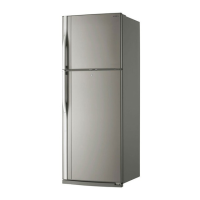



 To Next Page