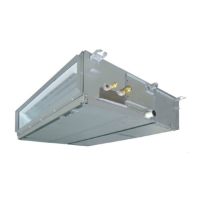
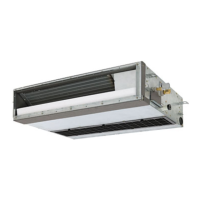
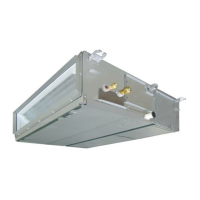
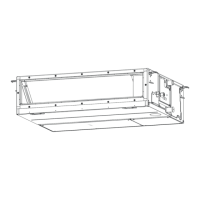
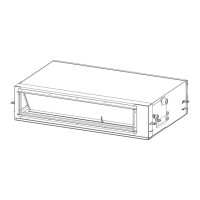
This document is an installation manual for the Toshiba Concealed Duct Type Air Conditioner, designed for multi-type systems and commercial use. It utilizes R410A refrigerant, an HFC (hydrofluorocarbon) that does not deplete the ozone layer.
Function Description:
The Toshiba Concealed Duct Type Air Conditioner is designed to provide cooling and heating for commercial spaces. It is a multi-type system, meaning it can connect multiple indoor units to a single outdoor unit. The concealed duct design allows for discreet installation within ceilings, providing an aesthetic and space-saving solution. The unit's operation is managed via a wired remote controller, which allows for various settings adjustments, including temperature, fan speed, and operational modes. It also supports group control, enabling a single remote controller to manage up to eight indoor units.
Important Technical Specifications:
The manual lists several models with varying capacities, indicated by their model names (e.g., MMD-AP0056BHP1-E1 to MMD-AP0566BHP1-E1).
- Refrigerant: R410A. This refrigerant has specific characteristics: it easily absorbs water, oxidizes membranes or oil, and its pressure is approximately 1.6 times higher than R22. Special tools are required for R410A systems to prevent incorrect refrigerant or oil charging.
- Power Supply: The appliance must be connected to the main power supply via a switch with a contact separation of at least 3 mm. The installation fuse (all types) must be used for the power supply line. Specific wiring details are provided for 208 V - 240 V, 50/60 Hz systems, with wire sizes of 2.5 mm² for power supply and 0.5 mm² to 2.0 mm² for remote controller wiring, depending on the total length.
- Duct Design: The unit supports various duct configurations, including "Under air intake" and "Back air intake" options. Dimensions for duct connections are provided for different model ranges (AP0056~AP0186, AP0246~AP0306, AP0366~AP0566).
- External Static Pressure: The unit's performance is characterized by fan curves showing external static pressure (Pa) versus air volume (m³/h) for different models and fan speed settings (Low, Mid, High). These curves help in selecting the appropriate fan speed based on duct resistance.
- Drainage: The drain pipe must be sloped downward (at an angle of 1/100 or more) to ensure proper drainage and prevent water leakage. The minimum length of the drain pipe from the indoor unit should be 850 mm or more.
- Sound Power Level: The manual provides sound power levels (dBA) for various models during cooling and heating operations, with most models listed as "< 70 dBA".
- Weight: The main unit weights range from 23 kg to 40 kg, depending on the model.
- Refrigerant Piping: The manual specifies outer diameters for copper pipes (gas side and liquid side) for different models, ranging from Ø9.5 mm to Ø15.9 mm for the gas side and Ø6.4 mm to Ø9.5 mm for the liquid side. Flaring dimensions are also provided.
Usage Features:
- Installation Flexibility: The unit can be installed in various ceiling configurations, with guidelines for reserving sufficient space for installation and service work. It supports both "Under air intake" and "Back air intake" configurations.
- Remote Controller Settings: The wired remote controller allows users to adjust various operational parameters, including external static pressure settings (tap change), filter sign term (notification of filter cleaning), and detection temperature shift for heating.
- Group Control: Up to 8 indoor units can be controlled by a single wired remote controller, simplifying management in multi-zone commercial environments.
- Test Run Functionality: A test run mode is available to verify proper installation and operation, including checking for water drainage and refrigerant leaks. This mode can be initiated and stopped via the remote controller.
- Safety Features: The manual emphasizes safety precautions, including the use of R410A refrigerant (which does not destroy the ozone layer but requires careful handling due to its higher pressure), and warnings against improper installation or maintenance that could lead to injury, electric shock, or equipment damage. It also details the importance of checking refrigerant concentration limits in rooms to prevent suffocation risk in case of leakage.
Maintenance Features:
- Filter Cleaning: The manual outlines a daily maintenance routine (once every 3 months) for cleaning the air filter. The remote controller displays a filter sign when maintenance is due. The process involves stopping the unit, turning off the circuit breaker, removing and cleaning the filters with water or a vacuum cleaner, drying them, and then re-installing them.
- Inspection Method: A detailed inspection method is provided for various parts of the unit, including the heat exchanger, fan motor, filter, and drain pan. This includes checking for abnormal sounds, dirt, damage, and proper drainage.
- Troubleshooting: The manual includes a comprehensive list of check codes displayed on the wired remote controller, outdoor unit 7-segment display, AI-NET central control display, and wireless remote controller sensor block. These codes help identify specific errors (e.g., sensor errors, communication errors, compressor issues, fan motor errors) and guide troubleshooting efforts.
- Protective Gear: The manual specifies the use of protective gear (gloves, safety clothing, insulating shoes, helmets) for various tasks such as transportation, installation, maintenance, and electrical work to prevent injuries.

 Need help?
 General


 To Next Page