

 Need help?
Do you have a question about the Toshiba Qosmio DX730 and is the answer not in the manual?
Essential safety guidelines for optimal computer use and user well-being.
Explains the document's formatting, abbreviations, icons, and key notation for clarity.
Verifies all necessary hardware, documentation, and software items are included with the computer.
Instructions for properly connecting the AC adapter for powering the computer.
Guides on connecting wireless keyboard and mouse to the computer for initial use.
Details how to safely turn on the computer and its power indicator status.
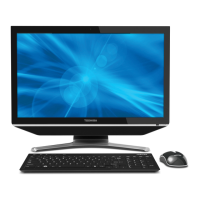
Identifies and describes key components located on the front, left, right, and back of the computer.
Explains the functions and indicators of the wireless keyboard for user interaction.
Details the buttons, sensor, and indicators of the wireless mouse for navigation.
Describes how to use the remote controller for various computer functions from a distance.
Explains how to use the touch screen for manipulating icons, buttons, and navigating the interface.
Covers keyboard layout, indicators, function keys, and special key combinations.
Provides instructions for using optical drives, including loading and removing discs.
Details how to use the TOSHIBA Video Player for DVD playback and 3D content.
Covers setting up and using Wireless LAN and Bluetooth for network connectivity.
Explains how to insert, remove, and care for various memory media cards.
Guides on installing and removing memory modules to increase system memory.
Instructions for connecting external devices via HDMI out and in ports for display and input.
Details on using Volume Mixer, Microphone Level, and Dolby Advanced Audio for sound management.
Provides essential guidelines for safely handling, cleaning, and moving the computer.
Describes pre-installed software utilities and their basic functions for system management.
Explains how to register and use facial recognition for logging into Windows.
Highlights unique and advanced features like Hot Keys, power management, and system utilities.
Details the use of hot keys for quick system configuration changes and feature activation.
Guides on using system recovery options and creating recovery media for system restoration.
Explains how to interpret the Power indicator lights for computer status.
Describes the different power-up modes: Shut Down, Hibernation, and Sleep Modes.
Outlines a systematic approach to diagnosing and resolving computer problems effectively.
Lists common hardware and system issues and their basic troubleshooting steps.
Addresses issues related to AC adapter, overheating, and power indicator status.
Covers troubleshooting for keyboard and pointing device malfunctions.
Provides solutions for problems related to wireless network and Bluetooth connectivity.
Offers guidance on how to obtain technical assistance from TOSHIBA support.
Provides the physical size specifications of the computer.
Details the operating and non-operating environmental conditions for the computer.
Explains compatibility and standards for Wireless LAN and Bluetooth devices.
Outlines radio frequency regulations and restrictions for wireless devices in various regions.
Details compliance with FCC rules for digital devices and radio frequency exposure.


 To Next Page
 General