This document serves as a comprehensive manual for the TOSOT PAT Series Portable Air Conditioner, encompassing owner's, operator's, and technical instructions for models GPC04AP-A6NNA1A, GPC05AP-A6NNA1A, and GPC06AP-A6NNA1A. It emphasizes safety, proper operation, and maintenance to ensure optimal performance and longevity of the appliance.
The portable air conditioner is designed to provide cooling, drying, and fan-only functions for indoor use. It utilizes R32 refrigerant, which is noted for its low flammability, minimal environmental impact on the ozone layer, and good thermodynamic properties, contributing to high energy efficiency. The unit is equipped with castors for easy mobility, allowing users to position it conveniently within a room. For effective cooling, it is recommended to operate the unit in a smooth and flat location, with doors and windows closed, and to ensure adequate clearance around the air inlet and outlet.
Function Description
The TOSOT PAT Series Portable Air Conditioner offers multiple operating modes to suit various comfort needs:
- Cool Mode: This is the primary cooling function, where the unit actively cools the room to a user-set temperature. The temperature can be adjusted between 61°F (16°C) and 86°F (30°C) using the +/- buttons on the control panel or remote. The cool mode indicator will be bright, and the dual-8 nixie tube will display the set temperature.
- Dry Mode: In this mode, the air conditioner functions as a dehumidifier, reducing humidity in the room. The dry mode indicator will be bright, but the dual-8 nixie tube will not display a temperature. The fan speed is automatically set to low in this mode. For optimal performance in dry mode, continuous drainage from the middle hole is recommended.
- Fan Mode: This mode circulates air without cooling or dehumidifying. The fan mode indicator will be bright, and the dual-8 nixie tube will not display a temperature. Users can select between low, medium, high, or auto fan speeds using the fan button on the control panel or remote.
- Sleep Mode: Available only in cool mode, this feature adjusts the preset temperature gradually to optimize comfort during sleep. The temperature will increase by 2°F (1°C) within the first hour and by an additional 2°F (1°C) within the next hour, maintaining this new temperature thereafter. The upper indicator will remain displayed, while other icons will not.
- Timer Function: This allows users to set a specific time for the unit to turn on or off. The timer can be adjusted in 0.5-hour increments for settings up to 10 hours, and in 1-hour increments for settings beyond 10 hours. Once set, the unit will display the temperature after 5 seconds of no operation. The upper indicator will remain bright if the timer is active.
Usage Features
The portable air conditioner is designed for user-friendly operation with both a control panel and a remote controller.
- Control Panel: Located on the unit, the control panel features buttons for ON/OFF, temperature adjustment (+/-), fan speed selection, mode selection, timer setting, and sleep mode activation. Each button press is accompanied by a sound, and corresponding indicators light up to show the active settings. The dual-8 nixie tube displays the set temperature in cool and heat modes, but not in dry or fan modes.
- Remote Controller: A wireless remote provides convenient control from a distance. It includes buttons for ON/OFF, temperature adjustment (+/-), cool mode, dry mode, fan-only mode, and fan speed selection (Auto, Low, Med, High). Note that only low fan speed is available in dry mode. The remote requires two AAA 1.5V dry batteries, and instructions for battery replacement are provided, emphasizing correct polarity. For effective communication, the remote's signal sender should be pointed at the unit's receiving window, with a maximum distance of 8m (26.25') and no obstacles in between. Users are advised to replace batteries when the display becomes fuzzy or non-functional and to remove batteries during long periods of non-use.
- Guide Louver: Before operation, the air guide louver should be opened by pressing the marked "PUSH" position. For improved comfort, it is suggested to open the louver to its maximum position.
- Installation: The manual provides detailed instructions for installing the heat discharge pipe and the window panel. The heat discharge pipe is connected to the unit via a joint and rear clip and should be led outdoors. The window panel assembly, which includes an adjustment panel, mothproof net, rain guards, and foam seals, adapts to different window sizes (horizontal or vertical sliding). The manual stresses the importance of keeping the heat discharge pipe as short and flat as possible to maximize cooling efficiency.
- Water Collection and Drainage: The unit has a chassis that collects condensed water. There are two drainage options:
- Lower Hole Drainage: When the chassis is full, the unit will sound an alarm ("H8" displayed) to prompt manual drainage. The unit should be moved to a suitable location, kept horizontal, and the rubber plug on the drainage pipe removed to discharge water.
- Middle Hole Continuous Drainage: For continuous operation, especially in dry mode, a 13.5 mm (17/32") inner diameter hose or garden hose (not included) can be attached to the middle drain connector, directing water to a floor drain. This method requires the unit to be on a level surface with no obstructions in the hose to prevent water accumulation and unit shutdown.
Maintenance Features
Regular maintenance is crucial for the air conditioner's performance and includes cleaning the outer case, grille, and filter, as well as checking the heat discharge pipe and water collection.
- Safety Precautions for Maintenance: Before any cleaning or maintenance, the unit must be turned off, and the power plug disconnected to prevent electric shock. Volatile liquids, corrosive detergents, or direct water splashing on the unit are strictly prohibited as they can damage the appliance.
- Cleaning the Outer Case and Grille: The outer case can be wiped with a soft towel. For stubborn dirt or grease, a neutral abluent can be used. The grille can be cleaned with a cleaner or a soft brush.
- Cleaning the Air Filter: The filter should be cleaned approximately every three months, or more frequently in dusty environments. To clean, the filter is removed by pressing a clasp, washed with water (or warm water with a neutral abluent for heavy grease), and then air-dried in a shady place. It should not be dried with fire or a hair dryer to prevent deformation or fire. After cleaning and drying, the filter is reinstalled.
- Cleaning the Heat Discharge Pipe: The heat discharge pipe should be removed, cleaned, dried, and then reinstalled.
- Pre-Season Checks: Before seasonal use, users should check for blocked air inlets/outlets, the condition of the plug and socket, filter cleanliness, remote controller batteries, and the tight installation of the joint, window bracket, and heat discharge pipe. Any damage to the heat discharge pipe should also be checked.
- Post-Season Checks and Long-Term Storage: After seasonal use, the power supply should be disconnected. The filter and outer case should be cleaned, and any dust or sundries removed. Accumulated water in the chassis must be drained. The window bracket should be checked for damage. For long-term storage, ensure all water is drained, the heat discharge pipe is disassembled, the power cord is unplugged and wrapped, and the unit is cleaned and packed to prevent dust accumulation.
- Malfunction Analysis: The manual provides a troubleshooting guide for common issues such as the unit not operating, poor cooling, remote control signal problems, unusual sounds, or off-flavors. It also lists malfunction codes (F1, F2, F4, F0, E8, H3, H8) with corresponding solutions, advising users to contact qualified professionals for complex issues.
- Refrigerant Handling (Specialist's Manual): For professionals, the manual outlines strict procedures for handling R32 refrigerant, including safety warnings, aptitude requirements for maintenance personnel, safety preparation work (checking for ignition sources, ensuring ventilation, using appropriate leak detectors), and specific work procedures for repairs, charging, and decommissioning. It emphasizes the importance of following national gas regulations and manufacturer guidelines to prevent hazards associated with flammable refrigerants.

 Need help?
 General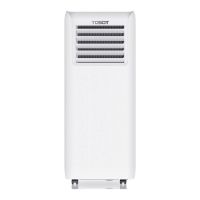


 To Next Page