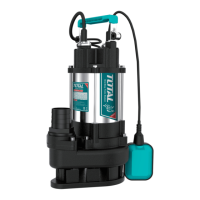
This document describes a range of submersible pumps designed for various water lifting applications. These electro pumps are suitable for use in wells, first collection tanks, cisterns, and streams. They can also be used for pumping out basements (cellars, garages), emptying swimming pools, and for small agricultural installations or garden sprinkling systems. A key advantage of these pumps, especially when installed in wells or tanks, is their quiet operation, which eliminates common issues related to suction and loss of priming. Some models may include a float switch for automatic operation, which cuts off the pump when the water level is insufficient, preventing dry running.
Function Description:
The primary function of these submersible pumps is to move water from one location to another. They are designed to be fully immersed in the liquid they are pumping. The pumps are built to handle water free from explosive substances, solid particles, or fibers. The design ensures efficient operation with liquids having a density of 1 Kg/dm³ and a kinematic viscosity of 1mm²/s, provided they are chemically non-aggressive.
Usage Features:
- Installation: Before immersion, ensure the pit or tank is free from sand or solid sediment. If sediment is present, clean the site thoroughly. It is recommended to keep the pump at least 1 meter above the bottom of the pit to prevent sediment from being sucked up. Regular removal of sediment is advised. Crucially, the water level must never fall below the pump body to prevent dry running. The pump can be installed in either a vertical or horizontal position.
- Operating Conditions: The pumps are designed to operate with water temperatures ranging from 0°C to +50°C. The pump body must always be completely immersed during operation. The maximum immersion depth is 5 meters below the water level. The housing pit should be frost-free.
- Piping: Hydraulic connections can be made using rigid or flexible iron or plastic parts. It is essential to avoid any choking of the output pipe. Using pipes with an internal diameter at least equal to that of the delivery pipe is recommended to prevent a fall in pump performance and potential clogging.
- Float Switch (if applicable): For models equipped with a float switch, ensure it can move freely during operation. The stop level set by the float switch should not uncover the filter. The float switch allows for automatic pump operation based on water level, switching off when the level drops to a predetermined point and restarting when it rises. The length of the cable between the float and the fixed point can be adjusted to regulate the switch-off level.
- Electrical Connection: Installation must be performed by authorized and qualified personnel. Verify that the mains voltage matches the pump's data plate, and ensure a good ground connection. The pumps are supplied with an electric cable; if damaged, it must be replaced, not repaired. It is advisable to connect the pump to a dedicated power line. A suitably sensitive magnetothermal differential switch should be installed upstream from the pump. Always switch off the power before making electrical connections. Single-phase motors include built-in thermal overload protection and can be connected directly to the mains. If overloaded, the motor will stop automatically and restart once cooled, without manual intervention. Three-phase pumps require protection with motor protectors calibrated to the values on the pump's data plate.
- Direction of Rotation (for three-phase motors): The direction of rotation must be checked upon each new installation. Place the pump on a flat surface, start and stop it immediately, and observe the kick-back from above. The upper cap should turn counter-clockwise for correct rotation. If the pump is already installed, check the water flow rate, stop the pump, invert two phases on the supply line, restart, and compare flow rates. The direction yielding the higher flow rate is correct.
- Start-up: Turn the differential magnetothermal switch to the "ON" position and wait for water to emerge from the delivery pipe. The pump can be started and stopped manually via the switch or automatically by the float switch when the water level rises.
- Safety Precautions: Never carry or lift the pump by its power cables. Always use a rope or chain attached to the upper handle to lower the pump. When using in deep wells, secure the power cable to the delivery pipe with clamps every two to three meters. The suction filter must always be present during operation. Avoid starting the pump more than 30 times per hour to prevent excessive thermal stress on the motor. The pumps are not to be used in swimming pools, ponds, or tanks where people are present, nor for pumping hydrocarbons (petrol, diesel fuel, fuel oils, solvents, etc.), in accordance with accident-prevention regulations. Never let the pump run dry; it must be fully immersed in the liquid. Slurping for long periods should be avoided. The length of the power cable limits the maximum immersion depth.
- Frost Protection: If the pump is inactive in temperatures below 0°C, ensure no water residue remains that could freeze and crack pump components.
- Contaminant Handling: If the pump has been used with substances that tend to deposit, rinse it thoroughly with a powerful jet of water after use to prevent the formation of deposits or scale, which could reduce pump performance.
Maintenance Features:
- General Maintenance: In normal operation, the pump requires minimal maintenance due to its oil bath lubricated seal and greased-for-life bearings.
- Disassembly and Repair: The electro pump should only be dismantled by skilled and qualified personnel who possess the necessary technical qualifications. All repairs and maintenance must be performed only after disconnecting the pump from the power mains and ensuring it cannot suddenly start. During dismantling, exercise caution due to sharp parts that may cause injury.
- Cleaning: The cutting-edge flange of the electro pump is equipped with aspiration fans. Periodically clean these fans to prevent loss of efficiency. The best cleaning method is a strong jet of water. Sand and other abrasive materials can cause premature wear and tear, leading to reduced performance.
- Motor Shaft Rotation Check (if motor does not work): If the motor does not work and the shaft does not turn when the switch or float is operated, check that all working parts turn freely. To do this, disconnect the pump from the mains, place it horizontally, remove the grill and diffuser, and rotate the motor shaft clockwise using a fork wrench (13). Then reassemble and install the pump.
- Spare Parts and Modifications: All spare parts used for repairs must be original. Any modifications not authorized by the manufacturer beforehand will relieve the manufacturer of all responsibility. All accessories must be approved by the manufacturer to ensure maximum safety.

 Need help?
 General

 To Next Page