Need help?
Do you have a question about the Trader Bear BESMOKEY4 and is the answer not in the manual?
Guidelines for optimal placement, considering building codes and regional legislation for smoke alarm performance.
Connect to 240V~ supply using licensed electrician and 1mm² cable. Ensure correct terminal connections A,E,N,S.
Verify battery fit/charge, check green mains light. Red light indicates battery function. Press Test/Hush to confirm.
Use 1mm² rated insulation wire. Do not connect AC power or incorrect wires to the S terminal. Only interconnect within a single dwelling.
Press the HUSH/TEST button for 3+ seconds to activate. Alarm will recommence sounding if smoke persists.
Replace every 12 months or on low battery signal. Open alarm, replace battery, ensure correct fit, and close the unit.
Interpret LED status (Green ON, Red Flashing) and sound patterns for alarm modes, hush mode, and low battery indications.
In case of fire: stay calm, leave immediately, check paths, stay low in smoke, gather at meeting place, call fire brigade from neighbour's.
Photoelectric alarms are less prone to false alarms. Check for dust, insects, cooking particles, or excessive steam.
Expected service life is 10 years. Weekly testing recommended. Replace unit after 10 years. No user-serviceable parts.
Performing insulation tests can cause irreparable damage and void the warranty. Do not conduct these tests.
Contact GSME via email with proof of purchase for repair or replacement of manufacturing defects.
Clip the skirt onto the base plate and rotate to lock it in place, covering paint marks from previous alarms.
The BESMOKEY4 is a photoelectric smoke alarm designed for residential applications, offering both single-station and interconnectable functionality. This device is mains-powered with a 9V replaceable battery backup, ensuring continuous operation even during power outages. Its design prioritizes ease of installation and maintenance, featuring a hinged base plate and large terminals.
The primary function of the BESMOKEY4 is to detect smoke using photoelectric technology and alert occupants with an 85dBA warning siren. It is designed to operate on a 240V~ mains supply at 50Hz, drawing 80mA. The alarm is approved to AS3786:2014 standards and is Active Fire listed, indicating its compliance with relevant safety regulations.
When smoke is detected, the alarm will sound a siren with an ISO 8201 sound pattern. In an interconnected system, if one alarm detects smoke, all interconnected units will also sound, providing widespread notification throughout the dwelling. The alarm includes a "Hush/Silence" feature, allowing temporary silencing of the siren for 8-10 minutes in cases of nuisance alarms caused by cooking particles or dust. If smoke persists after the hush period, the alarm will recommence sounding.
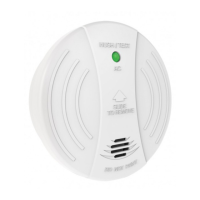
The device incorporates visual indicators for its operational status. A green a.c. mains LED illuminates when mains power is connected and the unit is correctly seated on its mounting base. A red flashing battery indicator provides feedback on the battery's functioning and low battery status. In normal operation, the red LED flashes every 30 seconds, indicating that the smoke alarm is performing a self-test of its battery and electronics. When the alarm is activated, the red light flashes every 0.5 seconds, and the siren repeats three long beeps. If the red light is off while the alarm is activated, it indicates that other interconnected units may have triggered the alarm.
An anti-tamper feature is integrated into the design to prevent unauthorized removal or interference with the unit. The hinged base plate facilitates easy access for battery replacement while keeping the unit securely attached to the mounting surface.
The BESMOKEY4 is suitable for both ceiling and wall mounting, offering flexibility in installation. For optimal performance, it is recommended to mount alarms as close to the center of rooms as practical and on the ceiling for residential applications. In sleeping areas, bedrooms, and along paths to exits, smoke alarms should be strategically located. For hallways longer than 9 meters, alarms should be mounted near each end. When installed on ceilings, smoke detectors must be at least 300mm away from walls or corners. If wall mounting is necessary, the alarm should be positioned on an inside wall between 300mm and 500mm from the ceiling. The alarm should also be at least 500mm away from the apex of any angled ceiling surface and no greater than 1500mm. It is advisable to locate alarms in every room where electrical appliances are used.
For multi-story dwellings, alarms should be installed on every floor level. Stairwells, which can act as smoke chimneys, require additional alarms.
In mobile homes or caravans, installation recommendations vary based on insulation. For modern, well-insulated units, standard placement guidelines apply. For older or poorly insulated units, mounting the detector on an inside partition between 300mm and 500mm from the ceiling surface is recommended to counteract thermal barriers that might prevent smoke from reaching the ceiling. If insulation is uncertain, installing the alarm on an inside wall panel and at least one alarm near bedrooms is advised for minimum protection. Regular testing before each excursion and at least once a week during use, especially when traveling on rough roads, is recommended for mobile home installations.
Locations to avoid for installation include air-conditioner ducts or appliance outlets that create airflow, areas within 1 meter of such outlets, kitchen areas prone to cooking fumes, damp or extremely humid locations (relative humidity exceeding 90%), areas with large temperature variations (5 to 45 degrees Celsius), "dead air space" where smoke may not reach the alarm, garages (due to combustion products from vehicles), less than 500mm from the peak of an "A" frame type ceiling, dusty areas or areas prone to insect infestation, and close proximity to other electrical equipment or fluorescent lights that may cause electromagnetic interference.
The alarm features a "Test/Hush" button for user interaction. Pressing this button confirms the alarm's correct functioning and allows temporary silencing of nuisance alarms.
The BESMOKEY4 is designed for minimal user maintenance, with no serviceable parts intended for user replacement. The expected service life of the alarm is 10 years under normal conditions, after which replacement is recommended.
The primary user maintenance task is the replacement of the 9V battery backup. Smoke alarms should have their backup batteries replaced regularly, at least every 12 months, or when the low battery signal starts chirping every 30 seconds. The hinged base plate facilitates easy access to the battery chamber. To replace the battery, the user presses the "Push to Open" button, allowing the alarm body to pivot down on its hinge. The old 9V d.c. battery is removed from its recess, and a new, equivalent 9V battery is installed. It is crucial to ensure the spring-loaded battery tag is correctly pushed down by the battery to allow the body to close properly and the alarm to function. After installing the new battery, the alarm is closed, and the clip latched back in place. The green LED should be lit, and the red LED should flash periodically. A final test using the "Test/Hush" button confirms correct operation.
Only specific 9V alkaline batteries (ENERGIZER 522, DURACELL MN1604, MX1604) or carbon zinc batteries (Gold Peack 1604E) are recommended for replacement.
Disconnecting the BESMOKEY4 alarm from its mounting base and/or removing the 9V battery will render the smoke alarm inactive.
Weekly testing of the smoke alarm is recommended to ensure its continuous functionality.
A crucial warning regarding maintenance is that under no circumstances should an insulation resistance test be carried out on a circuit to which a smoke alarm is fitted. Such a test could cause irreparable damage to the internal circuitry of the smoke alarm, rendering it inoperative and voiding the warranty.
 General
| Sensor Type | Photoelectric |
|---|---|
| Battery Life | 10 years |
| Interconnectability | No |
| Hush Button | Yes |
| Power Source | Battery |
| Alarm Sound Level | 85 dB |
| Operating Temperature | 0°C to 40°C |

 To Next Page