Need help?
Do you have a question about the Tramontina 1398135 and is the answer not in the manual?
Essential guidelines for operating your enameled cast iron cookware, covering preparation, cooking, and safety protocols.
Detailed instructions for washing, maintaining, and preserving the finish of your enameled cast iron cookware.
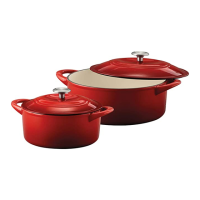
This document describes the use and care of Tramontina enameled cast iron cookware, specifically a 2-pack of Dutch ovens (4QT/3.7L and 7QT/6.6L).
The Tramontina enameled cast iron Dutch ovens are designed for a variety of cooking tasks, including frying, searing, and general cooking. The enamel coating provides a durable and non-reactive surface, while the cast iron construction ensures even heat distribution and retention. These Dutch ovens are oven-safe up to 450°F (232°C), making them versatile for both stovetop and oven use. The integral handles and lid knob are also oven-safe, allowing for seamless transfer between cooking methods.
Upon unboxing, users should remove plastic clips and hand-wash the cookware with warm, soapy water, then rinse and dry thoroughly. While the enamel coating does not require seasoning, it is recommended to season the exposed cast iron rims of the vessel and lid. This is done by lightly rubbing cooking oil onto the surface and heating the cookware in an oven for one hour at 350°F (176°C), then allowing it to cool.
To preserve the enamel surface, it is crucial to avoid knocking utensils against the cookware or cutting food directly within it. The use of silicone, nylon, bamboo, or wood utensils is recommended, as metal utensils or sharp objects can damage the cooking surface over time. The enamel surfaces are not suitable for dry cooking; a liquid, butter, or oil should always be added to the bottom of the cookware before heating.
For optimal cooking results, a gradual low-to-medium heat setting is advised for most tasks, including frying and searing. High heat is generally unnecessary once the cookware is hot and can permanently discolor and damage the cookware. When using the Dutch ovens on ceramic glass stovetops, they should always be lifted rather than slid to prevent scratching the cooktop. It's important to keep the cookware on the burner only for the necessary cooking or boiling time, and to avoid overheating empty cookware or allowing gas flames to extend up the sides and overheat the handles.
Due to the heat retention properties of cast iron, the integral handles and lid knob will become hot during use, especially in the oven or on gas stoves. Therefore, protective mitts should always be used when handling hot cookware to avoid injury.
Enameled cast iron is durable but can be damaged if dropped or knocked against hard surfaces. To prevent thermal shock damage to the enamel, avoid sudden temperature changes, such as immersing hot cookware in cold water. Always allow the cookware to cool completely before washing.
For cleaning, hand-washing and drying are recommended to preserve the original finish. For stubborn, stuck-on foods, the cookware can be soaked in hot, soapy water, followed by re-seasoning the exposed cast iron rims if necessary. Only nylon or soft abrasive pads or brushes should be used to remove residues; metallic pads or harsh abrasive chemicals will damage the enamel.
When storing, care should be taken when stacking or nesting cookware to prevent scratching or chipping of the exterior and interior surfaces. It is essential to ensure the cookware is thoroughly dry before storage to prevent dampness, which can be achieved by placing it in an airy space away from kitchen steam.
Over time, the screw attaching the lid knob may loosen. This can often be corrected by retightening the screw, taking care not to over-tighten to avoid damaging the lid. If the knob cannot be retightened, users should contact Tramontina's Customer Service Department for assistance, as a loose knob can pose a safety risk.
 General
| Category | Kitchen Utensil |
|---|---|
| Material | Stainless Steel |
| Handle Material | Stainless Steel |
| Dishwasher Safe | Yes |
| Color | Silver |

 To Next Page