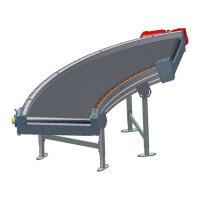
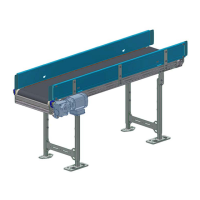
This document provides operating instructions for the TS 1600-140 SP Curve Belt Conveyor, manufactured by TRANSNORM SYSTEM GmbH.
Function Description
The TS 1600-140 SP is a continuous handling system designed for transporting unit loads at an angle on a plane, referred to as a curve belt conveyor. These conveyors are generally used to connect two conveying elements positioned at an angle to each other. The design emphasizes high quality and reliability, with a focus on simple maintenance and repair operations. Key features include new, patented belt guidance and adjustment systems.
The operating principle of the TS 1600-140 SP curve belt conveyor is based on a tapered belt which is brought onto one level and driven by means of conical pulleys with a wrap angle of approximately 180°. Due to the geometry of this arrangement, forces occur which drag the belt in the direction of the centre point of the curve. The main components of the curve belt conveyor include a basic frame, which consists of a sheet steel structure, a non-driven tail pulley, and a drive station with a drive assembly. The drive assembly is designed as a shaft-mounted solution so that it can be positioned both on the inner or outer radius. Sheet metal side guides with a belt edge holder form the main component of this curve conveyor.
Important Technical Specifications
- Conveying speed (VF): Up to 120 m/s (centre line)
- Safe working load (SWL): Max. 50kg/m
- Drive power (PN): 0.37 - 3.0 kW, depending on load and speed. Specific contract specifications or motor type identification plate should be consulted.
Mechanical Data:
- Design versions: Middle radius (RNMI)/Nominal width (BFLI)/Nominal angle (wN)/Conveying height (HF). Refer to performance specifications.
- Middle radius (RNMI): 1500-1700 mm
- Nominal width (BFLI): 860-1060-1260 mm
- Nominal angle (wN): 30, 45, 60, 90°
- Conveying direction (r/f): Right/left (from centre point)
- Conveyor belt (YG): Belt with woven fabric inlay
- Drive type (YD): Worm gear motor, spring gear motor. Refer to performance specifications.
- Drive bearing (ID): Right/left or inside/outside (from central point)
- Bed material (ma): Flat board combination plate
- Drive/tail pulley: Conical
- Basic frame: Welded steel construction with bottom cover
- Distance to up-/downstream machines: Min. 20 mm
Electrical Data:
- Motor voltage supply: Standard: 230 V/400 V AC 50 Hz. For deviations, see motor type identification plate.
- Motor brake voltage: Standard: 230 V AC / 400 V AC. See motor type identification plate for variations.
- Protection class: Standard: IP 55, not explosion-protected.
Installation Location Requirements:
- Ambient temperature: +5 to +40 °C, max. 1h up to +50 °C
- Relative humidity: Max. 80 %
- Ambient atmosphere: Normal atmosphere, no potentially explosive atmosphere, not containing oil or gas, no corrosive components.
- Erection: Internally: Well protected from rain; only securely bolted to a solid base.
Other Data:
- Year of construction: See type identification plate.
- Noise emission: Sound pressure level measured at less than 77 dB(A) in accordance with DIN EN 13023:2003-03.
Usage Features
The conveyor is designed as an incomplete machine, manufactured in keeping with current scientific and technological developments. It is intended for transporting unit loads, corresponding to requirements defined in the service specifications, and is integrated into a fully automatic intralogistic system with a master controller. Any use other than that intended, improper operation, non-permitted operating conditions, failure to follow instructions, or failure to comply with general safety regulations during transport and installation are considered risks.
The machine should only be used in a protected industrial environment with restricted access. The manufacturer accepts no liability for damage arising from improper use of the machine.
Commissioning:
Commissioning for the first time and after repairs generally involves carrying out the following steps:
- Daily commissioning using the control system for the entire conveyor system as described in the system/control documentation.
- The machine is designed for the following electrical connection data: 3 phases, neutral conductor and earthing conductor; alternating voltage 400 V; mains frequency 50 Hz.
- Preconditions for commissioning/commissioning after repair: The machine is correctly installed/repaired, electrically connected, taken out of operation, secured to prevent it from being switched on inadvertently, and the working area is clear of installation aids/foreign objects and accessible for authorised personnel.
- Check installation: Check the position of all drive, tail pulleys, rollers, tensioning/return rollers as necessary.
- Check the direction of rotation: Ensure the drive elements have been correctly installed, aligned, and tensioned.
- Carrying out a test run: Switch on the machine, check the machine on flat ground, localise the cause of noise if any, check the tension and alignment of the conveyor belt, and ensure the conveyor belt is running correctly.
- Normal application: Daily switching on and off and operation by the operating personnel. The machine uses the control system for overall plant in normal application as described in the system/control documentation. After a machine downtime of more than 4 weeks, all points of the maintenance schedule must be carried out.
- Shutdown: Turn off the main switch for the power supply according to the control unit documentation and secure the machine against restarting.
Maintenance Features
The document outlines various maintenance and care procedures to ensure the longevity and safe operation of the conveyor.
Maintenance Works:
- Electrical equipment: Check regularly, refasten loose connections and joints, immediately replace damaged lines and cables, and always keep the control cabinet closed.
- Routine maintenance: Adhere to intervals given in the maintenance schedule. Maintenance includes regular cleaning in accordance with specific operating conditions.
- Motor maintenance: Refer to the motor manufacturer's specifications for detailed information.
- Gear unit maintenance: Refer to the manufacturer's specifications for detailed information.
Maintenance Schedule (e.g., damaged load):
- Immediate (Complete machine): Visual inspection for conveyor belt residues, foreign particles/foreign objects on the conveyor belt or in the pulley/roller area.
- Weekly (Complete machine): Visual inspection for shift change-over, foreign particles/foreign objects, and residues.
- Weekly (Protective devices): Visual inspection for equipment completeness and operating instructions, and for undamaged/functional equipment.
- Weekly (Conveyor belt): Visual inspection for dirt, surface damage, bulging, and correct belt tension and adjustment.
- Depending on individual case (Gear motor): Check oil marks under the gearbox, oil level, attachment and adjustment, and abnormal running noises. Check bearings, cable feed and temperature, running noises, and cooling fins and air intakes.
- Monthly (Drive pulley): Visual inspection for dirt, surface damage, and replacement if necessary.
- Monthly (Flange bearings and pedestal bearings): Inspect for abnormal running noise, replace bearings if necessary, compare bearing temperatures.
- Monthly (Bearings of belt edge holders): Inspect for abnormal running noise, replace if necessary, check for excessive lubrication, and replace belt edge holders if necessary.
- Semi-annual (Fasteners): Check screws subject to dynamic load for firm seating.
- Quarterly (Example - bottom conveyor/track covers, drive stations): Inspect for any soiling, remove and clean covers.
- Quarterly (Supports with rubber-metal buffers): Visual inspection for damaged, loose, or replaced rubber-metal buffers, and tighten screws if necessary.
Lubricating Intervals and Lubricants:
- Gear oil: Refer to motor manufacturer's operating instructions (enclosed).
- Lubricating grease: ARAL HLP 2, BP Energrease LS-EP 2, ESSO Beacon EP 2, KLÜBER Staburags NBU 12, KLÜBER Centoplex EP 2, MOBIL Mobilux EP 2, SHELL Alvania R2.
- Chain oil: OKS 240, OKS 341, BECHEM Berumoly P 73, BECHEM Berumoly P 80.
Cleaning and Care:
- Danger of injury due to particles forced out by compressed air: Blindness and injuries to the skin are possible. Wear personal protective equipment and protection goggles.
- Increased risk of accident due to exposed machine parts: Do not reach into machine when in operation, do not access the machine, switch off machine during cleaning work, and secure the machine so that it cannot be switched on inadvertently.
- Cleaning procedure: Clean the machine regularly and appropriately for the degree of soiling. It may only be cleaned dry (brush, cloth, compressed air, etc.). Ensure the machine and especially the electrical components are protected from wetness.
Corrective Maintenance:
- Spare part purchasing: Only genuine TRANSNORM SYSTEM GmbH spare parts may be used. DIN parts may be ordered from specialised trade.
- Tools, equipment and supplies: A list of necessary tools and auxiliary equipment is provided, including pneumatic screwdriver, torque wrench, circlip pliers, combination spanner, hexagon socket wrench, and assembly paste.
- Tightening torques: Tables are provided for tightening torques for screw connections on steel parts, aluminium parts, and for bush numbers.
- Guards: Fixed guards are defined by machinery directive 2006/42/EC. TRANSNORM provides captive fasteners for protective devices.
- Assembling/disassembling the bottom conveyor track cover: Undo screws, push cover, and reassemble.
- Demounting/installing the side guide: Undo screws, loosen off joining elements, remove side guide, and reassemble.
- Replacing gear motor: Remove electrical supply connections, remove cap, remove joining elements, place gear motor on a suitable support surface, apply assembly paste, and reassemble.
- Loosening/tensioning and adjusting the conveyor belt: Loosen counter-nut, undo screws, loosen belt with tensioning bolt, tighten and adjust belt, switch on machine, check belt, switch off machine, repeat steps, and tighten lock nuts.
- Demounting/fitting the bed: Open upper belt edge holder, lift conveyor belt, remove joining elements, remove beading, and reassemble.
- Replacing bearings: Remove feather key, grub screws, joining elements, and bearing, and reassemble.
- Replacing the conveyor belt: Loosen off joining elements, remove cover, remove joining elements, open upper and lower belt edge holder, lift drive- and tail pulley, remove conveyor belt, and insert new conveyor belt.
- Replacing drive pulley: Loosen off joining elements, remove cover, raise drive pulley, pull out belt loop, and reassemble.
- Replacing tail pulley: Loosen off joining elements, remove cover, raise drive pulley, pull out belt loop, and reassemble.
- Replacing the base parts of the belt edge holder: Demount base parts, install base parts, fit side guide, and tighten/adjust the conveyor belt.
Fault Clearance:
A table is provided listing common mechanical malfunctions, possible causes, and remedial actions, such as replacing motors, pulleys, or bearings, and adjusting belt tension.
Decommissioning and Waste Disposal:
- Machine disposal: Comply with local regulations on waste disposal. The machine must be dismantled for disposal, and individual components can be supplied for recycling.
- Disposing of packaging materials: Individual components of packaging are correspondingly marked and mainly consist of wood, cardboard, PP and PE film, and polystyrene. Separate different materials and dispose of them accordingly using local waste management service.

 Need help?
 General

 To Next Page