This document is an owner's manual for the Traulsen TB Series Glycol Pizza/Salad/Sandwich Prep Tables. It provides comprehensive information on the installation, operation, maintenance, and troubleshooting of these refrigerated prep tables.
Function Description:
The Traulsen TB Series Glycol Pizza/Salad/Sandwich Prep Tables are designed to maintain proper food temperatures for ingredients used in pizza, salad, and sandwich preparation. These units feature a glycol refrigeration system, which helps ensure consistent cooling and eliminates the need for periodic shutdowns for defrost cycles, allowing food to remain consistently cooled 100% of the time, day or night. The unit includes a pan chiller section for exposed insert pans and a lower storage cabinet for refrigerated product. The glycol system is an upgraded refrigeration system that simplifies operation by removing the burden of removing food pans prior to defrost periods or for overnight storage.
Usage Features:
The prep tables are designed for ease of use and optimal food preservation.
- Temperature Control: The unit comes with factory pre-set temperature settings for both the cabinet and the rail. Users can adjust these setpoints within a +/- 3°F range using the control display. The display alternately shows the cabinet and rail temperatures, prefixed with 'C' and 'r' respectively.
- Control Display: The control display features an unlock symbol, a three-digit LED display, and icons indicating compressor status, fan status, defrost status, and alarms. Five capacitive touch buttons allow access to controller settings. The keypad is normally locked to prevent accidental changes but can be unlocked by pressing the Unlock key twice within a second.
- Pan Chiller Operation: To ensure proper food temperatures in exposed insert pans, it is recommended that all food brought to the line be at 41°F (5°C) or below. The unit should be protected from direct air blowing from other kitchen equipment, and room ambient temperatures around the pan chiller should be 86°F (30°C) or less. Shelving mounted over insert pans with heated equipment above it must be insulated, and there should be no direct line of sight from radiant heat sources to the insert pans. Occasional stirring of certain foods may be necessary to maintain consistent temperatures.
- Lower Storage Cabinet: The lower storage cabinet is designed to maintain temperatures between 33°F (0.55°C) and 40°F (4°C). It is intended for storing refrigerated products. Frequent opening of doors or drawers will increase the cabinet temperature, requiring time to recover.
- Food Product Management: For overnight storage, it is recommended to leave food product in the unit. The upgraded glycol refrigeration system allows food to remain in the unit without periodic shutdowns for defrost. Plastic wrap should be placed over exposed food, and the night cover must be closed to prevent condensation. If the unit is not to be used for an extended period, the electrical power supply should be disconnected, and doors/drawers opened to allow the cabinet to warm to room temperature before wiping out the pan chiller cavity and base interior. If all food is removed, the ON/OFF switch can be used to shut down the entire unit.
- Installation: Prep table models can be installed with no clearance at the back and sides. Units are supplied with a cord and plug for easy connection to a dedicated outlet. Some components are packed inside the lower storage cabinet for protection during shipment and should be removed. Shelves, if equipped, are secured with plastic ties that need to be cut. The cutting board is placed on the rail, aligning holes with pins on the countertop. The evaporating catch pan slides over support brackets below the prep table drain outlets.
- Glycol Level Check: The glycol level in the plastic expansion tank should be checked. A non-toxic food-grade 35% Propylene Glycol level may vary and might not be visible in the overflow tank upon arrival, influenced by environmental and unit temperatures. If the unit is powered down, the glycol level may rise above the "Maximum Fill Line," which is normal. The glycol ball valve should be in the open position.
Maintenance Features:
Regular maintenance is crucial for the longevity and optimal performance of the Traulsen prep tables.
- General Cleaning: Before cleaning any parts, disconnect the electrical power supply. All Traulsen glycol equipment should be cleaned with warm water, mild soap, and a soft cloth, wiping in the direction of the metal grain. Strong detergents, gritty, abrasive cleaners, or cleansers containing chlorine should be avoided as they can mar, scratch, or corrode the metal surface. Care should be taken to avoid splashing the unit with water or chlorinated cleansers when mopping the floor. For stubborn odor spills, a mixture of baking soda and water (1 TBSP baking soda to 1 pint water) can be used.
- Condenser Coil Cleaning: The condenser coil is located in the system area behind the front louver door. Open the louver door to access the coil and clean it with a vacuum cleaner or soft brush; do not use a wire brush. After cleaning, close the louver door and reconnect the electrical supply.
- Evaporator Coil Cleaning: The evaporator coils are located in the storage cabinet behind the coil can cover. Remove the four screws with a Phillips head screwdriver, take off the cover, and clean the coils with a vacuum cleaner or soft brush. Replace the cover and reconnect the electrical supply.
- Air Filter: The air filter is located in the interior of the louver door and does not require tools for removal.
- Pan Chiller Cleaning: The pan chiller should be cleaned with water, a mild detergent, and a soft cloth or sponge. The drain, located in the pan chiller for condensate run-off, must be cleared/cleaned regularly, at a minimum of once a month, to prevent clogging. A removable screen is provided to prevent debris from entering the drain.
- Lower Storage Cabinet Cleaning: Clean the lower storage cabinet and doors with warm, soapy water. Avoid cleaners with grit, abrasive materials, bleach, or harsh chemicals. Rinse thoroughly and dry with a clean soft cloth, always rubbing in the direction of the stainless steel grain.
- Shelf Adjustment and Cleaning: Wire shelves are adjustable and can be easily removed for cleaning in a sink. When replacing shelf clips, ensure all four clips per shelf are at the same height in the pilaster. The shelf clips have a small projection to hold the shelf in position and prevent it from slipping forward; they must be "snapped" into place by squeezing the clip and inserting it into the slot in the pilaster keyhole.
- Defrost Initiation: The unit is set up to defrost automatically, but manual defrost can be initiated by pressing the Minus Key and the Esc Key simultaneously and holding for 5 seconds. The Defrost Symbol will illuminate on the LED temperature display, indicating a defrost cycle is in process.
- Troubleshooting: The manual provides a troubleshooting section and advises checking basic items like the electrical cord, fuse/circuit breaker, condenser coil cleanliness, and power switch before calling for service. For service or parts, contact Traulsen's facility, providing the model and serial number.
- Warranty Registration: New Traulsen units can be registered by contacting the Ft. Worth facility.

 Need help?
 General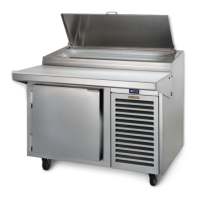

 To Next Page