
 Need help?
Do you have a question about the Traxxas XL-5 and is the answer not in the manual?
Detailed technical specifications for the XL-5 electronic speed control.
Crucial safety warnings and usage guidelines to prevent damage to the ESC.
Guidelines for battery charging, NiMH use, and critical safety for LiPo batteries.
Tips for installing the ESC, including wiring and proper mounting techniques.
Adjusting transmitter settings and programming the ESC for optimal performance.
Configuration and importance of Low-Voltage Detection for LiPo batteries.
How to select between Sport, Race, and Training modes for desired performance.
Instructions for operating the ESC, including throttle and brake control.
Guide to diagnosing and resolving common problems like motor not running or overheating.
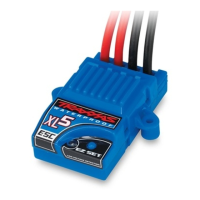
The Traxxas XL-5 electronic speed control (ESC) is a sophisticated device designed to provide smooth, precise, and full-proportional control over your model's speed in both forward and reverse, along with powerful and intuitive full-range braking. It is intended for advanced users and requires adult supervision for installation, setup, and use, especially for children under 14. The XL-5 comes with a Lifetime Electronics Warranty and customer support from Traxxas.
The XL-5 ESC manages the power delivery from the battery to the motor, allowing for variable speed control. It features a single-button setup for easy programming and operation. The ESC includes Low-Voltage Detection (LVD) circuitry, which can be enabled for LiPo batteries or disabled for NiMH batteries. When enabled for LiPo batteries, the LVD monitors the battery voltage and alerts the driver when the battery reaches its minimum safe discharge threshold, first by limiting power output to 50% throttle and then by shutting down motor output if the voltage continues to drop. This prevents over-discharging LiPo batteries, which can cause damage.
The XL-5 offers three selectable drive profiles:
The ESC also incorporates thermal shutdown protection. If the internal operating temperature exceeds safe limits due to excessive current flow, the XL-5 will automatically shut down to prevent damage. Once the temperature returns to a safe level, the ESC will resume normal operation. Additionally, it features Throttle Neutral Protection, which prevents sudden acceleration if the transmitter's throttle trim is incorrectly set or if the trigger is held when the ESC is switched on.
The XL-5 does not use a conventional on/off switch; it is turned on and off by pressing the EZ-Set button. It should be mounted in a location protected from crash damage, dirt, and debris, with easy access to plugs and the EZ-Set button. Care must be taken to ensure no power components (wiring, motor, ESC) contact the radio system, especially the antenna wire, to prevent radio noise. If mounting on a graphite or metal chassis, the receiver should be positioned as far as possible from the chassis to minimize interference. When mounting with double-sided servo tape, surfaces must be thoroughly cleaned with alcohol for maximum adhesion.
For optimal performance, the transmitter must be properly adjusted before programming the XL-5. This involves setting the throttle neutral switch to 50/50, throttle trim to the middle ("0"), and Channel 2 servo reversing switch to the left position. For aftermarket transmitters, users should consult their transmitter's instructions for setting High ATV/EPA to maximum, Low ATV/EPA/ATL to maximum, and throttle trim to neutral. The throttle channel reversing switch should be set and not changed after programming. Trigger throw adjustment should be 50% throttle and 50% brake, and exponential settings should be zero or fully linear.
The ESC must be programmed to learn the neutral, full throttle, and full brake (reverse) points of the transmitter's throttle trigger. This is done by pressing the EZ-Set button in sequence with signals from the flashing LED. Before programming, it is recommended to disconnect one of the motor wires to prevent runaway, especially during the first-time setup. Once programmed, the motor wires can be reconnected.
Users must verify the LVD setting before use. To disable LVD (for NiMH batteries), ensure the LED is solid GREEN, then press and hold the EZ-Set button for ten seconds until the LED blinks three times and shines RED. To activate LVD (for LiPo batteries), ensure the LED is solid RED, then press and hold the EZ-Set button for ten seconds until the LED blinks twice and shines GREEN. It is critical to never use LiPo batteries while LVD is disabled.
After programming, the motor wires should be reconnected, and the vehicle placed on a stable block or stand with the driven wheels off the ground for testing. To operate, press and release the EZ-Set button; the LED will shine RED (or GREEN if LVD is activated). Applying forward throttle will turn off the LED until full throttle power is reached, at which point the LED will shine RED (or GREEN). Moving the trigger forward to apply brakes will turn off the LED until full braking power is reached, then the LED will shine RED (or GREEN). Returning the throttle trigger to neutral will cause the LED to shine RED (or GREEN). Moving the trigger forward again will engage reverse (in Sport Mode), turning off the LED until full reverse power is reached, then the LED will shine RED (or GREEN). To stop, return the throttle trigger to neutral. To turn off the XL-5, press and hold the EZ-Set button for 1.5 seconds until the LED turns off.
The XL-5 is waterproof, allowing use in mud, snow, puddles, and other wet conditions. However, users must ensure other model components are also waterproof or sufficiently water-resistant. Always switch on the transmitter first before the ESC to prevent runaways.
Rechargeable batteries require careful handling for safety and longevity. Users must follow all instructions provided with their battery packs and charger. Key practices include: never leaving batteries to charge unattended, removing batteries from the model while charging, allowing battery packs to cool between runs, unplugging the battery from the ESC when not in use, and avoiding damaged battery packs or connectors. Children should always have adult supervision when charging and handling batteries.
The XL-5 has a motor limit of 15-turns for 540 size motors and 12-turns for 550 size motors with 0 timing. Using more powerful motors (fewer turns) can lead to overheating and frequent thermal shutdown. Motors must have 0° timing for reverse use; modified motors with adjustable end bells timed to 0° or Johnson/Mabuchi (closed end bell) motors are recommended. Using motors with other than 0° timing in reverse can draw excessive current, causing overheating and premature motor wear. Three 0.1µF (50V) ceramic capacitors must be properly installed on every motor to prevent radio interference; capacitors are provided with the XL-5.
Exposed wiring must always be insulated with heat shrink tubing to prevent short circuits. If changing battery or motor connectors, only change one at a time to prevent accidental mis-wiring. The XL-5 is not protected against reverse polarity voltage, and mis-wiring can cause damage. Removing battery connectors or using same-gender connectors will void the product's warranty. External Schottky diodes are not compatible with the XL-5 and will damage the ESC and void the 30-day warranty.
The manual provides a troubleshooting guide for common issues. If the steering channel works but the motor does not, possible causes include a bad motor, thermal shutdown (indicated by a rapidly blinking red LED), incorrect power cable connection to the receiver's throttle channel, or internal damage. If the motor and steering servo do not work, users should check wiring, radio system, crystals, battery, and motor connectors, and battery packs. If the XL-5 does not enter programming mode, ensure it is plugged into Channel 2 of the receiver and is turned off before attempting to program. Issues like the motor running backward, receiver glitches, throttle stutters, slow acceleration, or overheating are addressed with specific checks and solutions, such as verifying motor wiring, checking capacitors, ensuring proper gearing, and confirming LVD settings.
 General
| Type | Electronic Speed Control (ESC) |
|---|---|
| Thermal Protection | Yes |
| Reverse | Yes |
| Connector Type | Traxxas High-Current Connector |
| Burst Current | 100A |
| Cooling | Heatsink |
| Waterproof | Yes |
| Motor Limit | 15-turn brushed |
| BEC Output | 6.0 VDC |



 To Next Page
