
 Need help?
Do you have a question about the Trek CARBON RAIL 9.8 and is the answer not in the manual?
Lists necessary tools for headset and Knock Block maintenance.
Details tools required for derailleur hanger installation and removal.
Lists tools needed for servicing the Active Braking Pivot system.
Specifies tools for rocker pivot and seat stay assembly.
Instructions and parts for the seat tube pivot assembly.
Lists tools required for adjusting the bike's geometry via Mino link.
Details tools for main pivot and chainstay assembly.
Lists tools for shock mount installation and servicing.
Guidelines for applying adhesive frame guards using isopropyl alcohol.
Lists tools for drive unit and battery system maintenance.
Specifications and warnings for seat post installation and fit.
Information on maximum tire clearance and fitment on the frame.
Details on the kickstand mounting bracket and bolts.
Setup guidance and specifications for the front suspension fork.
Setup guidance and specifications for the rear shock absorber.
This document serves as a service manual supplement for the 2022 Carbon Rail 9.8 and 9.9 bicycles, providing detailed instructions and diagrams for various maintenance and assembly procedures. It is designed to assist both service technicians and bike owners in understanding the proper care and setup of these specific models.
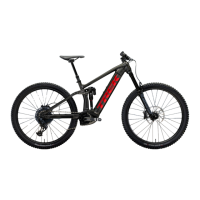
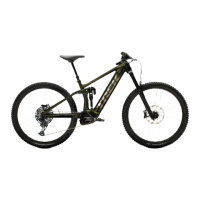
The 2022 Carbon Rail 9.8 and 9.9 are full-suspension electric mountain bikes, featuring a carbon frame designed for aggressive trail riding. The manual covers the assembly, adjustment, and maintenance of key components that contribute to the bike's performance and rider experience. These components include the headset with Knock Block, derailleur hanger, Active Braking Pivot (ABP), main pivot and chainstay, shock mounts, cable routing, frame guards, drive system, and suspension.
The headset with Knock Block system is a crucial feature designed to prevent the handlebars from over-rotating, which could damage the frame or cables. This system incorporates a specialized chip and compression ring to limit steering angle, protecting the bike from impacts during crashes or tight maneuvers. The manual provides instructions for its assembly, emphasizing the correct torque for the chip bolt and the importance of installing the Knock Block replacement chip if the original is removed.
The derailleur hanger is a sacrificial component designed to break away in the event of an impact, protecting the more expensive derailleur and frame from damage. This manual highlights that the frame uses a Universal Derailleur Hanger (UDH) and provides specific instructions for its installation, including torque specifications and warnings against greasing the hanger or bolt. It also specifies the required thru-axle compatibility for the UDH.
The Active Braking Pivot (ABP) is a suspension design feature that aims to keep the suspension active and responsive even under heavy braking. The manual details the assembly of the ABP components, including the thru-axle, non-driveside dropout, bearings, dropout axle, and spacers. Proper bearing installation and thru-axle compatibility are emphasized.
The main pivot and chainstay are fundamental to the bike's rear suspension linkage. The manual provides a step-by-step guide for assembling these components, including the nuts, spacers, bearings, main pivot sleeve, and main pivot axle. It also indicates how to identify and order color-matched chainstay parts.
The shock mounts are the points where the rear shock connects to the frame. The manual distinguishes between standard and thru-shaft shock mounts, providing assembly instructions for both. It lists the necessary tools, including bearing presses and hex wrenches, and specifies torque values for the bolts.
Cable routing is critical for the bike's aesthetic and functional performance, ensuring that cables are protected and do not interfere with moving parts. The manual illustrates the routing paths for various cables, including dropper post, display to remote, derailleur, rear brake, display to drive unit, front light, speed sensor, and battery power. It also highlights the use of zip ties to secure cables and mentions the dropper post cable's routing through a cable tunnel.
Frame guards are protective elements designed to shield the carbon frame from impacts and abrasion. The manual details the installation of seatstay, chainstay, down tube, and drive unit guards, along with the associated screws, bolts, and cage spacers. It also provides instructions for applying adhesive guards, emphasizing the use of isopropyl alcohol for cleaning and warning against cleaning the entire frame with it.
The drive system section focuses on the Bosch e-bike components, including the drive unit, mounting bolts, and battery charge port cover. It provides an exploded view of the RIB (Removable Integrated Battery) system, detailing the alignment plate, screws, locknuts, washers, lower and upper docking brackets, battery connection plug, lower battery mounting plug, upper lock cover, bumpers, ejector assembly, and lock assembly. It directs users to Bosch e-bike service information for technicians and local Trek retailers for owners.
The suspension section provides guidance on setting up the fork and rear shock. It explains the importance of determining sag as the first step and refers users to the suspension setup card or Trek's online suspension calculator for detailed settings. It also includes warnings about exceeding recommended maximum fork length to prevent damage.
The manual implicitly describes several usage features through its maintenance instructions:
The manual is primarily a maintenance guide, offering detailed instructions for various service tasks:
 General
| Rear Shock Size | 230x57.5mm |
|---|---|
| Speeds | 12 |
| Wheel Size | 29" |
| Frame Features | Internal storage, tapered head tube, Knock Block 2.0, Control Freak internal routing, Carbon Armor, ISCG 05, magnesium rocker link, Mino Link, ABP |
| Travel | 150mm |
| Fork Features | 44mm offset |
| Rear Shock Features | 230x57.5mm |
| Wheel Features | Tubeless Ready, 6-bolt, Boost110 front, Boost148 rear |
| Tires | Bontrager SE5 Team Issue |
| Tire Features | Tubeless Ready, Core Strength sidewall, aramid bead |
| Tire Size | 29x2.50" |
| Cassette Range | 10-51 |
| Saddle | Bontrager Arvada |
| Saddle Features | austenite rails |
| Seatpost Features | internal routing |
| Seatpost Travel | 150mm |
| Handlebar | Bontrager Line Pro |
| Handlebar Features | OCLV Carbon, 35mm, 27.5mm rise |
| Stem | Bontrager Line Pro |
| Stem Features | 35mm |
| Frame Material | Carbon |
| Wheels | Bontrager Line Pro 30 |



 To Next Page