Need help?
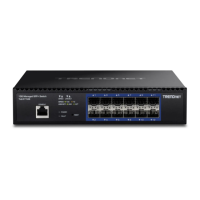
Do you have a question about the TRENDnet TL2-F7120 and is the answer not in the manual?
Lists items included in the switch package.
Describes the key capabilities and benefits of the switch.
Highlights the main functionalities and advantages of the switch.
Explains the status and meaning of the switch's LED indicators.
Provides instructions for installing the switch on a flat surface.
Guides on mounting the switch in a standard equipment rack.
Step-by-step guide for initial setup and connection to the switch.
Instructions on how to log in to the switch's web interface.
Displays current status and general information about the switch.
Allows configuration of system name, description, location, and contact.
Configures the switch's IPv4 address, subnet mask, and gateway.
Configures IPv6 address, prefix length, and other related parameters.
Adds new IPv4 address interfaces assigned to VLANs.
Adds new IPv6 address interfaces assigned to VLANs.
Configures ARP global settings, static entries, and checks ARP statistics.
Displays port statistics for L2 Spanning Tree, GVRP, and other protocols.
Configures RMON events for alarms and defines actions for threshold crossings.
Sets up RMON alarms to generate alert messages based on threshold values.
Configures physical port parameters like speed, duplex, and flow control.
Manages VLAN creation, assignment, and port configuration.
Configures Spanning Tree Protocol (STP) settings to prevent network loops.
Configures MSTP instances, mapping VLANs to specific spanning tree instances.
Configures spanning tree properties on a per-port basis for MST instances.
Configures trunking to aggregate multiple ports for increased bandwidth.
Configures Link Aggregation Control Protocol (LACP) for dynamic port channeling.
Enables/disables IGMP snooping and sets report suppression intervals.
Enables or disables the Fast Leave feature for IGMP snooping.
Configures IGMP snooping status and version for specific VLANs.
Enables or disables loopback detection to prevent network loops.
Configures Link Layer Discovery Protocol (LLDP) for network device information exchange.
Configures Class of Service (CoS) for prioritizing voice traffic quality.
Identifies IP phones by their MAC address OUI for voice VLAN mapping.
Configures voice VLAN state, ID, priority tag, DSCP, and 802.1p remark.
Enables QoS and configures scheduling methods and trust modes.
Sets CoS priority settings and maps them to egress queues.
Maps DSCP values to egress queues for traffic prioritization.
Configures 802.1X authentication methods for network access control.
Controls access to ports by limiting the number of MAC addresses.
Manages MAC, IPv4, and IPv6 Access Control Lists (ACLs).
Instructions for upgrading the switch's firmware to the latest version.
Manages switch configuration backup and restore operations.
Provides tools for network diagnostics like cable tests and ping tests.
Guides on connecting to the switch via its console port using CLI.
Lists the networking standards supported by the switch.
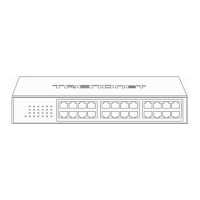
Details the physical ports and indicators on the switch.
Outlines key performance metrics like switching capacity and RAM buffer.
Lists the available management methods and protocols supported.
Addresses issues with accessing the switch's web management interface.
Guides on handling cases where the switch IP address differs from the network subnet.
Provides methods to determine the switch's IP address on different operating systems.
Explains how to set a static IP address on client computers for switch access.
Outlines TRENDnet's warranty terms and conditions for the product.

 To Next Page
 General