ELECTRICAL EQUIPMENT
(cj Maximum Permissible Electrolyte Temperature During Charge
Fig.
I
Topping
up
Battery.
N.B.-Never use a naked light
zcvh
examin-
ing a battery, as the mixture of
oxygen and hydrogen given off by
the battery when on charge, and to a
lesser extent when standing idle, can
be dangerously explosive.
Examine the terminals and, if necessary,
clean them and coat them with petroleum
jelly. Wipe away any foreign matter or
moisture from the top of the battery, and
ensure that the connections and the
kings
are clean and tight.
3.
SERVICING
(a) Battery Persists in Low State
of
Charge
First consider the conditions under
which the battery is used. If the bat-
tery is subjected to long periods of
discharge without suitable opportuni-
ties for re-charging, a low state of
charge can be expected. A fault in the
dynamo or regulator, or neglect of the
battery during a period of low or zero
mileage may also be responsible for the
trouble.
Vent Plugs
See that the ventilating holes in each
vent plug are clear.
Level of Electrolyte
The surface of the electrolyte should be
level with the tops of the separators. If
necessary, top up with distilled water.
Any loss of acid from spilling or
spraying (as opposed to the normal
loss of water by evaporation) should be
made good by dilute acid of the same
specific gravity as that already in the
cell.
Cleanliness
See that the top of the battery is free
from
dirt
or moisture which might
provide a discharge path. Ensure that
the battery connections are clean and
tight.
TAKE READINGS
AT
EYE LEVEL
DO
NOT
DRAW
IN
X)O
MUCH
ELECTROLYTE
Fig.
2
Taking Hydrometer Readings.
Hydrometer Tests
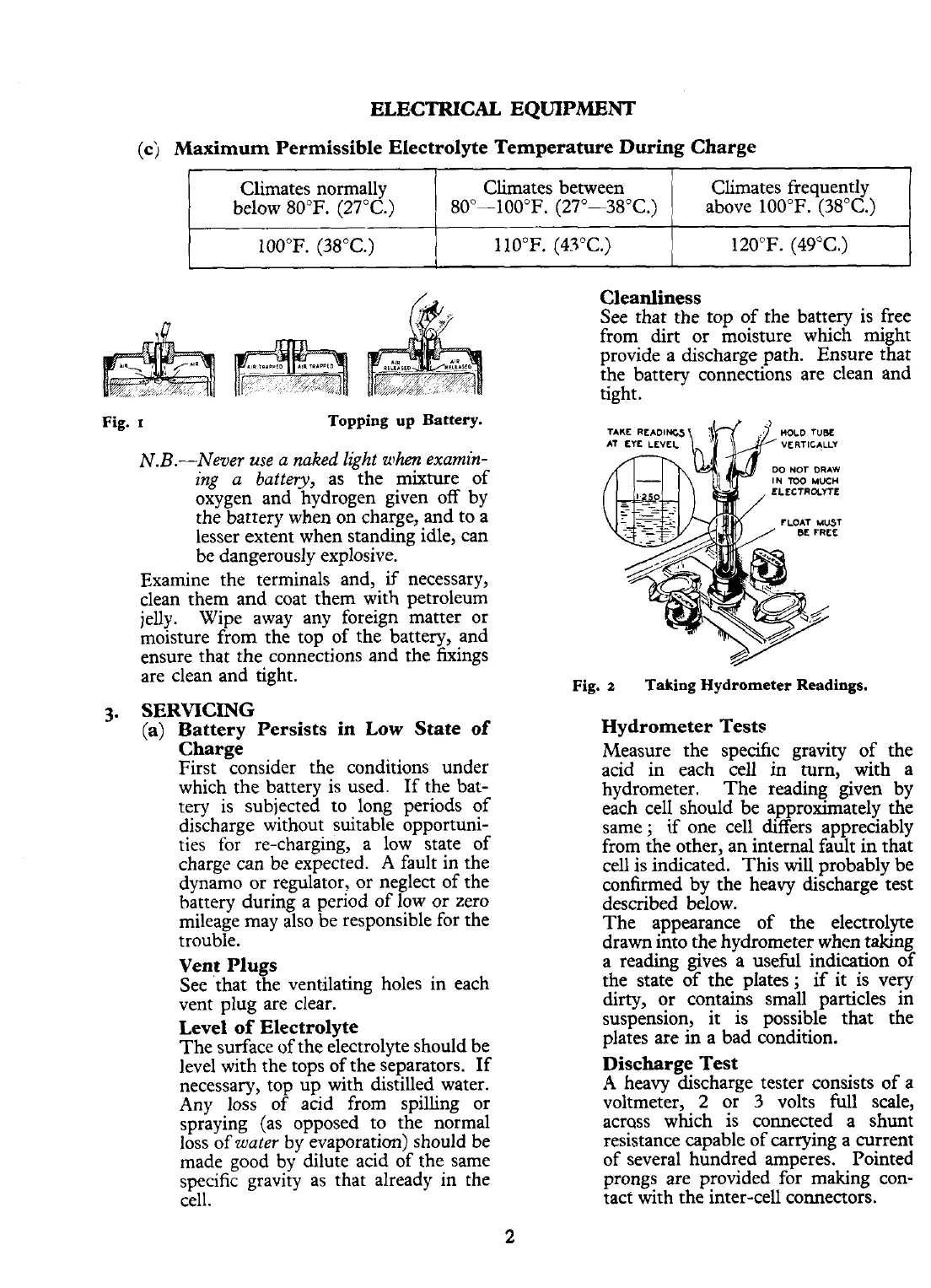
Measure the specific gravity of the
acid in each cell
in
turn, with a
hydrometer. The reading given by
each cell should be approximately the
same
;
if one cell differs appreciably
from the other, an internal fault in that
cell is indicated. This will probably be
confirmed by the heavy discharge test
described below.
The appearance of the electrolyte
drawn into the hydrometer when taking
a reading gives a useful indication of
the state of the plates
;
if it is very
dirty,
or contains small particles in
suspension, it is possible that the
plates are in a bad condition.
Discharge Test
A
heavy discharge tester consists of a
voltmeter,
2
or
3
volts full
scale,
acrqss which is connected a shunt
resistance capable of carrying a current
of several hundred amperes. Pointed
prongs are provided for making con-
tact with the inter-cell connectors.


 To Next Page
 Loading...