ELECTRICAL EQUIPMENT
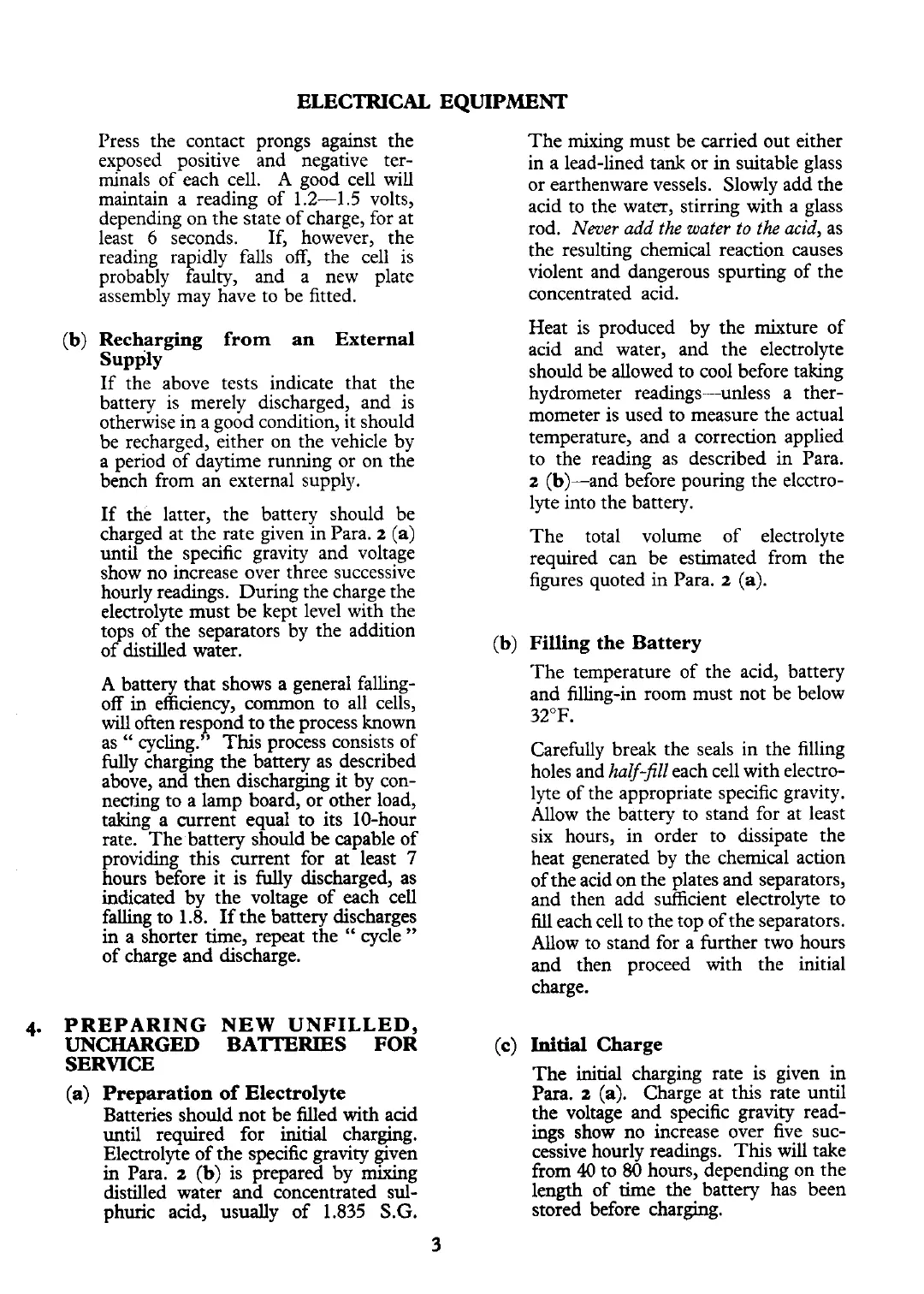
Press the contact prongs against the
exposed positive and negative ter-
minals of each cell.
A
good cell will
maintain a reading of 1.2-1.5 volts,
depending on the state of charge, for at
least
6
seconds. If, however, the
reading rapidly falls off, the cell is
probably faulty, and a new plate
assembly may have to be fitted.
(b) Recharging from an External
supply
If the above tests indicate that the
battery is merely discharged, and is
otherwise in a good condition, it should
be recharged, either on the vehicle by
a period of daytime running or on the
bench from an external supply.
If the latter, the battery should be
charged at the rate given in Para.
2
(a)
until the specific gravity and voltage
show no increase over three successive
hourly readings. During the charge the
electrolyte must be kept level with the
tops of the separators by the addition
of distilled water.
A
battery that shows a general falling-
off in efficiency, common to all cells,
will
often respond to the process known
as
"
cycling." This process consists of
fully charging the battery as described
above, and then discharging it by con-
necting to a lamp board, or other load,
taking a current equal to its 10-hour
rate. The battery should be capable of
providing this current for at least
7
hours before it is fully discharged, as
indicated by the voltage of each cell
falling to 1.8.
If
the battery discharges
in a shorter time, repeat the
"
cycle
"
of charge and discharge.
4.
PREPARING NEW UNFILLED,
UNCHARGED
BATTERIES
FOR
SERVICE
(a) Preparation of Electrolyte
Batteries should not be filled
with
acid
until required for initial charging.
Electrolyte of the specific gravity given
in Para.
2
(b)
is prepared by mixing
distilled water and concentrated sul-
phuric acid, usually of 1.835
S.G.
The mixing must be carried out either
in a lead-lined tank or in suitable glass
or earthenware vessels. Slowly add the
acid to the water, stirring with a glass
rod. Never add the water to
the
acid, as
the resulting chemical reaction causes
violent and dangerous spurting of the
concentrated acid.
Heat is produced by the mixture of
acid
anc! water, and the electrolyte
should be allowed to cool before taking
hydrometer readings-unless a ther-
mometer is used to measure the actual
temperature, and a correction applied
to the reading as described in Para.
2
(b)-and before pouring the elcctro-
lyte into the battery.
The total volume of electrolyte
required can be estimated from the
figures quoted in Para.
2
(a).
(b) Filling the Battery
The temperature of the acid, battery
and filling-in room must not be below
32°F.
Carefully break the seals in the filling
holes and hav-jll each cell with electro-
lyte of the appropriate specific gravity.
Allow the battery to stand for at least
six hours, in order to dissipate the
heat generated by the chemical action
of the acid on the plates and separators,
and then add sufficient electrolyte to
fill each cell to the top of the separators.
Allow to stand for a further two hours
and then proceed with the initial
charge.
(c)
Initial
Charge
The initial charging rate is given in
Para.
2
(a). Charge at this rate until
the voltage and specific gravity read-
ings show no increase over five suc-
cessive hourly readings. This will take
from
40
to
80
hours, depending on the
length of time the battery has been
stored before charging.


 To Next Page
 Loading...