ELECTRICAL
EQUIPMENT
petrol-moistened cloth. Replace the
brush in its original position. Brushes
which are worn must be replaced, see
Para.
4
(d) (i).
(b)
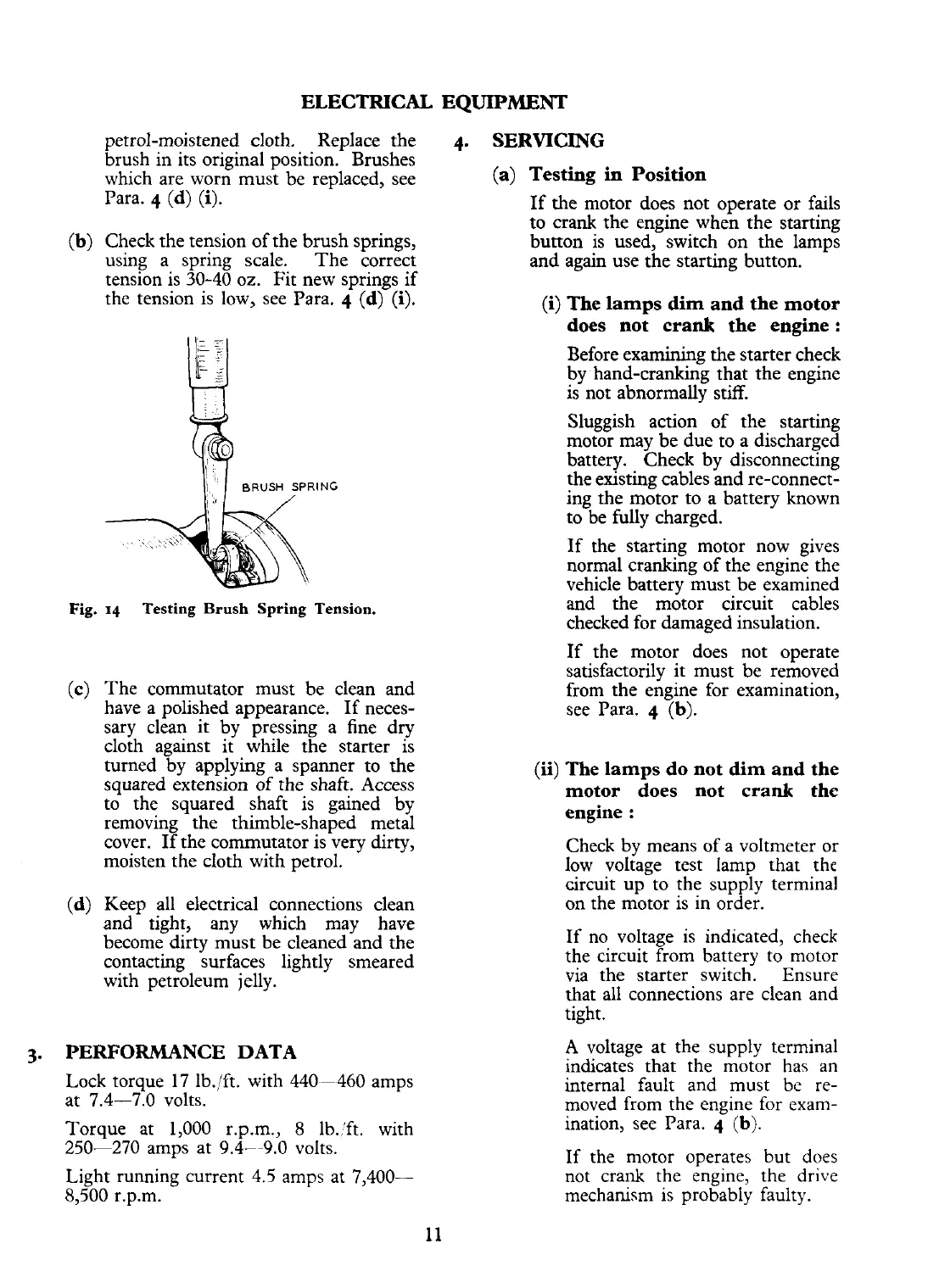
Check the tension of the brush springs,
using a spring scale. The correct
tension is 30-40 oz. Fit new springs if
the tension is low, see Para.
4
(d) (i).
Fig.
14
Testing Brush Spring Tension.
(c)
The commutator must be clean and
have a polished appearance. If neces-
sary clean it by pressing a fine dry
cloth against it while the starter is
turned by applying a spanner to the
squared extension of the shaft. Access
to the squared shaft is gained by
removing the thimble-shaped metal
cover. If the commutator is very dirty,
moisten the cloth with petrol.
(d)
Keep all electrical connections clean
and tight, any which may have
become dirty must be cleaned and the
contacting surfaces lightly smeared
with petroleum jelly.
3.
PERFORMANCE DATA
Lock torque 17 1b.ft. with 440-460 amps
at 7.4-7.0 volts.
Torque at 1,000 r.p.m., 8 lb.'ft. with
250-270 amps at 9.4--9.0 volts.
Light running current 4.5 amps at 7,400-
8,500 r.p.m.
4.
SERVICING
(a) Testing in Position
If the motor does not operate or fails
to crank the engine when the starting
button is used, switch on the lamps
and again use the starting button.
(i)
The lamps dim and the motor
does not crank the engine
:
Before examining the starter check
by hand-cranking that the engine
is not abnormally stiff.
Sluggish action of the starting
motor may be due to a discharged
battery. Check by disconnecting
the existing cables and
re-connect-
ing the motor to a battery known
to be fully charged.
If the starting motor now gives
normal cranking of the engine the
vehicle battery must be examined
and the motor circuit cables
checked for damaged insulation.
If the motor does not operate
satisfactorily it must be removed
from the engine for examination,
see Para.
4
(b).
(ii)
The lamps do not dim and the
motor does not crank the
engine
:
Check by means of a voltmeter or
low voltage test lamp that the
circuit up to the supply terminal
on the motor is in order.
If no voltage is indicated, check
the circuit from battery to motor
via the starter switch. Ensure
that all connections are clean and
tight.
A
voltage at the supply terminal
indicates that the motor has an
internal fault and must be re-
moved from the engine for exam-
ination, see Para.
4
(b).
If the motor operates but does
not crank the engine, the drive
mechanism is probably faulty.


 To Next Page
 Loading...