ENGINE
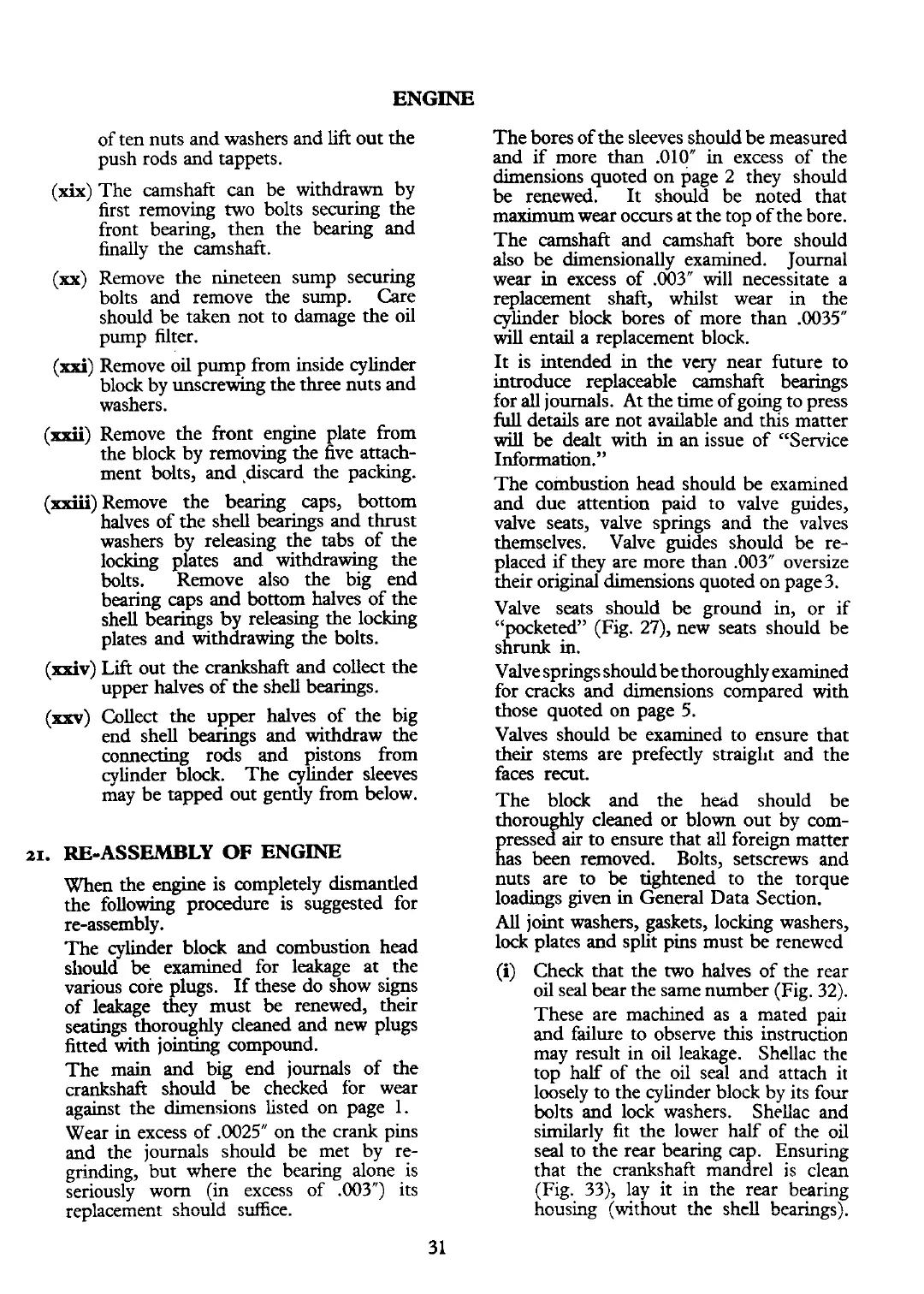
of ten nuts and washers and lift out the
push rods and tappets.
(xix)
The camshaft
can
be withdrawn by
first removing two bolts securing the
front bearing, then the bearing and
finally the camshaft.
(xx)
Remove the nineteen sump securing
bolts and remove the sump. Care
should be taken not to damage the oil
pump filter.
(xxi)
Remove oil pump from inside cylinder
block by unscrewing the three nuts and
washers.
(xxii)
Remove the front engine plate from
the block by removing the five attach-
ment bolts, and ,discard the
packing.
(xxiii)
Remove the bearing caps, bottom
halves of the shell bearings and thrust
washers by releasing the tabs of the
locking plates and withdrawing the
bolts. Remove also the big end
bearing caps and bottom halves of the
shell bearings by releasing the locking
plates and withdrawing the bolts.
(xxiv)
Lift
out the crankshaft and collect the
upper halves of the shell bearings.
(xxv)
Collect the upper halves of the big
end shell bearings and withdraw the
connecting rods and pistons from
cylinder block. The cylinder sleeves
may be tapped out gently from below.
21.
RE-ASSEMBLY
OF
ENGINE
When the engine is completely dismantled
the following procedure is suggested for
re-assembly.
The cylinder block and combustion head
should be examined for leakage at the
various core plugs.
If
these do show signs
of leakage they must be renewed, their
seatings thoroughly cleaned and new plugs
fitted
with
jointing compound.
The main and big end journals of the
crankshaft should be checked for wear
against the dimensions listed on page
1.
wear
in
excess of .0025" on the crank pins
and the journals should be met by re-
grinding, but where the bearing alone is
seriously worn (in excess of .003") its
replacement
shculd S-ace.
The bores of the sleeves should be measured
and
if
more than .0lO1' in excess of the
dimensions quoted on page 2 they should
be renewed. It should be noted that
maximum wear occurs at the top of the bore.
The camshaft and camshaft bore should
also be dimensionally examined. Journal
wear in excess of
.003" will necessitate a
replacement shaft, whilst wear in the
cylinder block bores of more than .0035"
will entail a replacement block.
It is intended in the very near future to
introduce replaceable camshaft
bearings
for
all
journals. At the time of going to press
full
details are not available and this matter
will
be dealt with in an issue of "Service
Information."
The combustion head should
be
examined
and due attention paid to valve guides,
valve seats, valve springs and the valves
themselves. Valve guides should be re-
placed
if
they are more than .003" oversize
their original dimensions quoted on page 3.
Valve seats should be ground in, or if
"pocketed" (Fig. 27), new seats should be
shrunk in.
Valve springs should be thoroughly examined
for cracks and dimensions compared with
those quoted on page 5.
Valves should be examined to ensure that
their stems are
prefectly straigl~t and the
faces recut.
The block and the had should be
thorou hly cleaned or blown out by com-
presse
ti
W
.
to ensure that all foreign matter
has been removed. Bolts, setscrews and
nuts are to be tightened to the torque
loadings given
in
General Data Section.
All
joint washers, gaskets, locking washers,
lock plates and split pins must be renewed
(i)
Check that the two halves of the rear
oil seal bear the same number (Fig. 32).
These are machined as a mated pair
and failure to observe this instruction
may result in oil leakage. Shellac the
top half of the oil seal and attach
it
loosely to the cylinder block by its four
bolts and lock washers. Shellac and
similarly
fit
the lower half of the oil
seal to the rear bearing cap. Ensuring
that the crankshaft mandrel is clean
(Fig.
33),
lay it in the rear bearing
housing (without the shell bearings).


 To Next Page
 Loading...