IMPOR
TANT
Here
are
simple
checks
you
can
make
. If
these checks do not isolate the problem, call
our
Technical Service Department for further
advice. Be sure to wear safety glasses!
1.
Check
AL
L
wires
and
cables.
a. Make sure that all connections are tight.
b. At all connections, check for rust that would
prevent good electrical contact.
c. Make
sure
that the insulation on all wires
and cables is in good shape. Make sure that a
break
in the insulation is not allowing a bare
wire to touch
any
metal surfaces.
d. After completing steps a through c, start the
engine. If it starts, you've corrected the prob-
lem. If it doesn't start, proceed to step 2.
TROUBLESHOOTING
-ELE
CTRIC
START SYSTEM (IF SO EQUIPPED)
Starter
Motor
Doesn't
Turn
Over
If your starter motor won't turn over when you
turn the Ignition Switch key to "STAR
T'
, it could
be due to one or more of the following causes:
1. Loose, broken, or corroded wires or cables.
2. Discharged battery.
3. A solenoid that isn't working.
4. A starter motor that isn't working.
5. An Ignition Switch that is broken.
6. A faulty wiring harness and / or a faulty
Ignition Switch.
b. After running
the
tiller,
shut
it off and try to
restart it by using
the
Ignition Switch. If it starts,
your
problem
was
a
discharged
battery.
If it
doesn't start, proceed to the next step .
3.
Your
solenoid
is bad. Remove the negative
battery cable . You'll be using it as a
jumpe
r wire.
Make a temporary, replacement negative battery
cable by stripping about 3/4" of insulation from
both
ends
of a 12" piece of
hea
vy-gauge
wire
(#10 or larger).
a.
Make
sure
that
both
the
Maneuver
ing
Clutch and the Forward Clutch are in their dis-
engaged position.
b.Touch one end of the removed negative bat-
tery cable to the solenoid terminal identified as
"B" in Sketch 5-30.
c. BRI EFLY
touch
the
other
end
of
the
re-
moved negative battery cable to the solenoid
terminal identified as "C" in Sketch 5-30. If the
starter motor turns over, your solenoid is work-
ing. If the starter motor didn 't turn over, your
solenoid
may
be bad.
First
check
to
make
sure that the screws which attach the solenoid
to the battery bracket are tight.
d. After tightening the solenoid screws, repeat
step
c. If
the
starter
motor
still
doesn
't turn
over
,
please
cal
l
our
Tec hnica l
Se
r
vice
Department for further advice.
e. If there was no spark when you
jumpe
d the
solenoid, it indicates that
your
battery will not
hold a charge. You should remove the battery
from the tiller and take it to a qualified battery
technician for testing.
1. Remove the temporary battery cable and re-
installthe
original negative battery cab le.
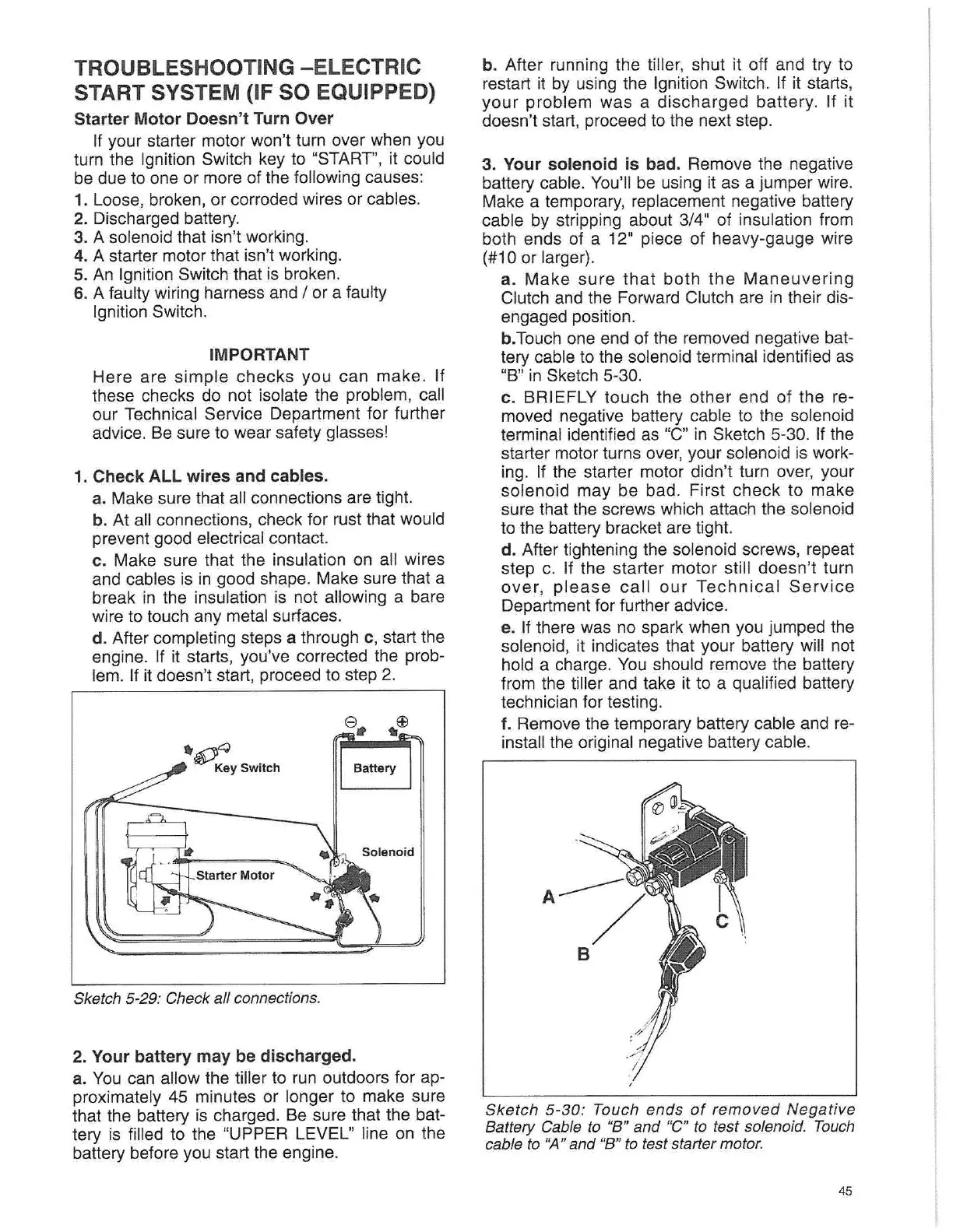
Battery
.
~
Key Switch
Starter Motor
Sketch 5-29: Check all connections.
2.
Your
battery
may be d
ischa
rged.
a. You can allow the tiller to run outdoors for ap-
proximately 45 minutes or longer to make sure
tha
t the battery is charged. Be sure that the bat-
tery is filled to the "UPPER LEVEL" line on the
battery before you start the engine.
Sketch
5-30
: Touch
ends
of
removed
Negative
8attery Cable to "8" and "C" to test solenoid. Touch
cable to
'
~
"
and "8 " to test starter motor.
45



 To Next Page