2
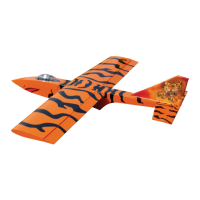
This product was originally designed by MF Models. Development was a joint effort between MF Models and Troy Built
Models USA.
If this is your first turbine powered aircraft and you need basic information, please see the Troy Built Models website and
review the turbine overview webpage. This will provide you with a quick overview to make your turbine flying experience
more enjoyable.
The intent of the ShockJet is to offer an inexpensive plane which will help newcomers to turbines aircraft get accustomed
to the nuances of turbines. The ShockJet is easy to build, fly and land. It is very aerobatic, so it is more fun to some pilots.
Once you are acclimated, you can move the turbine and other ancillary equipment to a higher performance or a scale
aircraft and sell the ShockJet for close to what you paid for it. A larger version of the ShockJet is being considered to ac-
commodate larger turbines for those pilots who have their eye on a larger plane to move the equipment into in the future
rather than the planes that the current turbines will accommodate.
This plane, like all planes, can be broken if the design limits are exceeded. Flying at top speed, at full throttle and pulling
extremely tight turns will put great stress on the airframe, and eventually it will fail. The plane is designed for spirited flying
but not for pylon racing.
Installation of the components is very straightforward. We find it easier to first install the turbine, then the interior compo-
nents, then the landing gear and finally the tail section.
Introduction
Parts Needed
Turbine: We recommend a 10 - 18 lb turbine. The engine rails have the blind nuts pre-installed for the Jet Central Super
Bee. The Jet Cat P-60 fits with minor modifications. For more power a Jet Cat P-70 can be used however a few modi-
fications are necessary because it is ¾” larger in diameter. The advantage of the P-70 is that it provides equal power to
weight when the fuel tank is full.
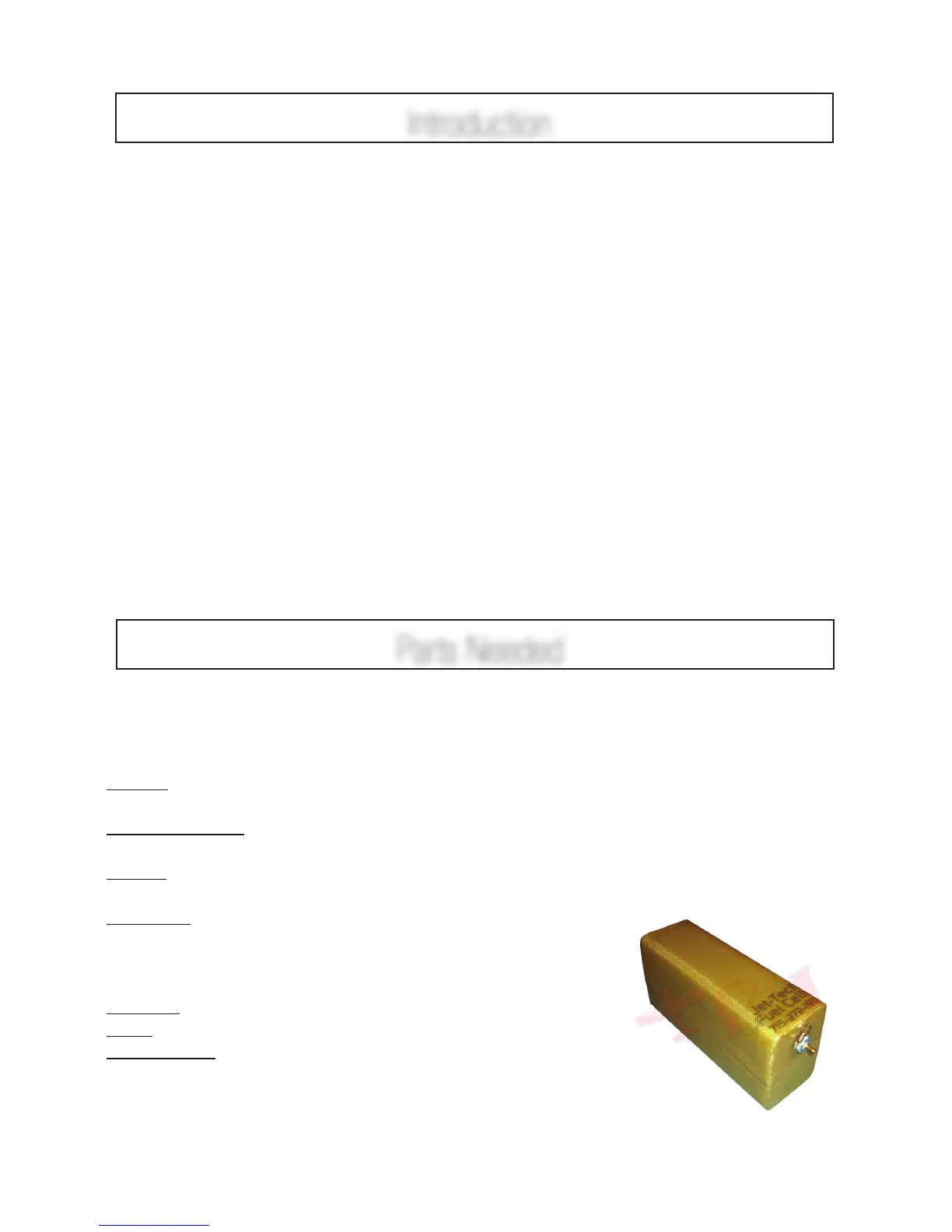
Fuel Tank: The fuselage accommodates a 50 oz Dubro tank which offers 7-9 minutes of flight time with the Super Bee.
You may also purchase a Kevlar Fuel Tank made for the Shockjet from Jet-Tech. (Shown below)
Bubble-less Fuel Tank: Because the plane is very aerobatic, we recommend the TBM BFT to keep bubbles out of the fuel
line. The kit includes a BFT mount and the fuselage has a space to accommodate the TBM BFT.
Fuel Line: A few feet of kerosene compatible fuel line is required for the main fuel tank and overflow.
Festo 6mm tubing clear - 2 meters (6’) From BFT to fuel pump and fill line
Festo Fittings:
Over flow fitting
Festo 6mm cap for kerosene filling
One way valve for propane filling
Safety Wire: for the many fuel and gas connections
Servos: 7 Hitech 645 and 1 Hitec HS 225MG (brake) or equivalent.
Servo Extensions:
6” servo wire, 2 for flaps in wing, rpm sensor, throttle
12” servo wire, 1-elevator servo, 1-flaps in fuse, 1-ailerons in fuse
24” servo wire, 2-ailerons in wing, 1-rudder


 To Next Page
 Loading...