26
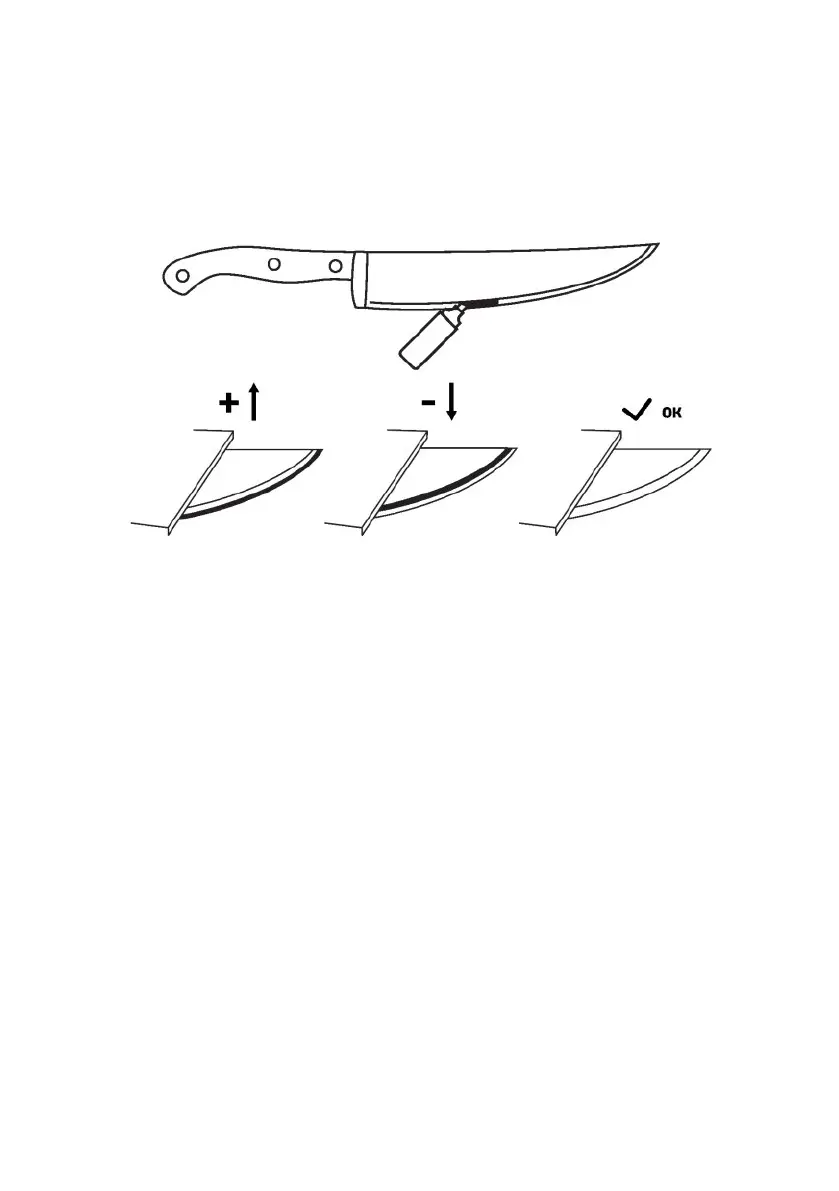
You can also sharpening a knife catching an existing angle. To do this you have to:
◆ use a marker to paint over the knife’s secondary bevel;
◆ place the abrasive in the abrasive holder;
◆ run the abrasive over the painted part;
◆ adjust the angle so that one movement of the abrasive erases the marker completely from the
painted area.
(g. 15)
6.3 Knife sharpening:
The general principle of sharpening is described below, which can be changed depending on the
characteristics of a particular knife:
◆ sharpening is done by moving away from yourself;
◆ even for roughing work, the pressure of the abrasive on the knife should be minimal;
◆ select the grit size of the abrasive, depending on the task;
◆ sharpening on each side is carried out before the burr occurs;
◆ the presence of a burr can be checked with your nger, with a careful movement on yourself;
◆ if a burr appears, move the abrasive holder to the side and place it in the parking;
◆ turn the knife over as described below. During all manipulations, be sure to hold the knife by the
handle;
◆ pull the lever of the rotary mechanism (1) towards you;
◆ by the handle of the knife turn the frame by 180°;
◆ return the lever to its original position;
◆ BE ESPECIALLY CAREFUL WHEN TURNING THE KNIFE OVER!
◆ repeat the sharpening on the back side of the knife;
◆ sharpen step by step with abrasives of the required grit.


 To Next Page