9
DISTILLER MAINTENANCE
WARNING: Always be sure to unplug power cord from wall outlet before
cleaning or servicing Distiller.
Cleaning Boiler
Rinse the boiler before every distillation cycle with warm tap water to
remove any loose residue. Loosen securing nut and remove steam baffle
(fig. D). Half fill boiler with warm tap water, agitate and discard the water.
The water should be drained through boiler spout.
Excessive deposits can cause malfunction. As scale deposits build up, use
an approved cleaner, such as KLEENWISE, to remove this deposit. White
vinegar or automatic coffee pot cleaner can also be used. DO NOT operate
Distiller with cleaning solution in boiler. Use a soft plastic or nylon scour-
ing pad if needed. DO NOT use abrasive cleaners, caustic acids, steel wool
pads or metal utensils. Wipe outside of boiler tank with a soft cloth or
sponge and mild soapy water.
IMPORTANT: Wipe off all water deposits inside the Distiller chassis and
on the outside of the boiler before each distillation cycle.
Cleaning Collector/Dispenser Bottle
See page 5 for cleaning and sanitizing instructions.
Replacing Carbon Filter Cup
See page 5 for preparation and installation instructions.
Distiller Chassis Maintenance
Outside surfaces may be cleaned with common, non-abrasive household
glass or appliance cleaners or warm soapy water applied to a soft cloth or
sponge. The Distiller’s cooling vents (fig. G) should be vacuumed occasion-
ally or cleaned with a soft brush to remove dust and debris.
IMPORTANT: There
are NO user serviceable
parts inside Distiller.
Contact qualified service
personnel for repair if
troubleshooting tips fail
(page 10).
Cooling
Vents
Figure G
Distiller Chassis
HOW IT WORKS
This Distiller produces purified water by using the oldest, most effective
method of water treatment—steam distillation. When the Distiller is
operating, the water temperature rises to 212°F (100°C), killing bacteria,
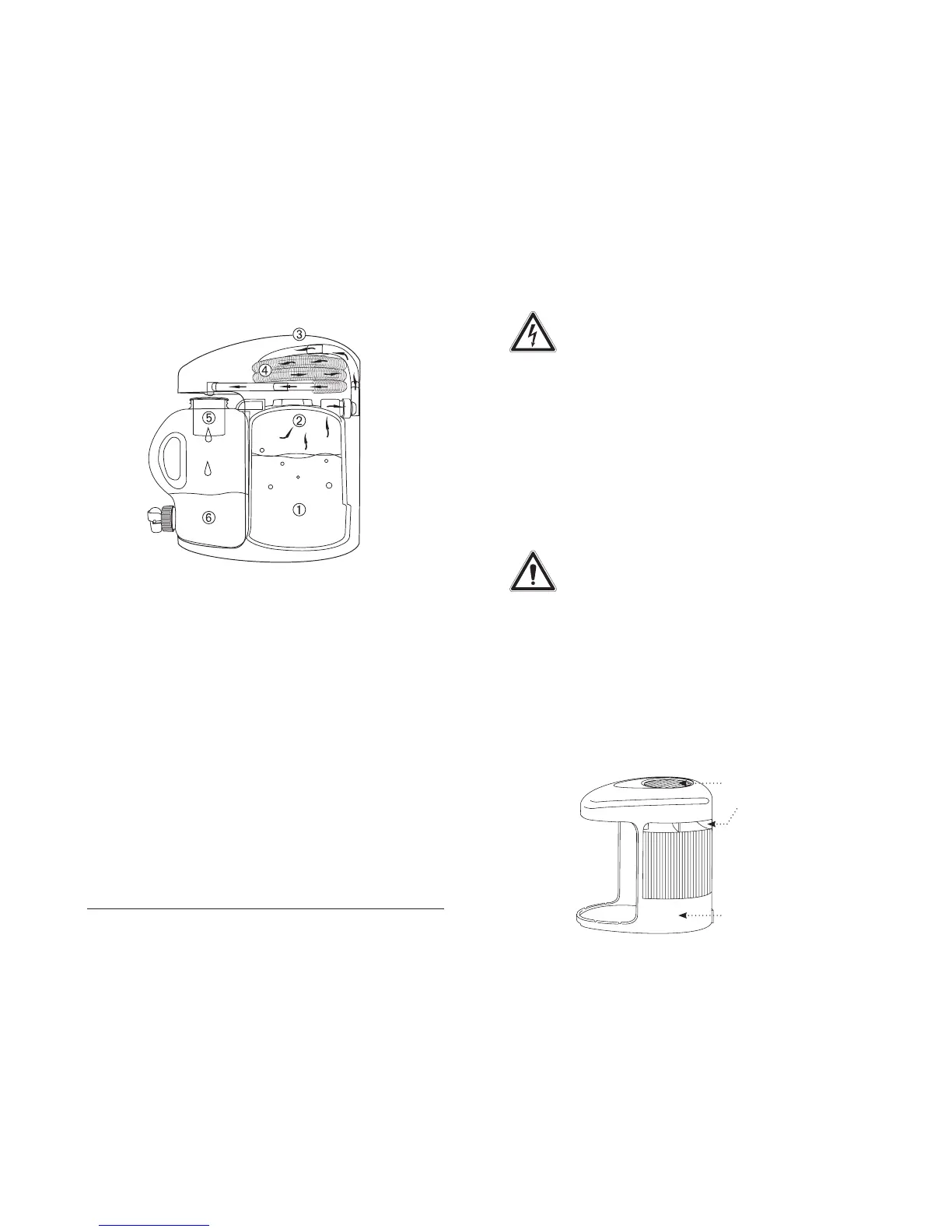
cysts, and viruses that may be present. As the boiling water (1) converts to
steam (2), it rises and leaves behind dead microbes, dissolved solids, salts,
heavy metals, and other substances. Low boiling light gases that may be
present are discharged through the gaseous vent (3). Steam is then cooled
in the stainless steel condenser (4), turning it into high quality water.
Distilled water percolates through a final polishing coconut shell carbon
filter (5) to enhance quality by adsorption of VOCs (volatile organic
compounds), and is then collected in the GE Lexan® polycarbonate
collector/dispenser bottle (6).
Lexan
®
is a Registered Trademark of General Electric Company
This system was tested and certified by the Water Quality Association
against WQA S-400 for the reduction of TDS (Total Dissolved Solids).
It has the product water production rate of 1 gallon per 4.5 hours and has
the product water storage capacity of 1 gallon.
Model 9000
Production rate: 5.5 gallons per day
Model Volts Hertz Watts
North America 9033 120 VAC 60 Hz 750W
4
Figure A


 To Next Page
 Loading...