Need help?
Do you have a question about the TUYA ZS3L and is the answer not in the manual?
Details the embedded low-power 32-bit Arm Cortex-M33 processor, peripherals, and Zigbee features of the ZS3L module.
Lists various applications for the ZS3L Zigbee module, including smart building, home appliances, and industrial control.
Provides the physical dimensions and footprint of the ZS3L module, detailing its size and pin spacing for PCB mounting.
Details the function and I/O type for each interface pin of the ZS3L module, crucial for hardware integration.
Specifies the function of test-related pins on the ZS3L module, including programming and reset pins.
Defines the absolute maximum and minimum electrical ratings for the ZS3L module, including voltage and temperature limits.
Specifies the normal operating conditions for the ZS3L module, detailing voltage, temperature, and input/output characteristics.
Details the current consumption of the ZS3L module during different transmission and receiving modes and power levels.
Presents the typical working current values for various modes of the ZS3L module, including EZ, connected, and deep sleep modes.
Lists fundamental RF specifications such as frequency range, Zigbee standard, data transmission rate, and antenna type for the ZS3L.
Details the transmit (TX) performance metrics of the ZS3L module, including output power and frequency error.
Specifies the receive (RX) performance of the ZS3L module, focusing on sensitivity and packet error rate (PER).
Identifies the type of antenna used with the ZS3L module, specifying it as an onboard PCB antenna.
Offers recommendations for minimizing interference and ensuring optimal performance for the onboard PCB antenna.
Details the mechanical dimensions of the ZS3L module's PCB, essential for hardware integration and PCB design.
Provides recommended PCB layout guidelines and pin connection diagrams for the ZS3L module.
Outlines the procedures for SMT placement, baking, and handling of the ZS3L module during production.
Presents the recommended reflow oven temperature profile for soldering the ZS3L module onto a PCB.
Specifies the required storage conditions for the ZS3L module, emphasizing moisture sensitivity and shelf life.
Provides the FCC compliance statement, cautions, and conditions for the ZS3L module, ensuring it meets regulatory standards.
Defines the FCC radiation exposure limits for the ZS3L module and specifies minimum installation distances.
Highlights critical operational notes for the ZS3L radio module, including co-location restrictions and country-specific frequency availability.
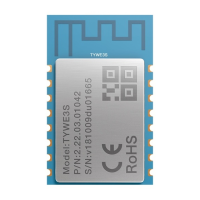
The Tuya ZS3L Zigbee Module is a low-power embedded Zigbee module designed for a wide range of intelligent applications. This module integrates a highly efficient RF processor chip and various peripheral components, offering a robust solution for developing embedded Zigbee products. It comes with an embedded 802.15.4 PHY/MAC Zigbee network protocol stack and a comprehensive set of library functions, making it a versatile component for smart device development.
The ZS3L module operates on a FreeRTOS platform, providing a flexible and efficient environment for developing Zigbee-enabled devices. At its core, it features a 32-bit low-power Arm Cortex-M33 processor, which is capable of executing digital signal processor (DSP) instructions and includes floating-point units (FPUs). This powerful processor can also serve as the main application processor, allowing for complex computations and advanced functionalities within the module itself. The module is equipped with substantial memory resources, including 768 KB of flash memory and 64 KB of random-access memory (RAM), which are crucial for storing firmware, application code, and operational data. Its extensive peripherals further enhance its adaptability, enabling interaction with various external components and sensors.
The primary function of the ZS3L module is to facilitate Zigbee communication, adhering to the IEEE 802.15.4 standard. It supports communication across channels 11 to 26 within the 2.400 GHz to 2.483 GHz frequency range, with an air interface rate of 250 kbit/s. This ensures reliable and efficient data exchange in a Zigbee network. The module is designed for low power consumption, making it suitable for battery-powered devices and applications where energy efficiency is critical. Its ability to operate in various power modes, including deep sleep, helps extend battery life significantly.
The module also supports proactive device pairing for terminals, simplifying the process of integrating new devices into a Zigbee network. This feature streamlines setup and enhances user experience by automating parts of the connection process. The inclusion of hardware encryption capabilities, specifically AES-128 or AES-256, ensures secure communication, protecting data integrity and privacy within the network. This is particularly important for applications handling sensitive information or requiring robust security measures.
The ZS3L Zigbee Module is designed for ease of integration into various host systems. It can be mounted onto a PCB using standard SMT placement machines, or through-hole mounted via a pin header, offering flexibility in manufacturing processes. The module's compact dimensions and onboard PCB antenna simplify the design of end products, reducing the need for external antenna components and saving valuable PCB space. The onboard PCB antenna is a key feature, providing a self-contained RF solution that minimizes external design complexities.
The module's robust set of peripherals, including nine general-purpose input/output (GPIO) pins, one universal asynchronous receiver/transmitter (UART), and one analog-to-digital converter (ADC), allows for flexible interfacing with a wide array of sensors, actuators, and other components. The GPIOs can be configured for various functions, enabling custom control and monitoring capabilities. The UART provides a standard serial communication interface, essential for debugging, configuration, and data exchange with a host microcontroller. The ADC allows for the measurement of analog signals, making the module suitable for applications requiring sensor data acquisition.
The ZS3L module is particularly well-suited for a diverse range of intelligent applications. In intelligent building scenarios, it can be used for controlling lighting, HVAC systems, and security devices, enabling automated and energy-efficient building management. For smart household and home appliances, the module facilitates connectivity and remote control of devices such as refrigerators, washing machines, and air conditioners, enhancing convenience and smart living. Its application in smart sockets and lights allows for remote switching, dimming, and scheduling, contributing to energy savings and personalized environments.
In industrial wireless control, the module provides a reliable communication backbone for monitoring and controlling machinery, sensors, and other industrial equipment, improving operational efficiency and safety. For baby monitors and network cameras, the ZS3L module can enable secure and low-power wireless connectivity, allowing for remote surveillance and alerts. Its potential use in intelligent bus systems suggests applications in smart transportation, such as vehicle tracking, passenger information systems, or fleet management. The module's wide working temperature range ensures its reliability in various environmental conditions, from typical indoor settings to more demanding outdoor or industrial environments.
The ZS3L module is designed with considerations for manufacturing and long-term reliability. For optimal SMT placement, specific guidelines are provided regarding the handling and baking of the module, especially after unpacking. This includes recommendations for vacuum packing if not used immediately and baking procedures based on humidity indicator card (HIC) status. These measures are crucial for preventing moisture-related defects during reflow soldering and ensuring the quality of solder joints. The use of electroless nickel immersion gold (ENIG) for the PCBs necessitates careful handling to prevent oxidation of solder pads, which could lead to dry joints or solder skips if exposed to air for extended periods. Adherence to these production instructions helps maintain the module's integrity and performance.
The module's design, with a focus on low power consumption and robust RF performance, inherently contributes to its low maintenance profile in deployed systems. The embedded firmware and protocol stack are designed for stability and reliability, minimizing the need for frequent updates or troubleshooting. The hardware encryption capabilities not only secure data but also contribute to the overall resilience of the system against unauthorized access or tampering, reducing potential security-related maintenance tasks.
For quality control during manufacturing, the manual recommends drawing a percentage of products for visual inspection and automated optical inspection (AOI) before and during SMT placement. This proactive approach helps in determining proper oven temperatures and component placement methods, thereby reducing reflow defect rates. Such practices ensure that the modules are correctly integrated into the end product, leading to higher product quality and fewer field failures, which in turn reduces maintenance efforts and costs over the product's lifecycle. The clear guidelines for storage conditions, including temperature and humidity control for dry-packaged products, further support the long-term viability and performance of the module before it is integrated into a final product.
 General
| Brand | Tuya |
|---|---|
| Model | ZS3L |
| Category | Control Unit |
| Wireless Protocol | Zigbee |
| Power Supply | DC 5V |
| Operating Temperature | -10°C to 40°C |

 To Next Page