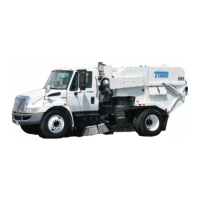
2008 13 500XOPTRS
BLOWER ASSEMBLY
A large turbine type blower is used in the TYMCO Model 500X to generate both the vacuum and
pressure air stream with which to sweep. The blower assembly is found on the left side of the
sweeper in the blower housing. Refer to the 500X Quick Reference Chart for blower housing lo
-
cation. The blower is driven hydraulically.
WARNING: NEVER REMOVE THE PRESSURE TRANSITION AND PLACE
HANDS INTO THE BLOWER HOUSING WHEN THE BLOWER
WHEEL IS TURNING!
Blower Operation
The blower wheel does not begin to rotate when the auxiliary engine is turned ON. The blower
rpm switch must be engaged manually before the blower wheel will start to turn. There are sev
-
eral safety interlocks that will prevent the blower from being turned on as well.
Operation
1. Start the auxiliary engine.
NOTE: The auxiliary engine will idle at 1100 rpm when started.
2. Lower the pick-up head and pull the sweeper forward to seal it to the ground.
3. Engage the Blower RPM switch in the UP position until desired blower rpm is
reached.
NOTE: The engine will automatically increase engine speed from idle to 1800 rpm
when the blower begins to be engaged.
4. The blower rpm can be varied from zero to a maximum of approximately 2750 rpm.
5. To turn off the blower, engage the Blower RPM switch in the DOWN position until
auxiliary engine speed decreases to idle (1100 rpm).
Safety Interlocks
1. The blower will not turn on if the stabilizers are down, the hopper is lifted up, the hop-
per is tilted, or the dump door is open. Also, the blower will not turn on if the Water
Wash Mode is engaged. Refer to the Water System.
2. The hopper will not lift or tilt if the blower is ON.
3. The water pump will not turn on unless the blower is ON. This is to conserve water.
Refer to the Water System.
Blower RPM & Sweeping Speeds Setting
The current blower rpm can be viewed on the electronic display screen on the control panel. As
a rule, the higher the blower rpm, the heavier debris which can be picked up providing the
sweeper is in good operating condition. However, higher blower rpm results in faster compo
-
nent wear so engine rpm should be set according to the debris load on the street. The best
sweeping speeds are between 1 and 10 mph depending upon how heavy the street curb is
loaded. The lighter the curb debris, the faster the sweeper can sweep. However, faster speeds
will cause faster wear of the pick-up head skid plates and curtains. The following rpm settings
and sweeping speeds are recommended:
Debris Type Sweeping MPH Blower RPM
Paper, Leaves, Light Trash 5 mph to 10 mph 1800 rpm to 2100 rpm
Normal Accumulation of Dirt, Sand and Gravel 3 mph to 5 mph 2300 rpm to 2500 rpm
Heavy Accumulation of Dirt, Sand and Gravel 1 mph to 3 mph 2500 rpm to 2750 rpm



 To Next Page