disposal facility.
CHARGERS
1. Use your charger only to charge the battery in the
tool which it was supplied. Other batteries could
burst, causing personal injury and damage.
2. Never attempt to charge non-rechargeable
batteries.
3. Do not expose the charger to water.
4. Do not open the charger.
5. Do not probe the charger.
SAVE THESE INSTRUCTIONS
1. Refer to then frequently and use then to instruct
others who may use this tool. If someone borrows
this tool, make sure they have these instructions.
2. Use only identical replacement parts.
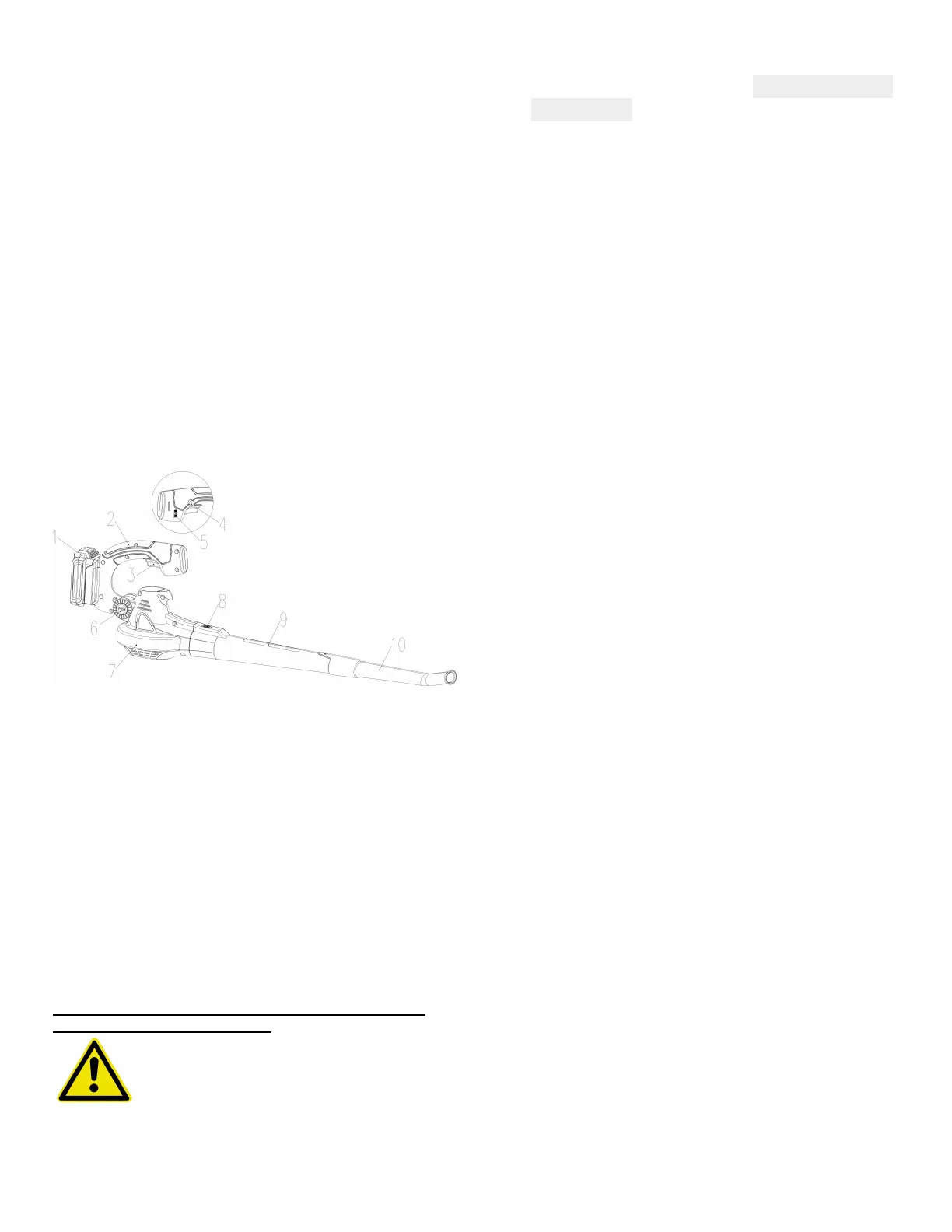
CONTENTS:
1. Battery Pack 2. Handle 3. Trigger 4. Trigger
Lockout 5. Speed switches 6. Locking Press Button
7.Working head 8. Locking Press Button 9. Blower
Tube 10. Extension Tube
CHARGING BATTERY (Fig.1)
Before attempting to charge the battery pack,
thoroughly read all Safety Instructions.
The battery needs to be charged before first use
and whenever it fails to produce sufficient power on
jobs that were easily done before.
The battery may become warm while charging;
this is normal and does not indicate a problem.
NOTE: After several charge and discharge cycles, the
battery will attain full capacity.
! DO NOT CHARGE THE BATTERY
AT AMBIENT TEMPERATURES BELOW 4ºC
OR ABOVE 40ºC (BELOW 40ºF OR ABOVE
104ºF).
Fig.1
◆ Plug the mains plug of the adaptor into a
socket outlet, At this time, the green light of
charging seat lights up. Insert the battery pack
into the charger station, At this time, red right
on and green light off. The battery charge-
control indicator indicates the charging
progress. The indicator lights up red during the
charge procedure. The battery is completely
charged when the indicator lights up green
again.
Disconnect the battery charger from the mains
supply when not using it for longer periods.
IMPORTANT CHARGING NOTES
1. After normal usage, your battery pack should be
fully charged in about 4 hours. Allow the battery to
cool down before charging after using the saw.
(NOTE: A hot battery placed in the charger will not
charge)
2. DO NOT charge the battery pack in an air
temperature below 40°F (4 °C) or above 104°F (40
°C). This is important and will prevent serious
damage to the battery pack. Longest life and best
performance can be obtained if battery pack is
charged when air temperature is about 75°F (24°C).
3. While charging, the charger may hum and become
warm to touch. This is a normal condition and does
not indicate a problem.
4. If the battery pack does not charge properly
• Check current at receptacle by plugging in a lamp
or other appliance.
• Check to see if receptacle is connected to a light
switch which turns power off when you turn out the
lights.
• Move charger and battery pack to a surrounding air
temperature of 40°F (4°C) to 104°F (40°C)
• If the receptacle and temperature are OK, and you
do not get proper charging contact (DESA Power
Tools) service center.
5. The battery pack need to be charged before first
using and should be recharged when it fails to
produce sufficient power on jobs which were easily
done previously. DO NOT CONTINUE using this
product with its battery pack in a depleted condition.
(NOTE: After several charge and discharge cycles,
the battery will attain full capacity.)
6. To prolong battery life, avoid leaving the battery
pack on charger for extended periods of time (over 30
days without use). Although overcharging is not a
safety concern, it can significantly reduce overall
battery life.



 To Next Page
 Loading...