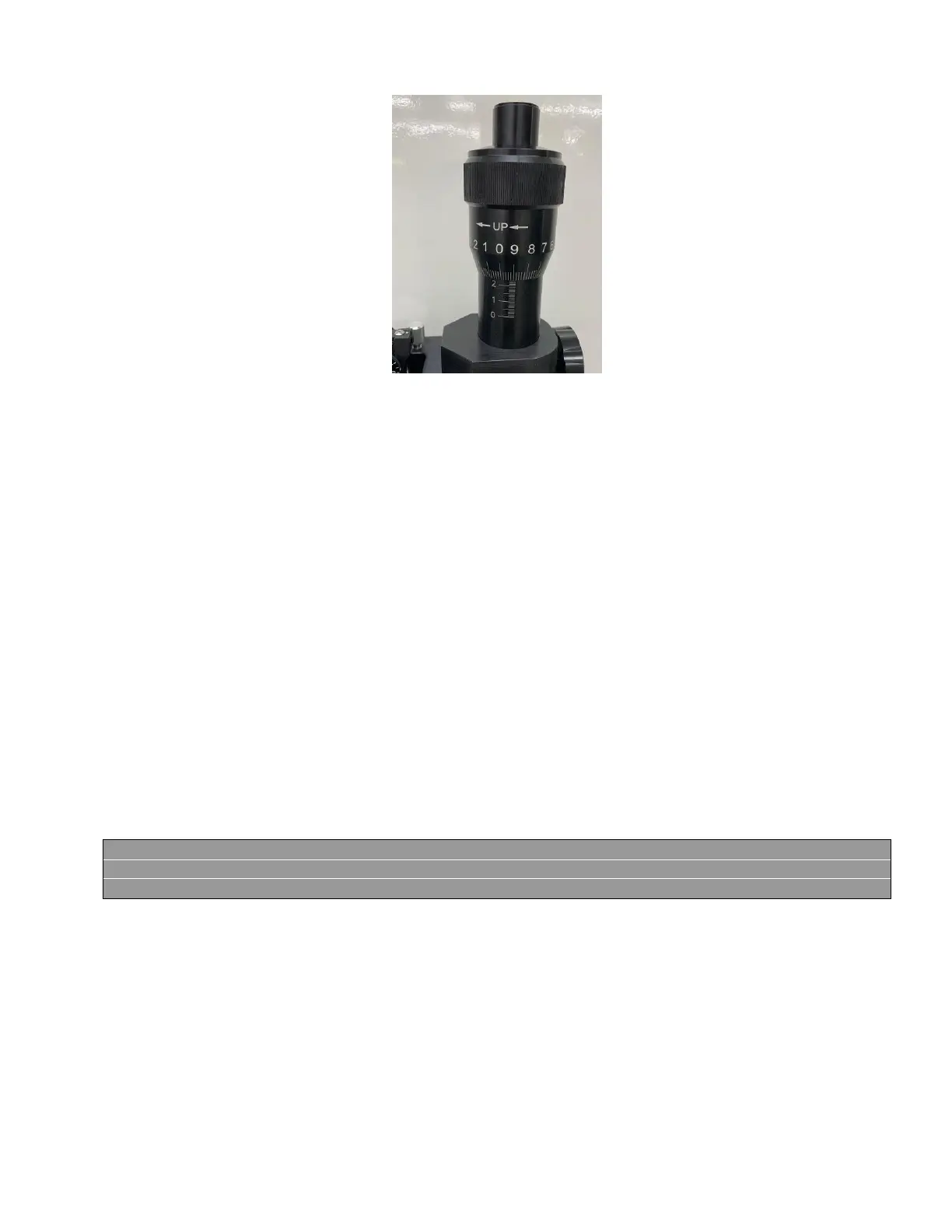
3.3 CONTROL OF HEIGHT - VERTICAL POSITIONING
AFTER SETTING THE Axial Angle… usually, when a new angle has been set, the Traveling Block is relatively
high on the Post. Loosening the Large Knob allows the Traveling Block to Slide down, carrying the gemstone
toward, and finally in contact with the Lap – so that the work can be performed. Manually sliding can work –
barely contacting the Lap surface. Then, an amount to remove can be set by adjusting the calibrated height
setting at the top of the Post. Notice that the UP direction is marked – the up direction raising the gemstone
from the Lap surface – most often the adjustment you will make is down – setting an amount to remove. Since
this downward adjustment is used frequently, the start out vertical position will gradually drift down – it is a good
idea, when starting to facet a stone to raise the calibrated height position to about half-way up the calibrated
scale – to about 1.5 on the calibrated scale.
3.4 CONTROL OF FLATNESS
This control is built into your ULTRA TEC. The surface runout of the Platen is less than .0003 of an inch. (less
than 8 microns).
Laps are manufactured to be suitably flat, but their accuracies vary, and all laps have some degree of error.
The important lap is the one used prior to the polishing operation, usually a 600 or a 1200 lap. You will be able
to detect any runout on a Lap, however small, but keep in mind that a highly detectable .002 inch runout over a
6 inch swing if the Quill, represents on angular error of only .02 degree. So, do not be overly concerned when
the stone makes contact at one place on the lap, but not in another--the actual error may be very small, perhaps
only a ten-thousandth of an inch—a few microns.
● A “TIP” -- Because no lap is “perfect” in its flatness, when faceting, on any lap, become accustomed to lifting
the stone from the lap surface in about the same location—probably best toward the center. That will tend to
minimize the out-of-parallel variation of the lap from place to place. It will become a good habit.


 To Next Page