- 52 - - 53 -
ENGLISH
• Sit on the bike with your usual cycling equipment and backpack.
• Adopt the normal driving position. To avoid falling, lean against a wall or a fixed object.
• Push down the rubber ring against the dust seal on the fork leg.
• Carefully get off the bicycle, making sure that the fork does not compress any more.
• The distance between the rubber ring and the dust seal of the leg is the negative travel.
• Calculate the percentage of SAG with respect to the total travel of the fork
• If the SAG is not the desired one, increase or decrease the pressure, and carry out the mea-
surement again.
Modifications to the suspension also affect the behaviour of the bicycle’s braking and steering
systems. Therefore, every time you make a new adjustment, do some test rides on different kind of
terrains, to become familiar with the new bicycle behaviour.
There are other settings that are more specific to each fork model, such as Rebound and Speed
Compression. For more information on how to make these adjustments, consult the fork manufac-
turer’s manual.
Some of these adjustments require specific technical knowledge. If after reading the manuals
you do not know how to do them properly, contact us or take the bicycle to an authorized mechan-
ic.
An improper adjustment of the fork can cause malfunctions, material damages and even cause
you to lose control and fall.
Lubrication
Suspension forks need to be lubricated regularly so they work smoothly and have a long life. To do
it:
• Keep the sliding surfaces of the fixed bars and the dust seal clean.
• Clean it with plenty of water and a soft sponge. Do not use water vapor, solvents or aggressive
detergents.
• Lubricate the tubes with an oil approved by the manufacturer.
• Compress the fork several times.
Inspection
If you use tyres with a large width, verify that there is enough distance between the tyre cover and
the fork legs and bridge (minimum of 12 mm).
On forks with air suspension, check the pressure periodically, as this may decrease over time. To
do this, a suspensions specific high-pressure air pump is required.
Verify that the SAG is set correctly. As a reference in XC bicycles, the SAG is adjusted between
10% and 25% of the total travel of the fork and on Downhill bikes it can be up to a 40%.
For more information go to the “Geometries” section of this manual and review the data for your
bicycle model.
Make sure that the compression stiffness is set correctly. The stiffness must be adjusted so hat
the fork reaches its compression stop only in very extreme cases. When riding on uneven terrain, a
too-low adjustment of the compression force (too long SAG) can cause the complete and sudden
contraction of the fork. These impacts can eventually damage the fork itself or even the frame.
If the suspension compresses excessively and it bottoms, you can lose control and fall.
Keep the fork clean. Dirt, mud and other contaminants can cause premature wear and cause
malfunction.
Adjustment
Adjustment of the SAG
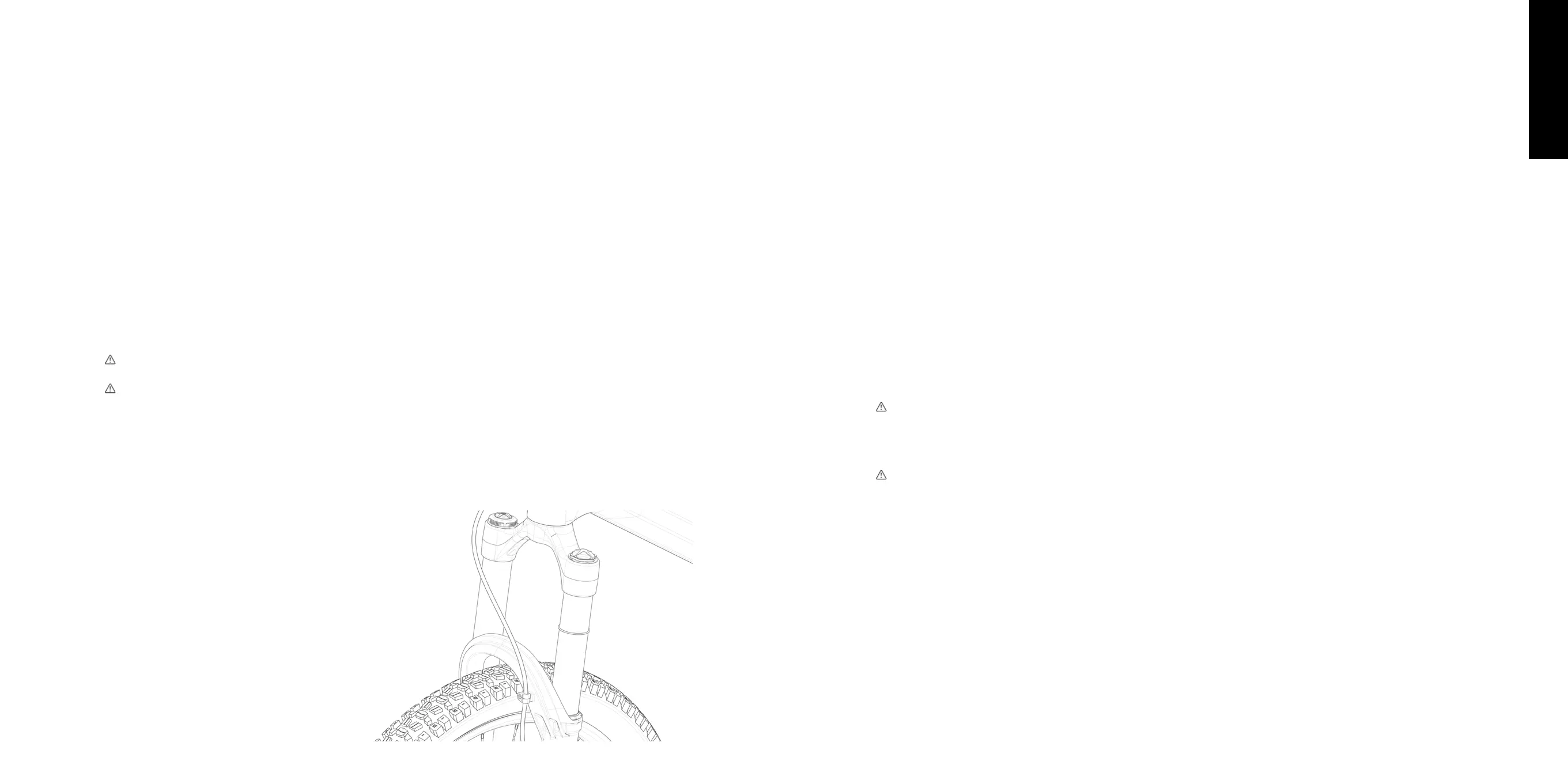
For the measurement of the percentage of SAG a rubber ring is used, which is normally located in
one of the legs of the fork.
To adjust the SAG in a pneumatic version,
modify the air pressure inside the fork legs.
To do it:
• On the fork, look for the self-adhesive
label with the table of recommended
pressures.
• Note the indicated pressure for your
weight, which will give you a first ad-
justment reference.


 To Next Page
 Loading...