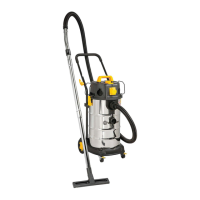
The Vacmaster VDK1138SWC-110 is a robust wet and dry vacuum cleaner designed for commercial use, suitable for environments such as hotels, schools, hospitals, factories, shops, offices, and rental businesses. It is engineered for optimal performance in various cleaning tasks, handling both liquids and dry materials.
Function Description:
This vacuum cleaner is primarily used for vacuuming dry debris and liquids. It features an integrated filter cleaning system to maintain suction efficiency during dry vacuuming. The device also includes a power tool take-off socket, allowing synchronized operation with power tools for dust extraction. For safety, it is equipped with a float valve that automatically reduces suction when the maximum liquid filling level is reached during wet vacuuming. The machine is designed to meet M-class certification requirements, necessitating the use of disposable collection means for hazardous dusts to maintain certification.
Important Technical Specifications:
- Model Number: VDK1138SWC-110
- Motor: 110V~50Hz
- Power Input: 1100W
- Max. Power Consumption of Power Tool Take-Off Socket Outlet: 660W
- Tank Volume: 38L
- Net Weight: 14.0kg
- Max. Vacuum Pressure: 22kPa / 220hPa
- Max. Flow Rate: 68L/s / 244.8m³/h
- Bearing Capacity of Disposable Bag: 11.0kg
- Bearing Capacity of Dust Bag: 12.0kg
- Noise Emission Values (EN 60335-2-69): A-weighted sound pressure level <76 dB(A), Uncertainty K = 3 dB. Noise level can exceed 79 dB(A).
- Total Vibration Values (EN 60335-2-69): a<2.5 m/s², K = 1.5 m/s².
- Ingress Protection (IPX4): Protected against splashing water from any direction.
Usage Features:
- Assembly: Requires a Phillips screwdriver for initial setup. Components like the carry handle, front casters, rear wheels, and hose storage rack are assembled onto the main unit. The upper handle assembly is adjustable in height and secured with wing knobs.
- Filter Installation: Comes pre-installed with a cartridge filter for dry vacuuming. For wet vacuuming, the cartridge filter must be replaced with the supplied foam filter. Dust bags and/or disposable bags are used for dry collection, with specific instructions for fitting them onto the inlet stub and over the container rim.
- Floor Nozzle Attachments: The floor nozzle includes interchangeable attachments (squeegee inserts, brush inserts) for different surfaces and applications:
- Brush and Squeegee Combination: For wet or dry liquids.
- Dual Brush Combination: For dry materials or carpeted floors.
- Dual Squeegee Combination: For hard floors with wet liquids. The textured side of the rubber squeegee must face outwards.
- Switching On/Off: Features a three-position switch: 'I' for continuous operation, 'O' for off, and 'II' for automatic synchronized start-up with a power tool.
- Power Tool Take-Off Operation: Connects to power tools (up to 660W) for synchronized dust extraction. The vacuum cleaner starts when the power tool is switched on and switches off after a 5-second delay once the power tool is turned off, allowing the suction tube to clear. Users must verify power tool wattage compatibility to prevent overloading.
- Filter Cleaning Operation: An integrated system for cleaning the cartridge filter during dry vacuuming. When airflow drops (≤20m/s), a flashing red LED on the air flow indicator signals the need for cleaning. The filter is cleaned by positioning the hose nozzle into a channel on the filter cleaner button, switching the vacuum to 'I', and pressing the button for 3-4 seconds, repeated two more times. This feature is only for the cartridge filter.
- Wet & Dry Vacuuming:
- Dry Vacuuming: Requires the cartridge filter and optionally a dust bag and/or disposable bag. A P2-respirator is recommended when vacuuming hazardous dusts. A visual warning indicator activates if airflow drops below 20 m/s.
- Wet Vacuuming: Requires the foam filter and the float valve system to be in place. Dust collection bags must not be used. The container should be emptied before wet vacuuming. The float valve prevents overfilling by reducing suction when the maximum liquid level is reached.
- Hazardous Dusts: The vacuum cleaner is certified for dust category M. When collecting dusts with occupational exposure limit values ≥0.1 mg/m³, specific filter and collection bag combinations are required (Cartridge Filter + Disposable Bag, Cartridge Filter + Dust Bag, or Cartridge Filter + Dust Bag + Disposable Bag). Disposal of contaminated items and waste must follow current regulations, often requiring impervious bags and P2-respirators during handling.
Maintenance Features:
- General Maintenance: Before any maintenance, the power cord must be unplugged. Keep safety devices, air vents, and motor housing free of dirt. Clean the equipment regularly with a soft, dry brush. Empty the collection tank after each use and allow it to dry before replacing the power head. Check the hose, attachments, and power cord for damage or blockages.
- Cartridge Filter Cleaning: After vacuuming hazardous dusts, it is recommended to dispose of the cartridge filter in a sealed bag according to regulations. For manual cleaning, gently tap or brush dirt off the filter in a well-ventilated area, always using a P2-respirator. The filter can also be washed with mild soap and water, then rinsed and air-dried before re-installation. Regular replacement of the filter is recommended for optimal performance.
- Foam Filter Cleaning: The foam filter can be removed, washed with mild soap and water, rinsed, and air-dried before re-installation.
- Float Valve Check: Regularly check the float valve to ensure it moves freely, especially important for wet vacuuming.
- Technical Inspection: A technical inspection is recommended at least annually, including checking filters for damage, air tightness, and control mechanism function.
- Decontamination: For Class M machines, the exterior must be decontaminated and wiped clean or treated with sealant before removal from a hazardous area. All parts removed from a hazardous area are considered contaminated and require appropriate action to prevent dust dispersal.
- Extension Leads: When using extension leads, ensure the cable cross-section meets specifications: 1.5 mm² for up to 20m (<16A), 2.5 mm² for up to 20m (<25A), 2.5 mm² for 20-50m (<16A), and 4.0 mm² for 20-50m (<25A).

 Need help?
 General

 To Next Page