3/4
6. Radio Fail Safe (Fourth Menu Screen)
• To access the Radio Fail Safe Screen, press the SET button four times.
• To set the amount of brakes applied by the throttle servo when the Radio fail safe is engaged:
• First turn the radio off.
• Starting at 16 in the Radio Fail Safe Screen (which should be close to neutral for your model),
adjust the number setting up or down until the Throttle servo reaches full brakes.
• The Radio Fail Safe position can be set from 1-32. Whether 1 is full brakes or full throttle depends
on the servo reverse settings (See Step 8).
• Press the
SET button once to move to the next menu screen and ensure ON is selected
for the radio fail safe. Press the UP or DOWN buttons to turn
ON or OFF.
NOTE! To test the Radio Fail Safe settings, begin by turning your radio on and checking that
the Throttle servo is in the neutral position and the Radio Fail Safe is turned on (See Step 7).
If the Throttle servo moves to full brakes when you turn your radio off, your Radio Fail Safe is
set correctly!
SET
7. ON/OFF Function for the Radio Fail Safe (Fifth Menu Screen)
• To access the ON/OFF Radio Fail Safe Screen, press the SET button five times.
• Press the up or down button to set the Radio Fail Safe feature ON or OFF.
• This Function selects whether or not the Radio Fail Safe will be activated in the event of a Radio
Signal Failure.
• If the system is set to ON, the Radio Fail Safe will be activated and the throttle will be moved to the
position set in the previous screen in the event of Radio Signal Failure.
• If the system is set to OFF, the Radio Fail Safe will be deactivated and the fail safe will not control the
servo in the event of a Radio Signal Failure. The Throttle will stay in the last position recorded
when the failure occurred, or may behave erratically depending on the nature of the fault.
SET
The Radio Fail Safe monitors for radio signal failure. A loss in radio signal can result in an uncontrollable model. If the VST
detects a loss of radio signal, the Radio Fail Safe will engage and the brakes will be applied. Note! Follow the instructions
below to ensure the VST applies the proper amount of brakes for your specific model.
16 F
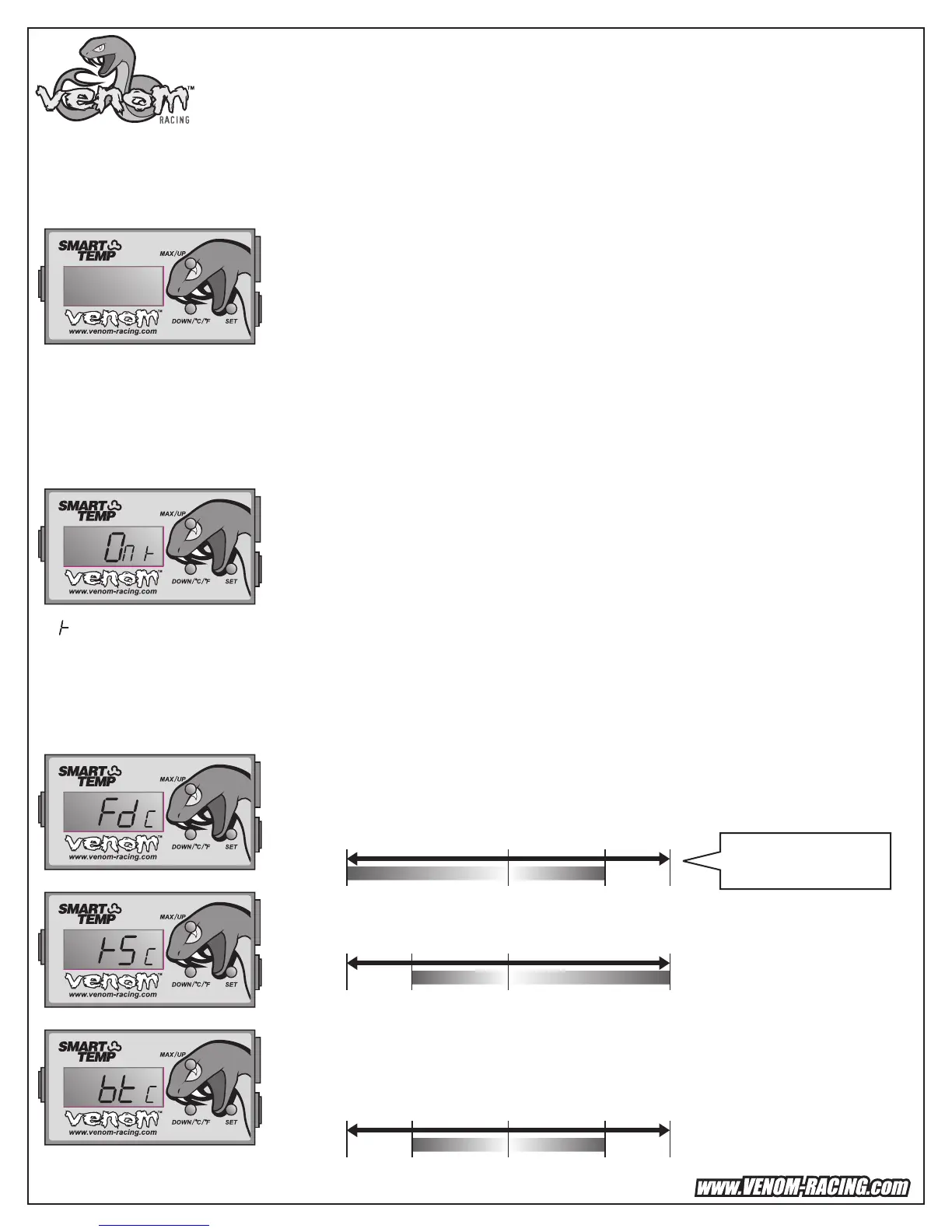
8. Set Control Direction for Voltage / Temperature Fail Safe (Sixth Menu Screen)
• To access the Control Direction menu, press the SET button six times.
• Press the UP and DOWN buttons to select one of the 3 following settings:
Setting 1 (Forward / Normal Servo Direction)
•During Low Voltage or Overheat Fail Safe activation, this setting will limit one direction of the servo
movement to the Throttle Limiter Percentage set in Step 5. The opposite direction will still retain
100% of its movement (ex. 60% Throttle, 100% Brakes)
Setting 2 (Reverse Servo Direction)
• This setting uses the same features as Setting 1 but reverses the direction.
Setting 3 (Advanced Throttle / Brake Setting)
• This feature limits both Throttle and Brake servo functions when the Overheat or Low Voltage
Fail Safe is engaged.
• This is an advanced feature for special applications.
Depending on your model, your throttle servo increases the throttle in a clockwise or counter-clockwise direction. Choose one of the
following settings to set the VST to your model’s specific servo direction.
NOTE! This is similar to the servo reversing function on most radios.
SET
SET
SET
SET
c = Servo Control Direction Setup Screen
SET
f
= Radio Fail Safe Setup Screen
SET
=
Radio Fail Safe On/Off Screen
100%
Full Throttle
60%
Throttle
0%
Neutral
100%
Brakes
100%
Full Throttle
60%
Throttle
60%
Brakes
0%
Neutral
100%
Brakes
100%
Full Throttle
60%
Throttle
0%
Neutral
100%
Brakes
If your Throttle Servo does not
function like the diagram in (Fig c),
use Setting 2 (Fig d) to reverse the
direction.
Fig c
Fig d
NOTE! Venom Racing highly recommends always using the radio fail safe feature to protect
your model from serious damage that can occur from radio signal loss.


 To Next Page
 Loading...