Need help?
Do you have a question about the Ventair Sahara and is the answer not in the manual?
Instructions for using the fan function, including its use for cooling.
Guidelines for using the heater, including pre-warming and steam management.
Advice on using the exhaust for maximum performance and moisture control.
Details on the required AC power supply and connection to circuits.
Guidance on connecting the unit to the electric mains and switch wiring.
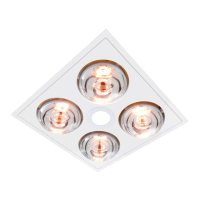
The Sahara Fan Heater, Light and Exhaust is a multi-functional bathroom unit designed to provide heating, ventilation, and illumination. It is intended for indoor use, specifically in bathrooms, to enhance comfort and manage moisture.
The device integrates three primary functions: a fan heater, an exhaust fan, and a light. The fan heater provides warmth, which is particularly useful in cooler weather or before a bath or shower to pre-warm the environment and reduce steam production. The exhaust fan is designed to remove steam, moisture, and odors from the bathroom, contributing to better air quality and preventing condensation on surfaces like mirrors and walls. The integrated light provides illumination for the bathroom.
The Sahara unit is operated via a five-switch wall plate, allowing independent control over its various functions. The 'Fan' function must be engaged before the 'Heat' functions can operate. This ensures that the heating elements are adequately cooled and prevents overheating. Users can choose to run the 'Fan' alone for a cooling effect in warmer weather, without engaging the heating elements.
For heating, it is recommended to stand directly underneath the fan heater for maximum effect. In cooler conditions, turning the heater on 5 to 10 minutes before a bath or shower can effectively warm the environment, helping to minimize steam and condensation. In situations with high steam, the exhaust function can be used in tandem with the heat function to maximize steam removal.
For optimal exhaust performance, it is crucial to ensure sufficient replacement intake air is available in the room. This can be achieved by leaving a door ajar, having an adequate gap underneath the door, or utilizing an air vent in the door. After leaving the bathroom, running the exhaust fan for several minutes is recommended to further help with condensation and moisture control.
The device is designed for installation in flat ceilings, with specific height and clearance requirements to ensure proper ventilation and safe operation. It should not be located directly above a bath or shower recess or enclosure, and a minimum height of 2 meters from the floor is required. Adequate air intake into the room through windows, vents, or under the door is necessary to replace the air displaced by the exhaust fan.
Regular maintenance is essential to ensure the longevity and safe operation of the Sahara unit. Before any cleaning, the unit must be allowed to cool completely, and it should always be disconnected from the mains supply.
To clean the fascia, a dampened cloth should be used to wipe off dust and dirt. Abrasive cleaning products should not be used on the appliance, as they may cause damage.
The device is not equipped with a mechanism to control room temperature, and users should be aware that some parts of the product can become very hot during operation, posing a risk of burns. Therefore, it is important to avoid touching the appliance while it is in operation or until it has fully cooled, which can take up to an hour.
The unit should never be covered with insulation material or similar materials, and items of clothing or hand towels should not be placed over the heater to dry, as this creates a risk of overheating and fire.
In case of any defect, the heater must be checked and repaired by the manufacturer, its service agent, or similarly qualified persons. Users should not attempt to open or repair the heater themselves, as this could void the warranty, cause damage, or result in personal injury.
Proper disposal of the electrical product at the end of its life cycle is also part of responsible maintenance. It should not be disposed of with household waste. Local councils should be consulted for advice on disposal or recycling to prevent hazardous substances from leaking into the environment.
 General
| Power Source | Electric |
|---|---|
| Voltage | 220-240V |
| Frequency | 50Hz |
| Overheat Protection | Yes |
| Thermostat | Yes |

 To Next Page