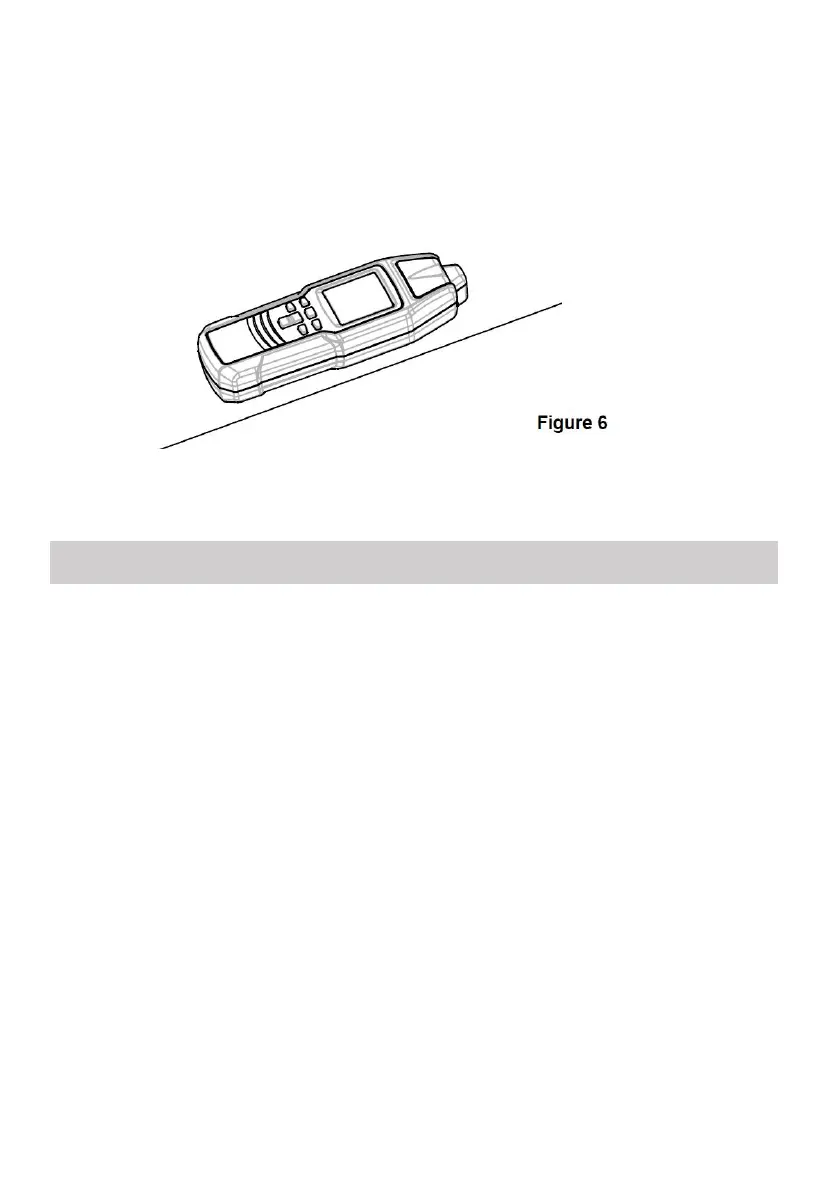
In the PINPOINT mode, when the longitudinal axis of the receiver is parallel to
the line conductor which is connected to the transmitter and the receiver is directly
above this line conductor ( see Figure 6 ), the signal received by the receiver is at
its maximum. The PINPOINT mode is used to accurately locate a line conductor
buried under wall/earth surface.
In the mains voltage detection mode, the receiver can detect 50Hz - 60Hz
electromagnetic field in any direction.
1st Possibility ( one pole application )
Connect the transmitter to only one conductor. The second conductor is the
ground. This arrangement causes a signal current to flow through the conductor
and to be transmitted to ground, similar to a radio and receiver. Hereafter, we
call the above described operation one-pole application.
2nd Possibility ( double-pole application )
Connect the transmitter to the mains. In this condition, the modulated current
flows through the phase and then returns to the transmitter via the neutral.
There is another possibility for voltage free systems by connecting the
transmitter to two line terminals while short-circuiting the other line ends. Thus a
complete circuit is created. Then, the transmitter is supplied by the built-in
battery. Hereafter, we call this operation double pole application.
Note:
The instrument can only detect or locate lines which are connected
correctly in accordance with the physical principle described.
In double-pole application, the PINPOINT mode of the receiver does not
work.Do not use the PINPOINT mode in any double-pole application.
LOCATOR IN COMPLETE CIRCUITS


 To Next Page
 Loading...