When locating a line interruption using one transmitter to feed from one
conductor end, the location of line interruption may not be precisely located
in case of bad condition due to a field disturbance. This drawback can be
easily avoided when using two transmitters ( one from each end ) for line
interruption detection. In this instance, each of the transmitters are set to a
different transmission code ( e.g. one transmitter is set to code " 1 ", the
other transmitter is set to code " 6 " ).
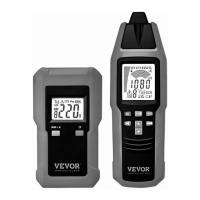
Your instrument includes only one transmitter. If you need a second
transmitter, you can separately order one or more transmitters from our
company.
If the transmitters are connected in accordance with Figure 11, the receiver
displays the transmission code " 1 " at the left side of the line interruption. If
you continue further than the interruption, toward the right, the receiver
displays the transmission code " 6 ". If the receiver probe is directly above
the line interruption, no transmission code is displayed, due to the
overlapping of both transmitter signals. The line interruption is located
between the displayed codes " 1 " and " 6 ".
Requirements:
The circuit must be dead.
All lines which will not be used must be connected to the auxiliary ground
as shown Figure 11.
Connect the two transmitters as shown in Figure 11.
Proceed as described in the application example.
The ground connected to the transmitter and to the wires not being used
can be an auxiliary ground, the ground contact of a properly earthed socket,
or a properly grounded water pipe.
When carrying out line interruption locating on a multi-wire shielded cable,
make sure that all unused wires are orderly grounded. This is required to
avoid inductive disturbance ( by capacity coupling ).
The locating depth for shielded conductors and cables varies, because the
individual wires within the shield are twisted.
Precise locating of line interruption using two transmitters ( one-pole application )


 To Next Page
 Loading...