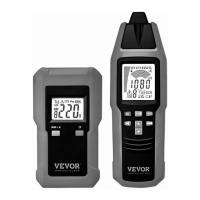
Use the following procedure to check whether the fuse is damaged:
Disconnect the transmitter from all cables/leads connected.
Turn on the transmitter, then set its transmission level to level 1.
" " is shown on the transmitter display. Connect one end of a
test lead to the red terminal of the transmitter.
Turn on the receiver. The receiver defaults to the automatic mode,
and the symbol " AUTO " appears on the receiver display as an
indicator.
Place both the transmitter and receiver on a wooden desk ( or a
nonmetallic desk ). Move the receiver probe close to the test lead that
is connected to the red terminal of the transmitter, and adjust the
position of the receiver until the receiver displays a reading which
approximates 700. Do not move the receiver from now on and in the
following procedure, and note down this reading.
Do not move the transmitter. Connect the unused end of the test lead
to the black terminal of the transmitter.
If the fuse in the transmitter is good, the reading on the receiver
display will roughly double.
If needed, use the following steps to replace the fuse:
Turn off the transmitter. Disconnect the transmitter from any
cable/lead and circuit.
Remove the screw on the battery cover of the transmitter, then
remove the battery cover, and then remove the battery.
Remove the screws on the back cover of the transmitter, and then
remove the back cover. Replace the damaged fuse with a new one of
the same ratings. Reinstall the back cover and its screws. Then
reinstall the battery, the battery cover, and the screw correctly.
The transmitter uses one fuse whose ratings are: 500mA/600V, FAST
action, Ø6.35X32mm.


 To Next Page
 Loading...