This document provides the user manual for the VEVOR Hitch Cargo Carrier, model TYGJ0062. It outlines safety warnings, specifications, package contents, and installation instructions for the product.
Function Description
The VEVOR Hitch Cargo Carrier is designed to provide additional cargo space for vehicles equipped with a 2"x2" Class III or Class IV hitch receiver. It allows users to transport various items that may not fit inside the vehicle or require external transport. The carrier features a ramp for easy loading and unloading of objects, which can be secured in an upright position during transport. It is intended for use with ropes and tie-downs (not included) to secure cargo.
Important Technical Specifications
- Model Series: TYGJ0062
- Maximum Load Capacity: 500 lbs (226.8 kg)
- Vehicle Hitch Receiver Size: 2" x 2" Class III and IV Hitch Receivers
- Cargo Basket Dimensions: 1270 × 750 × 220 mm (approximately 50 x 29.5 x 8.7 inches)
- Hitch Pin: 5/8" Diameter with Cotter Pin
- Gross Weight: 22.7 kg (approximately 50 lbs)
- MEAS (Packaging Dimensions): 1320 × 805 × 130 mm (approximately 52 x 31.7 x 5.1 inches)
The carrier includes components such as a main frame, various support plates (small, middle, large), a U-brace, tie-down hooks, a hitch bar, a ramp, and associated hardware (bolts, nuts, washers, pins, clips). Reflectors are also included for visibility.
Usage Features
- Hitch Receiver Compatibility: Designed exclusively for 2"x2" Class III or Class IV hitch receivers, ensuring broad compatibility with many trucks and SUVs.
- Ramp for Easy Loading: The integrated ramp (Part 17) facilitates the loading and unloading of heavy or bulky items, reducing physical strain. The ramp can pivot freely and be locked in an upright position using lock pins (Part 13) and R-pins (Part 14) during transport.
- Secure Cargo Transport: Equipped with tie-down hooks (Part 2) at each corner of the carrier bed, allowing users to securely fasten cargo with ropes and tie-downs (not included), preventing movement during transit.
- Reflectors for Safety: Includes reflectors (Part 5) and plates with reflectors (Part 22) to enhance visibility, especially in low-light conditions, contributing to road safety.
- Robust Construction: The carrier is built with a main frame (Part 26) and various support plates (Parts 21, 22, 23, 24) to ensure structural integrity and support the maximum load capacity.
- Simple Installation: The manual provides a step-by-step guide for assembly and installation, involving connecting supports, attaching the U-brace, fastening the hitch bar, and securing the ramp.
- Weight Distribution: Users are advised to distribute weight evenly within the cargo carrier, placing heavier items towards the center, to maintain vehicle stability and carrier integrity.
- Speed Limit: It is recommended not to exceed 55 MPH while the carrier is attached to the vehicle.
- Ramp Clearance: The carrier should not be used if the ramp is higher than 12.5" from the bottom, indicating a potential issue with vehicle clearance or carrier setup.
Maintenance Features
- Regular Inspection: Users are instructed to frequently check the condition of the Cargo Carrier and the vehicle's hitch receiver. This includes inspecting all components for good condition, checking for damage from accidents, or any weld damage.
- Hardware Security: All hardware, including bolts and nuts, must be tightly secured in place. The manual emphasizes checking this during assembly and periodically thereafter.
- Cleanliness: The Cargo Carrier should be kept clean to ensure proper function and longevity.
- Damage Replacement: If the Cargo Carrier or hitch receiver becomes damaged, or if any weld damage is noted, the product should be replaced to ensure safety.
- Storage: The carrier should be stored out of reach of children and untrained individuals to prevent misuse and potential accidents.
- Moving Parts Check: Users should check for misalignment or binding of moving parts, breakage of parts, and any other condition that may affect the carrier's operation. Damaged carriers should be repaired before use.
- Product Labels: Maintain product labels and nameplates, as they carry important safety information. If unreadable or missing, contact customer service for assistance.
- No Modifications: The carrier should not be modified, and it should only be used for its intended purpose to prevent damage and ensure safety.

 Need help?
 General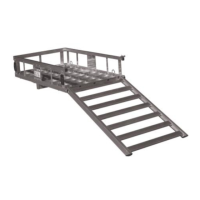

 To Next Page