Need help?
Do you have a question about the Viking YouSafe One and is the answer not in the manual?
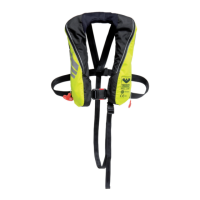
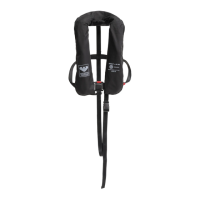
The VIKING YouSafe™ One is an automatically inflatable lifejacket designed for high-quality marine safety. It is available in two versions: 180N (PV9342 A) and 275N (PV9342 B), both of which have been tested and approved in accordance with the EU Council Directive (MED) 2014/90/EU for marine equipment.
The primary function of the VIKING YouSafe™ One is to provide buoyancy and support to individuals in water, helping them stay afloat. It features a buoyancy chamber with two separate compartments, which, when fully inflated, provide either 180 or 275 Newtons of buoyancy, depending on the version. The lifejacket is designed for persons weighing from 43 kg to over 100 kg, with a chest measurement between 60 and 175 cm.
Before initial use, it is highly recommended to familiarize yourself with the lifejacket's functions and to test it in a swimming pool or other safe conditions while wearing normal clothing.
Regular maintenance is crucial for safety. The lifejacket must undergo an annual service at an authorized VIKING servicing station. Information on finding the nearest service station is available on www.viking-life.com.
If the lifejacket is equipped with a Halkey Roberts inflator, the bobbin must be replaced annually after the lifejacket has been put into use. Do not use bobbins that are more than four years old; the production date is printed on the bobbin.
Clean the lifejacket only with mild soapy water.
If the lifejacket includes a sprayhood, follow the general packing instructions up to step 5, then apply these additional steps: 6. Fold the sprayhood three times. Fold the neck like a fan with the welding visible. Place the sprayhood into the neckfolds, ensuring the welding on the neck remains visible. 7. Fold the left corner so that the welding is on top. Zip the cover up to the middle of the neck. 8. Fold the right corner of the neck so that the welding is on top. Zip the cover a bit more to cover the corner. Mount the lifting strap. 9. Fold up the bottom section on the right side of the buoyancy chamber. The release unit must be visible. 10. Fold the inner section on the right-hand side towards the middle so that the release unit is visible. 11. Fold the inner section of the left-hand side towards the middle, ensuring the release unit is visible. 12. Zip the rest of the cover. Remember to pull the release handle through the hole in the cover. Close the hook/loop closure and insert zipper ends into the cover. * IMPORTANT: The release handle must be positioned as shown in the packing photo. The release line and handle must hang out from the bottom edge of the velcro.
After use, rinse the lifejacket with fresh water (especially if used in salt water) and allow it to dry completely. Empty any remaining air using the oral inflation valve. a. Unscrew the automatic holder (8) and discard the bobbin (7). Rinse the holder carefully with fresh water and dry it. b. Unscrew and discard the used CO₂ cylinder (1). c. Place a new bobbin (7) into the inflator. Screw the automatic holder onto the inflator. d. The service indicator must be green. e. If the release arm (3) has been pulled out, press it back into position and place the indicator clip (4) over the release arm. f. Remove and discard the old gasket (2) under the CO₂ cylinder. Insert a new gasket into the inflator (5), ensuring it is placed at the very bottom of the inflator. g. Install the CO₂ cylinder (1) into the inflator and hand-tighten it.
Contact an approved VIKING servicing station for spare parts. Find the nearest service station at www.viking-life.com.
Store the lifejacket in a dry place, ideally suspended on a hanger in a wardrobe, at temperatures above freezing. Unintended inflation can occur due to a combination of moisture and vibration. Adhering to annual service reduces this risk.
The lifejacket has been tested in water temperatures ranging from -1°C to 30°C. At temperatures below 0°C, automatic inflation may be delayed, requiring manual activation. Never wear any clothing over the lifejacket. If worn with an immersion suit or other special buoyancy-equipped clothing (e.g., sailing wear), the lifejacket's functionality may be affected.
 General
| Brand | Viking |
|---|---|
| Model | YouSafe One |
| Category | Safety Equipment |
| Language | English |

 To Next Page