EasyManua.ls Logo

Villager VHW 100 - User Manual

Villager VHW 100
84 pages
Go to English
Print Icon
To Next Page IconTo Next Page
Loading...
1
Villager
VHW 100 – VHW 120 (SI)
VISOKOTLAČNI ČISTILEC
VHW 100 VHW 120
ORIGINALNA NAVODILA ZA UPORABO
OPOZORILO! Pred uporabo preberite ta navodila.
Question and Answer IconNeed help?

Do you have a question about the Villager VHW 100 and is the answer not in the manual?

Overview

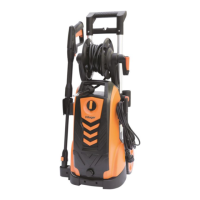
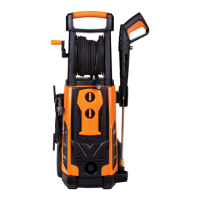
The Villager VHW 100 – VHW 120 is a high-pressure cleaner designed for various cleaning tasks. It is a portable, multifunctional machine with a high degree of safety assurance, suitable for washing cars, bikes, outdoor equipment, garden patios, and greenhouses.

Important Technical Specifications:

The device comes in two models, VHW 100 and VHW 120, with slightly different performance characteristics:

Feature VHW 100 VHW 120
Working pressure 9 MPa (90 bar) 11 MPa (110 bar)
Allowable pressure 13.5 MPa (135 bar) 16.5 MPa (165 bar)
Working flow rate 6.0 l/min 6.0 l/min
Max. flow rate 7.2 l/min 7.2 l/min
Max. pressure water supply 0.4 MPa (4 bar) 0.4 MPa (4 bar)
Motor Capacity 1.8 kW 2.1 kW
Power Supply Voltage 230 V~50 Hz 230 V~50 Hz
Max. Water Temperature 50°C 50°C
Weight 17 kg 20 kg
Dimensions 39x37x79 cm 39x37x79 cm
Supply cord length 5 m 5 m
High-pressure water outlet length 5 m 5 m
Protection class IPX5 IPX5
Sound pressure level LpA 76 dB(A) 76 dB(A)
Guaranteed sound power level LwA 93 dB(A) 93 dB(A)
Uncertainty K 3 dB(A) 3 dB(A)
Vibration emission value ah ≤2.5 m/s² ≤2.5 m/s²

Usage Features:

The device features an automatic ON/OFF system, meaning the motor only runs when the spray gun trigger is squeezed. Before initial use, it is crucial to bleed the gun by squeezing the trigger for up to 2 minutes until a steady stream of water emerges from the nozzle, ensuring all trapped air escapes.

For cleaning, the device should be connected to a cold water source only. The operating procedure involves connecting the outlet hose to the washer and spray gun, attaching the nozzle and extension, checking the gauze filter for blockages, connecting the water supply hose (ensuring no kinks), turning on the water, and checking for leaks. After depressing the trigger to expel air and locking it, the machine can be plugged in, switched on, and then the trigger unlocked for use.

The high-pressure cleaner offers a wide fan pattern for efficient cleaning of large surfaces, reducing the risk of surface damage. For detergent application, the cleaning solution should be poured into the built-in suction pot, and the adjustable spray wand set to a low-pressure position.

Maintenance Features:

Regular maintenance is essential for safe and efficient operation. The machine should be cleaned every three months. Before each use, the nozzle and water inlet filter (Fig 2) must be inspected for impurities or blockages. After use, ensure no water remains in the pump and hose.

If the machine requires repair during the warranty period, it should be returned to an authorized service center with proof of purchase. Before packaging for storage or repair, the machine should be cleaned and placed in firm, closed packaging. Store the machine in a dry, frost-free environment. Long-term storage without operation may lead to limescale buildup, which can hinder restarting.

Safety Regulations:

The manual emphasizes several safety warnings:

  • Always read the instructions before use.
  • The machine is not to be used by children or persons with reduced physical, sensory, or mental capabilities, or lack of experience/knowledge. Children must be supervised.
  • Operate the machine only at temperatures above 0°C (for H05VV-F power cord models).
  • Follow operating methods to prevent accidents (e.g., rinse with water if detergent contact occurs).
  • Use only cleaning agents recommended by the manufacturer.
  • Wear ear protectors during operation.
  • Do not use the machine near other people unless they wear protective clothing.
  • Never direct the jet at yourself, others, animals, live electrical equipment, or the machine itself.
  • Do not spray flammable liquids.
  • Use only manufacturer-recommended high-pressure hoses, fittings, and couplings.
  • Use only original or manufacturer-approved spare parts.
  • Water flowing through backflow preventers is non-potable.
  • Disconnect from the power source before cleaning, maintenance, or changing functions.
  • Maintain a distance of at least 30 cm when cleaning painted surfaces to avoid damage.
  • Do not use the machine if the supply cord or important parts (safety devices, hoses, trigger gun) are damaged.
  • If using an extension cord, it must be watertight and suitable for outdoor use, with connections kept dry and off the ground (preferably on a cord reel at least 60mm above ground).
  • Do not supply power through external switching devices like timers to avoid accidental thermal cut-out resets.
  • Be aware of kickback force when opening the trigger gun; grasp the gun firmly with both hands.
  • Know how to stop the machine and bleed pressure quickly.
  • Stay alert and do not operate when fatigued or under the influence of alcohol/drugs.
  • Keep others out of the working area.
  • Maintain good footing and balance; do not overreach.
  • The machine must be grounded. Ensure the outlet is properly grounded and matches the machine's rated voltage. Do not modify the plug or use adapters.
  • Do not operate in rain or storms; keep connections dry and off the ground. Do not touch the plug with wet hands. Water leakage into the machine is strictly prohibited.
  • Do not leave the machine running unattended for more than 3 minutes without depressing the trigger, as this can cause heat damage to the motor and pumps.
  • Maintain a constant water supply during operation to prevent damage to sealing rings.
  • Activate the spray attachment within 1-2 minutes of starting to prevent critical temperature rise and damage to sealing rings.
  • Do not operate in extremely cold conditions to prevent freezing.
  • Use only cleaning water; do not use corrosive chemicals.
  • Always switch off the mains when leaving the machine unattended.
  • When moving or installing, the machine must be on a flat surface. Pull the handle to move it.

Troubleshooting:

The manual provides a troubleshooting guide for common issues:

  • Machine not starting: Check plug/socket, main voltage, or if the pump is stuck. If the thermal safety switch tripped, turn off and let the motor cool.
  • Fluctuating pressure: Check for air in the pump, dirty/worn/stuck valves, or worn pump seals.
  • Water leaking from pump: Worn seals.
  • Motor stops suddenly: Thermal safety switch tripped due to overheating.
  • Pump not reaching necessary pressure: Clogged water inlet filter, air in pump connections/hoses, clogged/worn suction/delivery valves, stuck unloaded valve, or incorrect/worn lance nozzle.

Environmental Protection:

The crossed-out wheeled dustbin symbol indicates that electrical machines should not be disposed of as unsorted municipal waste. Instead, they should be collected separately. Contact local authorities for information on available collection systems. Improper disposal can lead to hazardous substances leaking into groundwater, affecting the food chain and human health. Retailers may accept old machines for disposal when new ones are purchased.

Villager VHW 100 Specifications

General IconGeneral
BrandVillager
ModelVHW 100
CategoryPressure Washer
LanguageEnglish

Related product manuals