

EasyManua.ls Logo

Viribus AAE-L1AB-AB - User Manual

Viribus AAE-L1AB-AB
62 pages
Print Icon
To Next Page IconTo Next Page
Loading...
Electric Tricycle
Read Carefully Before Use
Keep for Future Reference
V20240430
Contact Us
Thank you for choosing our products! If
you have any questions or comments,
contact us at support@viribusbikes.com
and we'll resolve your issue ASAP!
For a .pdf copy of the latest version of
these instructions, use the appropriate
app on your smartphone to scan the QR
code.
User Manual

Table of Contents

Question and Answer IconNeed help?

Do you have a question about the Viribus AAE-L1AB-AB and is the answer not in the manual?

Overview

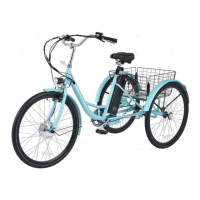
This document describes the Viribus Electric Tricycle, a three-wheeled electric bicycle designed for personal transportation. It serves as a user manual, providing comprehensive information on assembly, operation, maintenance, and safety.

Function Description

The Viribus Electric Tricycle is an electric-powered three-wheeled bicycle. It features a motor to assist with pedaling, a throttle for independent electric propulsion, and a rear basket for carrying goods. The tricycle is designed for urban and paved road use, emphasizing stability and ease of use. It incorporates a display panel to show speed, battery level, and pedal assist levels, along with a front light for visibility. The design prioritizes user comfort and safety, with detailed instructions for proper setup and handling.
Important Technical Specifications

  • Motor Power: 250 W
  • Display Panel: Liquid Crystal Display (LCD)
  • Display Panel Weatherproof Rating: IPX5
  • Battery Type: 36 V Lithium
  • Battery Weatherproof Rating: IPX4
  • Battery Operational Temperature Range: -4 to 140 °F (-20 to 60 °C)
  • Battery Charging Temperature Range: 32 to 113 °F (0 to 45 °C)
  • Battery Optimal Storage Temperature Range: -4 to 77 °F (-20 to 25 °C)
  • Rear Basket Weight Capacity: 110 lb. (50 kg)
  • Total Weight Capacity (including rear basket): 330 lb. (150 kg)
  • Rider Height Range: 5.3 to 5.9 ft. (160 to 180 cm)
  • Max. Speed: 15.5 mph (25 km/h) (based on unloaded wheel rotation at full power without friction; actual speed may vary)
  • Max. Travel: 31 mi. (50 km) (based on a 165 lb. or 75 kg load at full power and full legal speed on actual roads)
  • Tire Type: 24×1.95 or 26×1.95 in.
  • Tire Pressure: 40-65 psi (2.8-4.5 bar)

Usage Features

  • Pedal Assist System (PAS): The tricycle offers 5 levels of pedal assist, providing additional power while pedaling. The PAS is activated when the battery and display panel are on.
  • Throttle Control: Users can operate the tricycle using a throttle handle on the right handlebar for electric propulsion up to the maximum speed, without needing to pedal.
  • Push Assist Control: A push assist system provides additional strength for walking or climbing, activating the motor at a speed of 2.5 mph (4 km/h) when the '-' button is held.
  • Manual Control: The tricycle can be ridden manually by setting the PAS level to 0, turning off the display panel, or leaving the key in the OFF position.
  • Display Panel: An LCD panel provides real-time information including current speed, PAS level, battery power level, total distance traveled (ODO), current trip distance (TRIP), battery voltage (VOL), and operating time (TI). It also displays icons for front light status, motor malfunctions, brake lever engagement, throttle control malfunctions, and control hardware malfunctions.
  • Front Light: The front light can be turned ON/OFF by holding the '+' button on the display panel.
  • Battery Management: The battery's power level can be checked on the battery itself via indicator lights (4 lights for full, 1 for weak). The battery can be removed for convenient charging.
  • Brake Lever Lock: A lock on the brake lever prevents the tricycle from rolling away when parked.
  • Horn Button: A horn button is included to alert other drivers or pedestrians.
  • Adjustable Handlebar and Saddle: Both the handlebar height and angle, and the saddle height, are adjustable to suit the rider's preference and ensure comfort.

Maintenance Features

  • Pre-Ride Safety Checklist: A comprehensive checklist is provided to ensure all components (brakes, wheels, tires, steering, chain, bearings, cranks, pedals, frame, fork, seat, motor drive, electrical cables, accessories) are in proper working condition before each ride.
  • Regular Inspections: Users are advised to regularly check for loose connections, wear, and damage, especially after an initial break-in period of 50-100 miles (80-160 km).
  • Lubrication Schedule: A detailed schedule outlines which parts require lubrication (chains, brake levers, freewheels, bottom bracket, pedals, wheel bearings, headset, seat post) and the recommended lubricant and method.
  • Tire Maintenance: Instructions are given for checking tire pressure, inflating tires to the recommended psi (40-65 psi), and repairing flat tires using a patch kit.
  • Cleaning: The exterior of the tricycle should be cleaned with a soft dry or damp cloth. Mild detergent can be used for painted frames, and soap and water for plastic parts and rubber tires. Direct pressurized spray on electronic components should be avoided.
  • Battery Care: The battery should be stored in a cool, dry place, away from direct sunlight and rain. It should be charged periodically (every three months) if not in use, ensuring it's at least half full. The battery should never be allowed to drain completely to preserve its lifespan.
  • Rust Prevention: If paint is scratched, touch-up paint or clear nail polish should be applied to prevent rust.
  • Professional Tune-ups: It is recommended to have a certified tricycle mechanic perform a tune-up after the initial break-in period and for any complex adjustments or repairs, especially concerning hub bearings or electronic components.
  • Troubleshooting Guide: A section provides common problems, their causes, and solutions to assist users in resolving minor issues.
  • Disposal Information: Guidelines are provided for the proper disposal of the battery and charger in accordance with national and local laws, emphasizing not to dispose of them with household waste.

Viribus AAE-L1AB-AB Specifications

General IconGeneral
BrandViribus
ModelAAE-L1AB-AB
CategoryBicycle
LanguageEnglish

Related product manuals