2
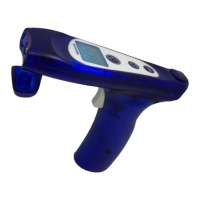
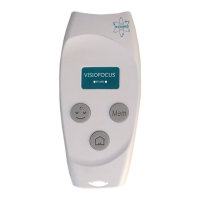
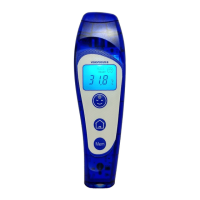
INTENDED USE: VisioFocus
®
is an infrared medical thermometer intended for non-
contact measurement of body temperature in children and adults.
It can also be used to monitor the temperature of inammations, ulcers, wounds (e.g.
on diabetics and under medical supervision).
1. FOREWORD
Dear Client, thank you for buying VisioFocus
®
- the Thermofocus
®
evolution (the wor-
ld’s rst non-contact thermometer) -.
VisioFocus is truly easy to use. It is capable of measuring a child or adult’s tempera
-
ture without ever coming into contact with the skin: just bring it close to the forehead,
at the distance that the thermometer itself will tell you. VisioFocus does not need to be
placed in any parts of your child’s body. If your baby is sleeping, you can use VisioFo
-
cus without waking him up; and, if the child is awake, VisioFocus will not bother him.
2. WARNINGS
Read these instructions carefully before using the thermometer
2.1 Precautions
1. To avoid reading anomalies, use VisioFocus according to this user manual.
2. Use VisioFocus in a draft-free room, at a steady temperature between 16,0 and
40,0°C (60.8 and 104.0°F). VisioFocus can also work if room temperature is in the
ranges 10,0-15,9°C (50.0-60.7°F) and 40,1-45,0°C (104.1-113.0ºF), but accuracy is
not guaranteed - see also par. #13.
3. If the device comes from a room having an ambient temperature dierent from the
one of the room in which you are taking the reading (or even from a drawer, etc.), it
needs to be stabilized. Do the MQCS before using it (see par. #8). As alternative, wait
at least 5 minutes or the end of the countdown (if any), for the temperature to stabilize
through the AQCS (see par. #8), without touching the device.
4. Do not take a temperature reading if the person is sitting in a draft or if the subject has:
• been walking, running or exercising;
• come from another room that was ventilated or at a dierent temperature than the
room where the thermometer is used;
• been wearing a cap, hat or scarf;
• been exposed to agents that could alter forehead temperature, e.g. shower, sham
-
poo, hair-drier, sponging, etc.
In all the above cases, interrupt the exposition of the subject to these agents and
wait a few minutes for the forehead temperature to stabilize.
5. Changing the reading point will bring to dierent results. Therefore, remember,
always aim the projection on the same spot, precisely at the centre of the
forehead (midway between the top of the nose and the hairline) and keep the ther
-
mometer perpendicular to the forehead. Do not take measurements on areas


 To Next Page